
Welcome back to the Santa Clara Meditation blog! 🌱
How many people are saved in your phone’s contacts right now? Among hundreds of contacts, there are friends whose faces you’ve forgotten, and people you barely contact once a year thanks to birthday notifications. Recently, especially after going through the pandemic era, there are more forgotten connections than new ones.
Looking at friends you’ve lost touch with, you might feel skeptical about your relationships, wondering, “Have I really lived my life well?”
We hope you gain insights from this Mind Solution on how to build more genuine and healthy relationships. 🕊️
🌿 “Should I ‘Cut Off’ Friends Who Only Reach Out When They Need Something?”
The Pandemic Era and the Growing Skepticism in Relationships
“Where did all those friends go? They say high school friends are friends for life… but I don’t have a single one.” “When a friend I haven’t heard from in years sends a mobile wedding invitation… I feel skeptical.”
From childhood to working life and into old age, we uniquely strive hard to maintain “good relationships.” However, when actually facing difficulties, the number of relationships where you can comfortably share your heart can often be counted on one hand.
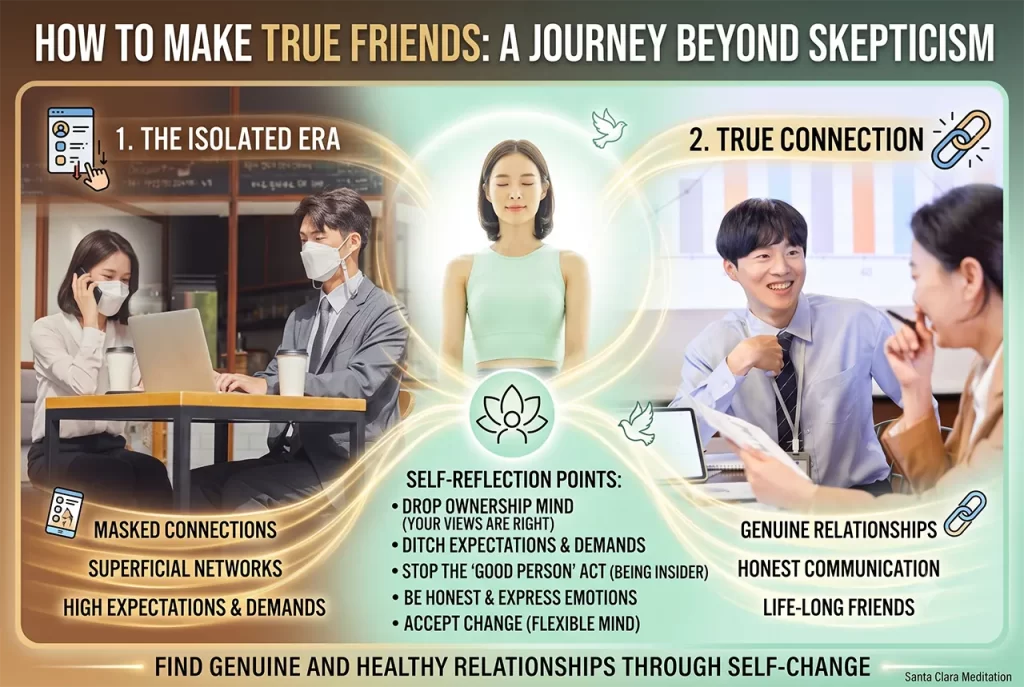
In the current untact (non-face-to-face) era, this is especially true. In isolated situations where there are more excuses not to meet than reasons to meet, skepticism about human relationships grows larger. For this reason, a generation is emerging that pursues one-off human relationships, leading to trends like “self-outcasting” or “tissue networks” (treating connections like disposable tissues).
💡 Reasons Why Skepticism in Relationships Grows
Beyond isolation caused by external environments, we also isolate ourselves in relationships. This causes a greater sense of relationship skepticism than physical isolation.
- We tend to think we “own” our personal network.
- We do not honestly share our thoughts and try to unconditionally accommodate others just to maintain the relationship.
- We spend time and energy maintaining a large number of connections rather than focusing on ourselves.
- We hastily judge and try to control the other person.
- We have high expectations and demands of the other person.
🌻 5 Questions for Genuine Human Relationships
What are some ways to create more meaningful relationships in a changing era? Try answering these five questions to look back on yourself in your human relationships.
1. Are you only asserting your own opinions?
Relationships are built together. The very first thing to do for a genuine relationship is to reflect on yourself and change the behaviors that cause discomfort to those around you. The number one cause of stress in human relationships is said to be the “mindset that one’s own thoughts are right.”
It is only natural to feel uncomfortable and think “we can’t communicate” with a person who forces their arguments by judging whether the other is right or wrong. To listen well to others, you must discard your self-centered mind. When you lack stereotypes and a narrow mind, you treat others with a humble and sincere heart. They, too, will listen to you, allowing your true feelings to be conveyed.
2. Are you trying to make too many friends unconditionally?
Do you think the more friends, connections, and acquaintances, the better? Do you feel anxious if you don’t belong somewhere?
When your self-confidence and self-esteem are low, you are easily swayed by external words or conditions. When loneliness is great, the desire to belong also increases. Before increasing the number of your relationships, think first about what values you consider most important. Then, focus first on the few who can share those values and spend ample time with them.
3. Are these meaningless relationships just for show?
If you are addicted to the desire to look like an “insider” on Instagram, at weddings, or at reunions, genuine relationships will drift further away. This is because the very purpose of the relationship is different. The heart that cherishes the people by your side—that genuine attitude—is the most important secret to maintaining a relationship for a long time.
4. Do you have expectations and demands of people around you?
Are you expecting that friend to do the exact same for you as you did for them? A friend who only seeks you out when needed, or a friend who expects a lot, somehow feels burdensome and becomes increasingly exhausting to meet. As much as you expect, your disappointment in the other person grows. With such a burdensome relationship, drifting apart is only a matter of time!
5. Are you trying to be a good person to everyone?
“To be happy, you must have the courage to be disliked. When that courage arises, human relationships change in an instant.” — Psychologist Alfred Adler
“To get along well with others, you must first know yourself well. If I don’t know myself well, I end up blaming others when conflicts arise.” — Psychiatrist Dr. Oh Eun-young
In our desire to be seen as a good person, we hide our true intentions, unilaterally accommodate others, or form superficial relationships. However, these do not last long. Acknowledging differences and mismatches, and making an effort to exchange honest emotions—that is the starting point of making true friends.
Speaking honestly here does not mean criticizing and condemning. It means expressing what discomfort you felt and how your emotions were. Through this process, you reflect on and get to know yourself well, and you can better understand each other’s conflict situations.
🍂 There Are No Eternal Friends: A Flexible Mind to Accept Change
Despite efforts to maintain human relationships, there are plenty of cases where relationships loosen and drift apart due to differences in personal tendencies, interests, and situations. This is a very natural occurrence. A relaxed mind that naturally accepts relationship changes fitting the situation is also necessary.
🧘♀️ Self-Reflection and Relationship Improvement Simultaneously Through Meditation
The effort to maintain human relationships starts with you. Rather than waiting and thinking, “My friends will change first, my family will change first,” try changing yourself one step at a time. By reflecting daily on the people you met that day and your own behavior, you can break free from the expectations and narrow-minded thoughts you have toward your family and those around you.
- Look back on your attitude and speaking habits when dealing with people around you.
- Discard stereotypes and narrow-minded thoughts about human relationships.
- Discard the ideal image, expectations, and demands you have for your family and friends.
If you know how to be grateful for the people standing by your side right now, share joy and sorrow together, and approach them honestly, won’t your surroundings soon be filled with friends for life? 🤝✨
