
Welcome back to the Santa Clara Meditation blog! 🌱
If you think about your day from the moment you wake up until you go to sleep, you will realize it is made up of various repeating habits. Even the actions and words you do without thinking are habits formed through long periods of repetition.
Good habits make your body and mind healthy and enrich your life. However, even a single bad habit can destroy your life’s balance. Everyone has experienced the endless cycle of planning to build a habit, failing, and blaming themselves. You might even feel completely sick and tired of watching yourself fail at building habits.
The reason we always fail when trying to build good habits is not due to a lack of willpower. It is precisely because of the characteristics of the brain that we didn’t know about. If you accurately understand the brain’s characteristics before building a habit, you can see it through to the end without failing! 🕊️
🌿 Why Do We Always Fail at Building Habits?
The brain is wired to initially trigger a rejection response when something new enters.
“I don’t think I’m suited for this.” “I’m going to give up soon anyway… should I just quit now?” “Let’s just live as we always have. It’s not like I’m trying to achieve some grand glory.”
This rejection response is the act of collecting countless excuses for why you cannot do this task. The reason we have failed to build habits all this time is that, even if we try hard, this brain reaction occurs, making execution difficult.
Weren’t you just blaming yourself for having no willpower without knowing this? Willpower also has a total capacity, so it naturally depletes as time passes. If you rely solely on willpower, habit building is bound to fail. By the time your willpower is depleted, you blame yourself, thinking, “I knew I couldn’t do it,” and feel disappointed. And then you give up.
Therefore, rather than trusting willpower, it is important to know the brain’s characteristics and execute. Here are 3 ways to understand the brain’s characteristics, achieve your desired goals, and see them through to the end!
🌻 3 Steps to Building Good Habits
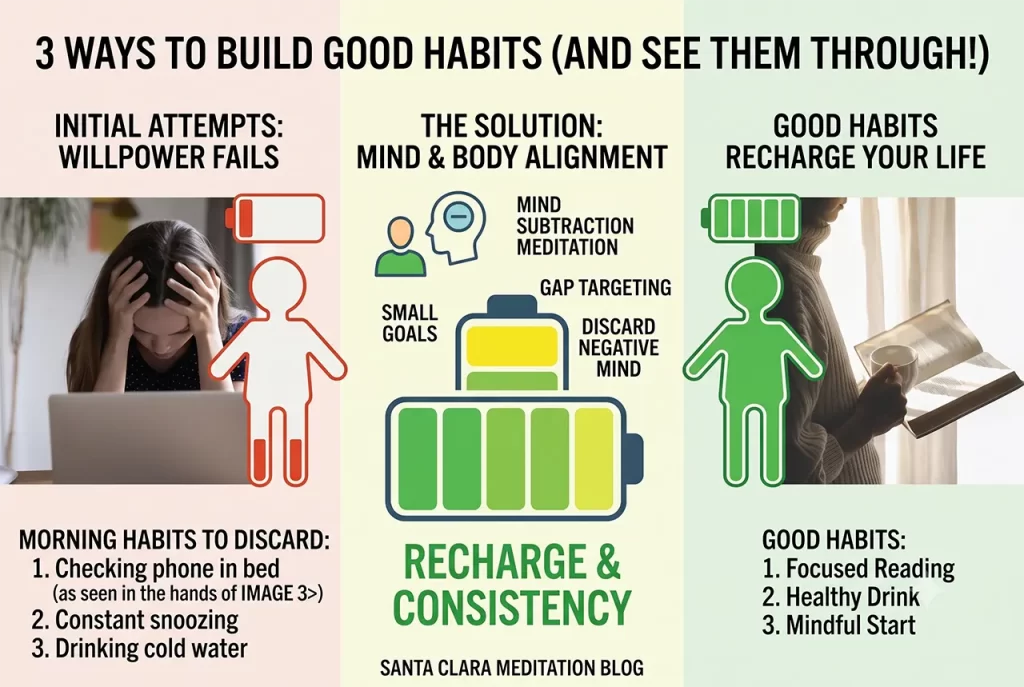
1. Set Burden-Free Goals
Habits are formed through repetitive practice. To repeat something, it must first be easy. To build an exercise habit, doing 5 minutes of bodyweight exercises every day is more effective than working out at the gym for 3 hours once a week. It is good to set a goal so small that you can execute it anytime without feeling burdened.
- Burdening, large goal ➔ Burden-free, easy, small goal
- 1 hour of jogging ➔ 10 jumping jacks in place
- 1 hour of English listening/reading ➔ Listening to and speaking one English sentence 10 times
- 1 hour of reading ➔ Reading 5 sentences every morning
Try doing it lightly for about two months, thinking of it as an adaptation period. Do you wonder when you’ll ever change by doing this? The reason we always failed before was that we set unreasonable goals and relied only on willpower. Give your brain enough time to get used to it. For a good habit to become familiar to the brain, repetition is more important than time.
2. Target the Gaps in Your Routine
Once you have set small and easy goals, it is time to insert them one by one into your routine. Rather than suddenly attempting a massive change, you must let the new goals naturally enter your current routine.
First, shall we look at your morning routine? Once you’ve examined it, add the newly created good habits into the gaps one by one. If you add goals to your daily life, a new routine is naturally created. Habits are formed by consistent repetition!
3. Discard Negative Minds About Yourself
The final and most important step in building good habits is ‘discarding the negative mind’ that drags you down.
“You’ve tried dieting so many times and always failed. You’ll probably quit again after a few tries.” “What kind of writing could I possibly do? That requires innate talent.” “Will reading a few books really change my life? Let’s just watch YouTube.”
Negative beliefs about yourself break your motivation. No matter how wonderfully you plan and create clear methods of practice, if the negative beliefs pulling you down are strong, they will always drag down your willpower. Do you hear the cry inside you saying, “It won’t work anyway”?
Your thoughts about yourself must change so you can cheer yourself on while building habits.
✨ Discarding the Negative Minds Interfering with You
Your thoughts are made up of life experiences from birth to the present. You have been influenced by your childhood, family, environment, and everything you have seen, heard, and felt. If you want to live the rest of your future life differently from the past, you must find and discard the negative thoughts you hold.
Ma-eum Su-ryun (Mind Subtraction) meditation is a huge help in building habits because it allows you to look back on your life and quickly discard hardened thoughts and negative emotions.
The only one who can change you is you. Challenge yourself to build habits with a mind that cheers you on and can see it through to the end. You will be able to meet a version of yourself that has grown more than yesterday, every single day! 🌅
🕊️ TIP: Morning Habits You Must Discard Before Building Good Habits
- Checking your phone immediately upon waking up: The countless pieces of information from the phone cause stress right from the morning.
- Constantly hitting snooze on the alarm: Once the body wakes up, it enters a state of tension. Repeating the cycle of waking and sleeping makes you even more tired.
- Drinking cold water right after getting up: Drinking cold water in the morning drops the body’s energy.
If you have many good habits, you can achieve what you want and live healthily. If you have many bad habits, your life’s balance will collapse, and your health will deteriorate. If you consistently maintain good habits, you can live the life you desire! 🌱
