
📌 Research Overview: Childhood Stress and Mental Health
Due to heavy academic burdens, excessive competition, and peer relationship problems, elementary school students experience rising stress levels. This chronic psychological pressure acts as a critical risk factor, triggering social anxiety, childhood depression, and aggressive behavioral problems.
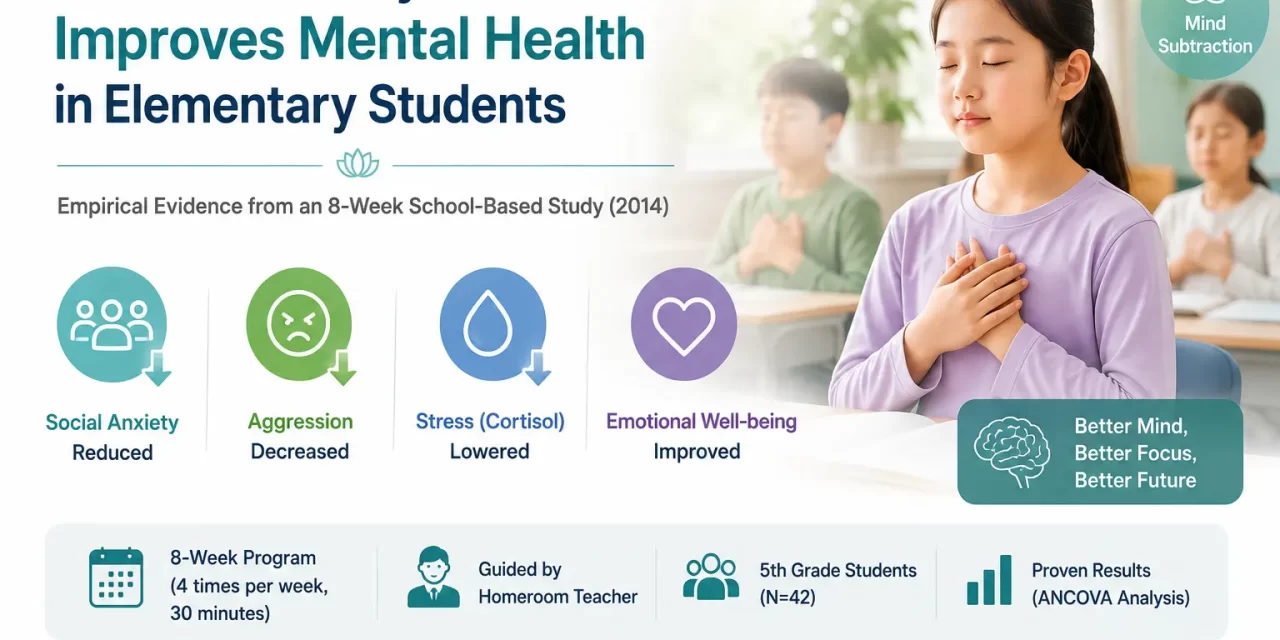
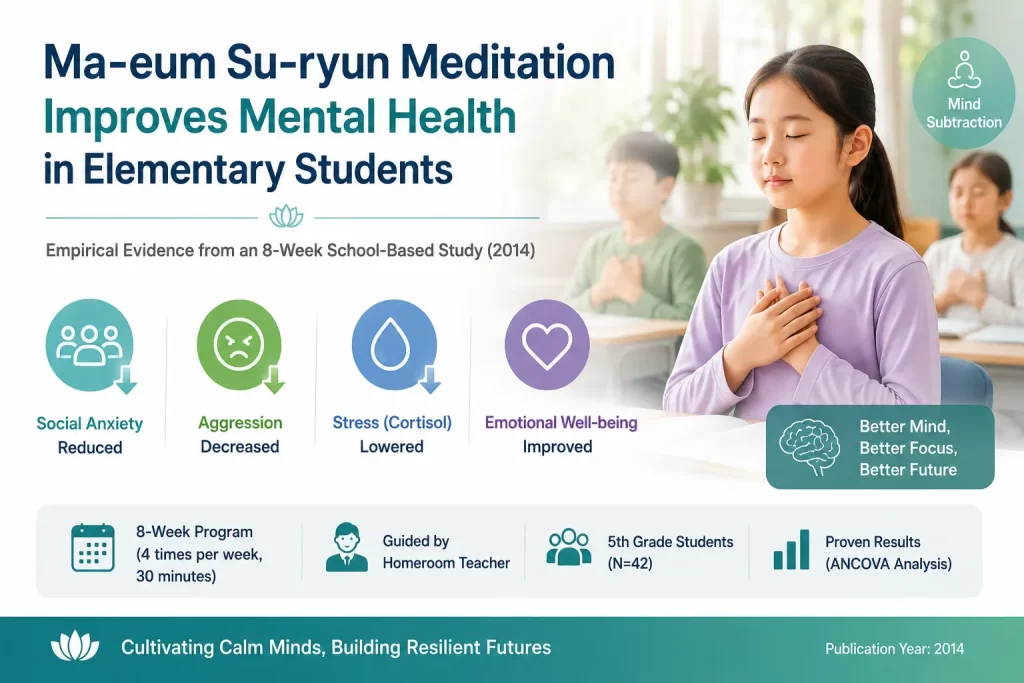
This 2014 empirical study investigates how school-based Ma-eum Su-ryun (Mind Subtraction) meditation mitigates these issues. By tracking both psychological surveys and biological stress markers (salivary cortisol), the research proves the clinical efficacy of structured mindfulness in primary education.
- Researchers: Na-min Shin (Dongguk University), Mi-ra Yoon (Seoul National University), Deok-joo Lee (KAIST), Boas Yu (Holy Family University, USA), In-soo Lee (Korea National University of Transportation), Yang-gyeong Yoo (Kunsan National University), Ju-yeon Park (Baeul Elementary School).
- Publication Year: 2014
- Key Methodology: Analysis of Covariance (ANCOVA) to control for pre-test baseline variances.
👥 Research Methodology and Experimental Design
The study utilized a highly controlled, quasi-experimental framework to monitor behavioral and biological shifts over an 8-week period (October 28 to December 20, 2013).
- Participants: 42 fifth-grade students from A Elementary School in D City, South Korea.
- Experimental Group (26 students): Participated in the Ma-eum Su-ryun meditation program during morning self-study time. The routine consisted of 4 sessions per week, 30 minutes per session, for a total of 8 weeks.
- Control Group (19 students): Engaged in conventional classroom library reading activities under the exact same schedule (4 times a week, 30 minutes per session, for 8 weeks).
- Meditation Intervention Details: Guided directly by their homeroom teacher, students practiced Step 1 of the official 7-step Ma-eum Su-ryun method. The curriculum focused on introductory lectures regarding the human mind that needs to be discarded, paired with developmental meditation guidance tailored for fifth-graders.
📊 Comprehensive Research Results (ANCOVA Analysis)
To verify the exact effectiveness of the mind subtraction program independent of initial group differences, researchers utilized Analysis of Covariance (ANCOVA) to adjust post-test scores based on pre-test baselines.
1. Measurable Reduction in Social Anxiety
- Raw Metrics: The meditation group changed from 31.18 (Pre) to 30.44 (Post). In contrast, the control group’s anxiety spiked from 36.22 to 46.29.
- ANCOVA Adjusted Result: The final adjusted anxiety score was 31.08 for the meditation group and 44.20 for the control group.
- SEO Data Point: The school-based meditation program is highly effective in lowering social anxiety regardless of the students’ initial baseline anxiety scores.
2. Significant Decrease in Youth Aggression
- Raw Metrics: The meditation group dropped from 36.36 to 30.74, while the control group remained statistically stagnant, moving from 46.35 to 45.94.
- ANCOVA Adjusted Result: Controlling for pre-test variants revealed a final aggression score of 32.42 for the meditation group and 44.12 for the control group.
- SEO Data Point: Practicing mind subtraction consistently lowers youth aggression independent of pre-existing behavioral tendencies.
3. Dropping Physiological Stress (Salivary Cortisol Levels)
- Cortisol Definition: Cortisol is a glucocorticoid secreted by the adrenal cortex. It serves as a reliable biological marker indicating human physiological stress. Higher concentrations signify higher internal stress.
- Raw Metrics: The meditation group’s biological stress index dropped from .05 to .046. The control group maintained higher physiological stress, moving from .080 to .073.
- ANCOVA Adjusted Result: The adjusted post-test cortisol level was .049 for the meditation group and .070 for the control group.
- SEO Data Point: This biological data proves that school-based meditation successfully lowers physiological cortisol stress responses in upper-grade elementary students independent of their baseline metrics.
4. Impact on Childhood Depression
- Raw Metrics: The meditation group scored 5.91 (Pre) and decreased to 4.52 (Post). The control group scored 12.42 (Pre) and stayed at 12.39 (Post).
- Statistical Note: While the meditation group maintained lower overall depression scores post-intervention, the specific variance isolated via ANCOVA adjustment did not reach statistical significance.
💡 Conclusion: Educational Implications for Santa Clara Parents
The empirical data confirms that an 8-week school-based Ma-eum Su-ryun program alleviates intense negative emotions like social anxiety, aggression, and physiological stress. Through regular practice, students shift toward comfort, inner freedom, and gratitude.
Rather than avoiding or bypassing psychological distress, this method guides children to accurately define the root causes of negative emotions and directly eliminate them. Achieving these profound transformations in a short morning self-study window—without disrupting conventional academic calendars—carries crucial implications for modern educators.
For parents seeking professional mindfulness guidance rooted in these exact scientific principles, programs offered by Santa Clara Meditation, inspired by the foundational mind subtraction methods of Master Woo Myung, provide a proven path toward youth emotional resilience.
