
📌 Research Overview
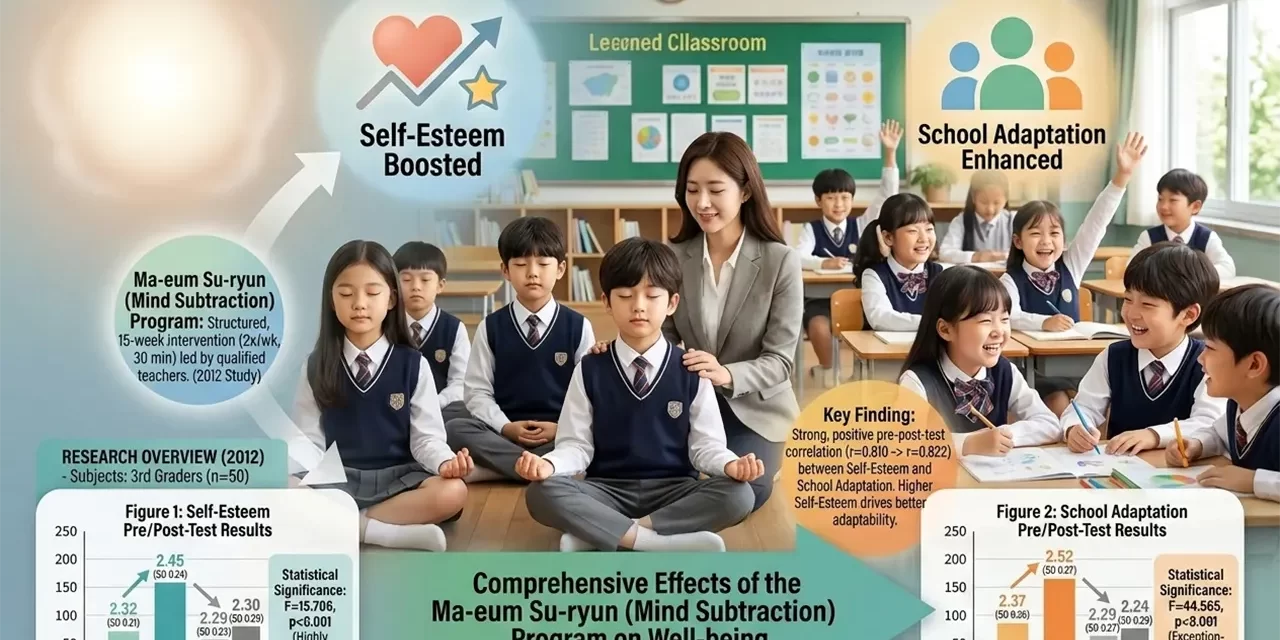
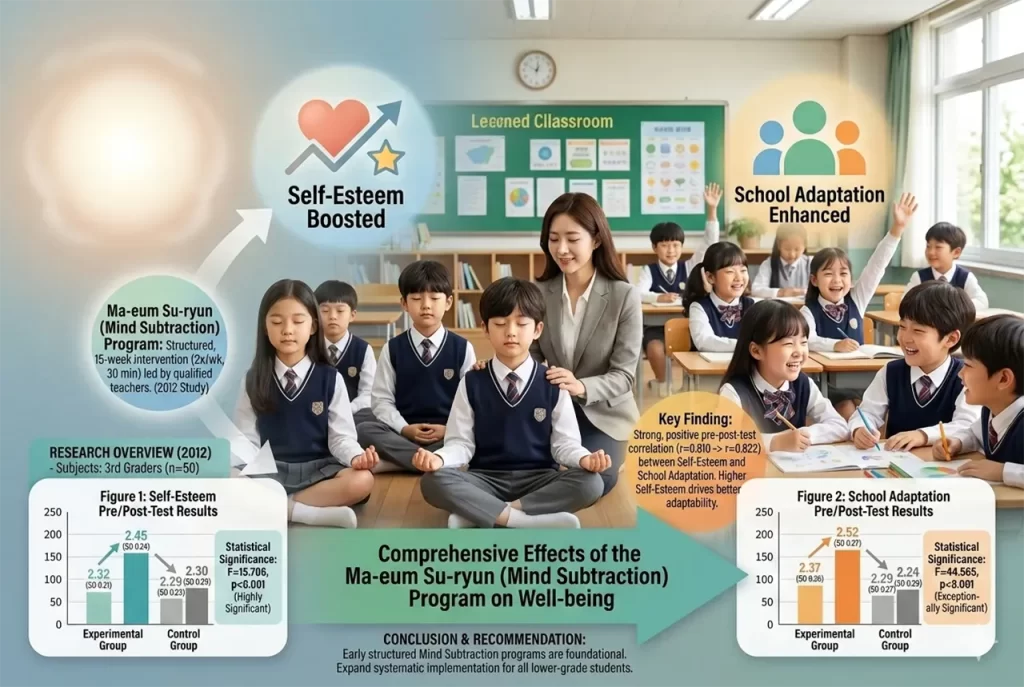
A landmark study published in 2012 investigates how the Ma-eum Su-ryun (Mind Subtraction) program influences young learners’ psychological well-being and academic adaptation.
- Researchers: Yang-gyeong Yoo (Professor, Kunsan National University) & Min-jung Lee (Teacher, Gimhae Neungdong Elementary School)
- Publication Year: 2012
- Research Purpose: To verify the program’s effects on self-esteem and school adjustment, providing a foundation for elementary school mental health promotion strategies.
👥 Research Subjects & Selection Criteria
The study utilized a highly controlled, rigorous selection process to ensure data accuracy:
- Target Pool: Third-grade students from a single class at N Elementary School in K City.
- Instructor Qualification: The class teacher had completed the entire official course of Ma-eum Su-ryun and held a professional qualification to guide the program.
- Experimental Group (25 students): Selected randomly from students who wished to participate and received explicit parental consent.
- Control Group (25 students): A separate class within the same grade and school, closely matching the experimental group in size and demographic characteristics.
⏱️ Research Procedure & Methodology
The intervention was strictly structured and integrated into the school schedule:
- Period: March to July 2012 (Total of 15 weeks)
- Frequency: 2 times per week
- Time: 30 minutes per session
📊 Comprehensive Research Results
1. Impact on Self-Esteem
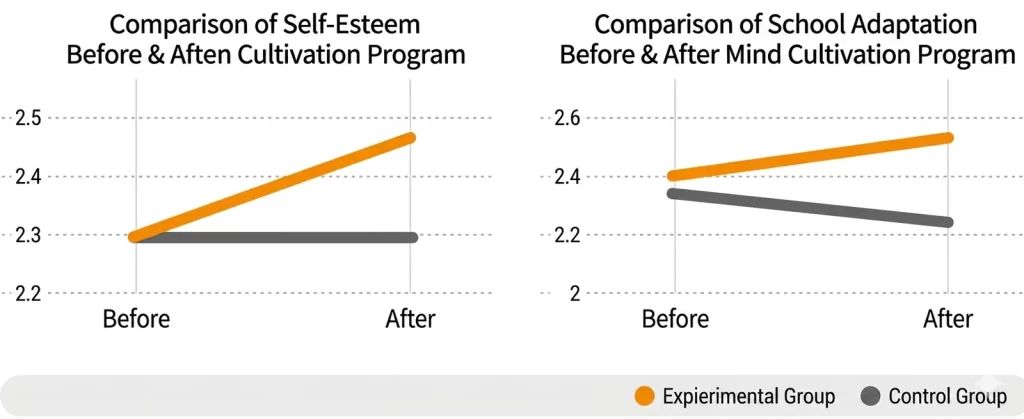
The psychological intervention yielded an immediate, measurable increase in the experimental group’s self-worth, while the control group stagnated.
- Experimental Group: Increased from 2.32 ± 0.21 (Pre-test) to 2.45 ± 0.24 (Post-test).
- Control Group: Remained virtually identical, moving from 2.29 ± 0.23 to 2.30 ± 0.29.
- Statistical Significance: The differences between the pre-test and post-test means were highly significant at the 5% level (F = 15.706, p < 0.001).
2. Impact on School Adjustment
Students practicing meditation adapted much better to classroom environments, peer relationships, and academic settings.
- Experimental Group: Increased from 2.37 ± 0.26 (Pre-test) to 2.52 ± 0.27 (Post-test).
- Control Group: Showed a slight decrease from 2.29 ± 0.27 to 2.24 ± 0.29.
- Statistical Significance: The variance between the groups demonstrated an exceptionally high statistical significance (F = 44.565, p < 0.001).
3. Correlation Between Self-Esteem and School Adaptation
The research proved that emotional stability directly impacts everyday school performance:
- Pre-test Correlation: A significant positive correlation of r = .810 was found initially.
- Post-test Correlation: The positive correlation strengthened to r = .822 after the program.
- Analysis: These metrics statistically imply that as an elementary student’s self-esteem rises, their overall school adaptability improves correspondingly.
💡 Conclusion and Academic Suggestions
The empirical data confirms that the Ma-eum Su-ryun program effectively boosts young students’ self-esteem and directly enhances their school adaptability.
Because early childhood is an irreplaceable, foundational period for the lifelong formation of personality and habits, the study strongly suggests expanding and systematically implementing the Ma-eum Su-ryun program for lower-grade school children.
