📌 Research Background: Academic Pressure and Brain Capacity in Young Adults
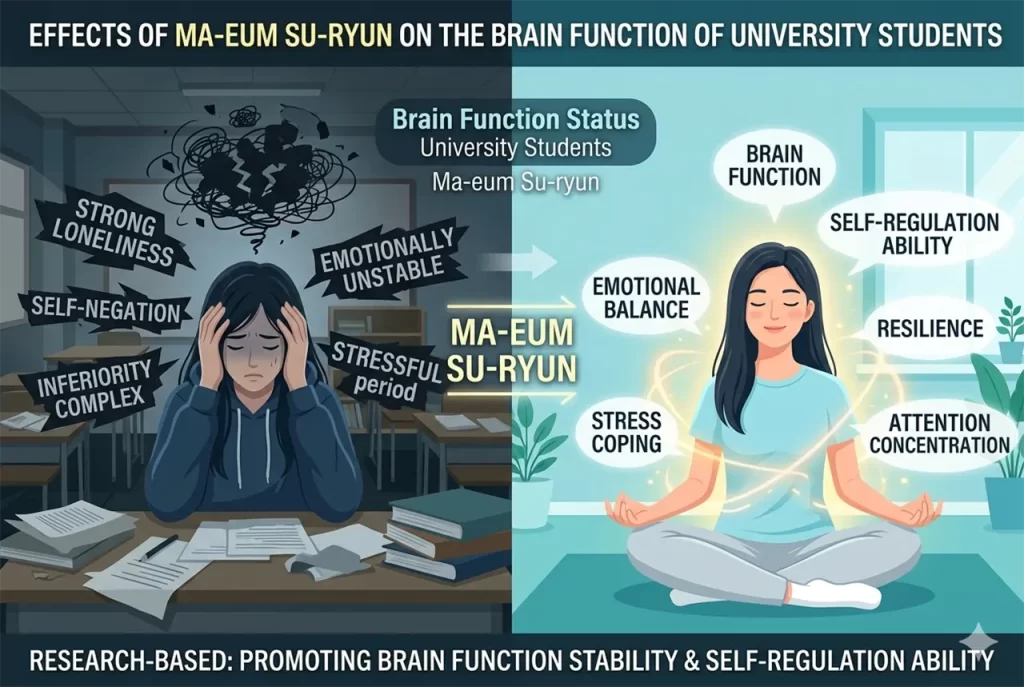
The university student period represents an emotionally unstable developmental window. During this phase, individuals are highly vulnerable to stress, intense loneliness, feelings of self-negation, and complex inferiority issues. Conversely, it is a critical time where high-level brain function capacities—such as strategic credit management for employment and complex judgment skills—are paramount.
Recently, neuroscientific fields have focused heavily on improving cognitive performance. This 2013 study evaluates Ma-eum Su-ryun (Mind Subtraction) meditation, a practice that subtracts not only the factual contents of the mind (memories and images) but also the heavy emotions attached to them. By tracking electrical signals via Electroencephalography (EEG), this research empirically proves that mind subtraction enhances physiological brain function and self-regulation capabilities in young adults.
- Researchers: Deok-joo Lee (Professor, Department of Aerospace Engineering, KAIST), Yeon-gyeong Yoo (Major in Brain Science, Seoul Buddhism Graduate University), Ji-sook Lee (Teacher, Mansu Middle School), In-soo Lee (Corresponding Author; Professor, Department of Emergency Medical Services, Korea National University of Transportation).
- Publisher & Year: Academic Society for Human Completion, Vol. 5 (2013).
- Research Design: A single-group pretest-posttest quasi-experimental longitudinal study.
👥 Research Methodology and Diagnostic Tools
The investigation integrated highly sensitive neuro-diagnostic technologies to monitor physical shifts in cortical activity across a 16-week timeline.
- Research Subjects: 11 university students who initiated the Ma-eum Su-ryun program on December 30, 2012, and completed the initial 4-week phase by January 26, 2013. A core cohort of 3 subjects was successfully followed up until the final 16-week mark (May 20, 2013).
- Brain Function Analysis Tool: The BQ-Test program, developed by the Korea Institute of Mental Science, used to systematically track 8 foundational brain function analysis indices.
- EEG Measurement Hardware: Neuroharmony M, a specialized 2-channel system program manufactured by Braintech Co.
- Data Analysis Framework: Raw EEG data was converted into 3D topographical graphs to visualize neurological stability, and statistical significance was verified via the Wilcoxon signed-rank test using SPSS 18.0 software.
📊 The 8 Brain Function Indices Analyzed
To evaluate overall neural optimization, the study systematically monitored the following components:
- Basic Rhythm Quotient (Baseline neural pacing)
- Self-Regulation Quotient (Autonomic nervous system balance)
- Attention Quotient (Brain arousal and attentiveness levels)
- Activity Quotient (Cortical alertness and engagement)
- Emotion Quotient (Psychological stability and mood regulation)
- Anti-Stress Quotient (Stress resistance and internal coping capacity against disease)
- Brain Balance Quotient (Symmetry between the left and right hemispheres)
- Brain Quotient (Comprehensive operational capacity of the brain)
📊 Comprehensive Neuroscientific Research Results
1. Significant Improvement in Right-Brain Metrics (4-Week Baseline)
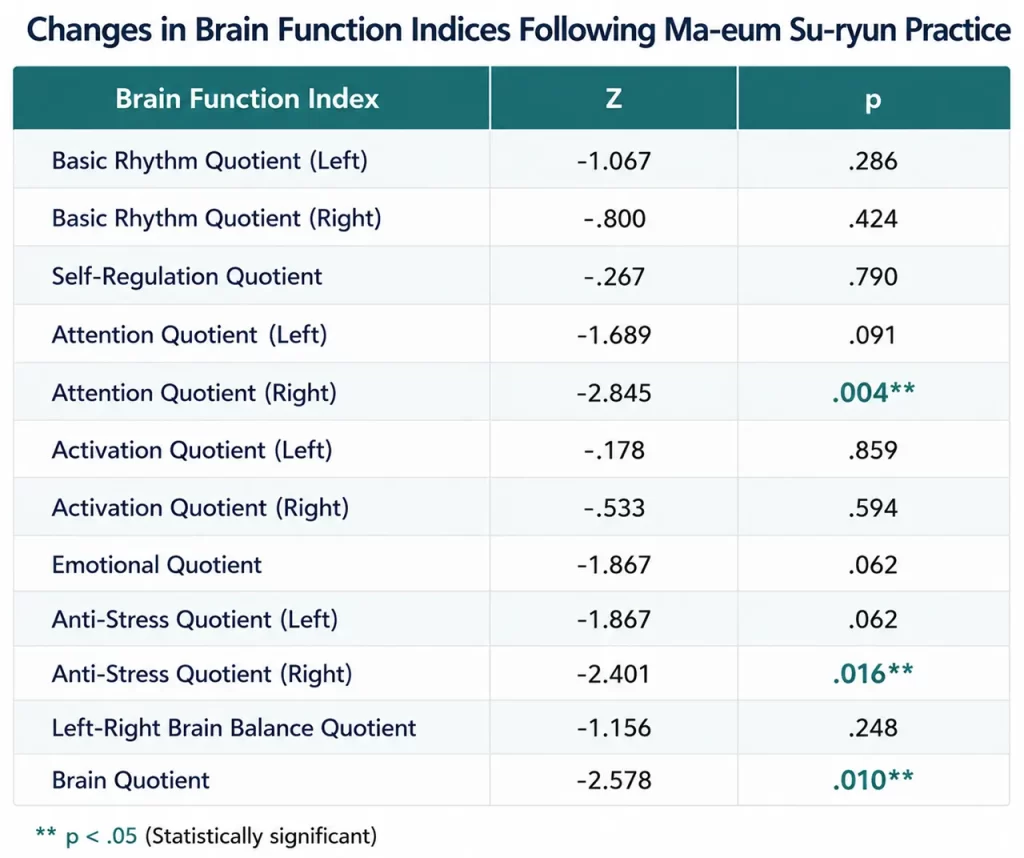
When comparing data from before the intervention to the 4-week post-test mark, the Wilcoxon signed-rank test confirmed highly localized, statistically significant improvements:
- Right-Brain Attention Quotient: Demonstrated a statistically significant difference, proving a major increase in internal brain arousal, attentiveness, and mental focus duration.
- Right-Brain Anti-Stress Quotient: Improved significantly before and after the program, indicating a vastly heightened resistance to stressors stemming from both internal thoughts and external environmental factors.
- Overall Brain Quotient: The global brain function score showed statistically significant advancement, enhancing overall thinking and cognitive processing speed.
2. Longitudinal 16-Week EEG and 3D Topographical Transformations
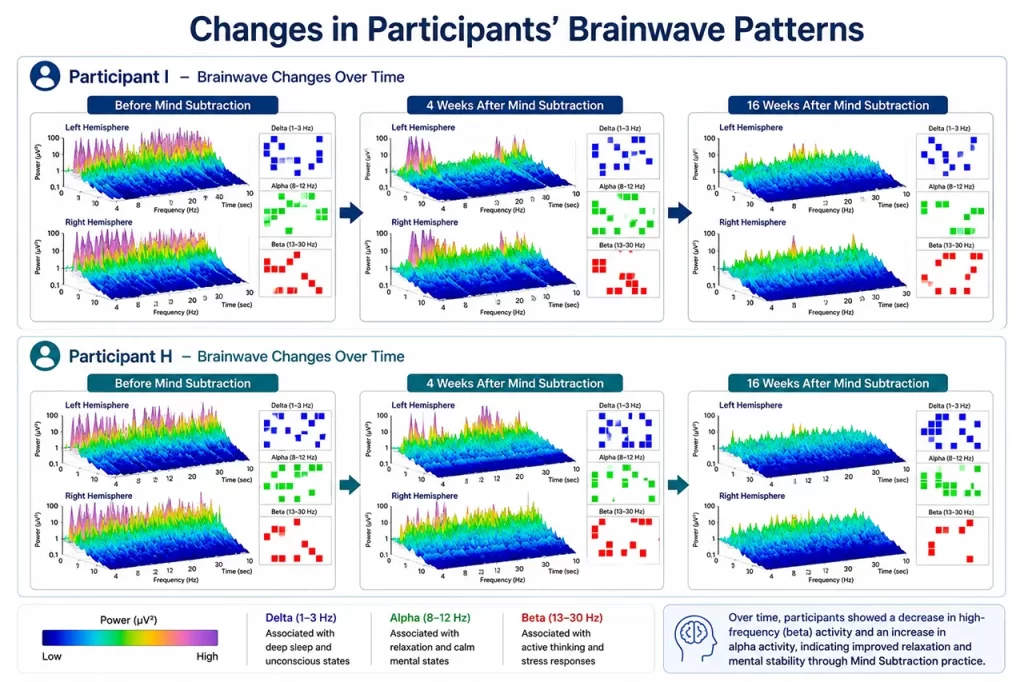
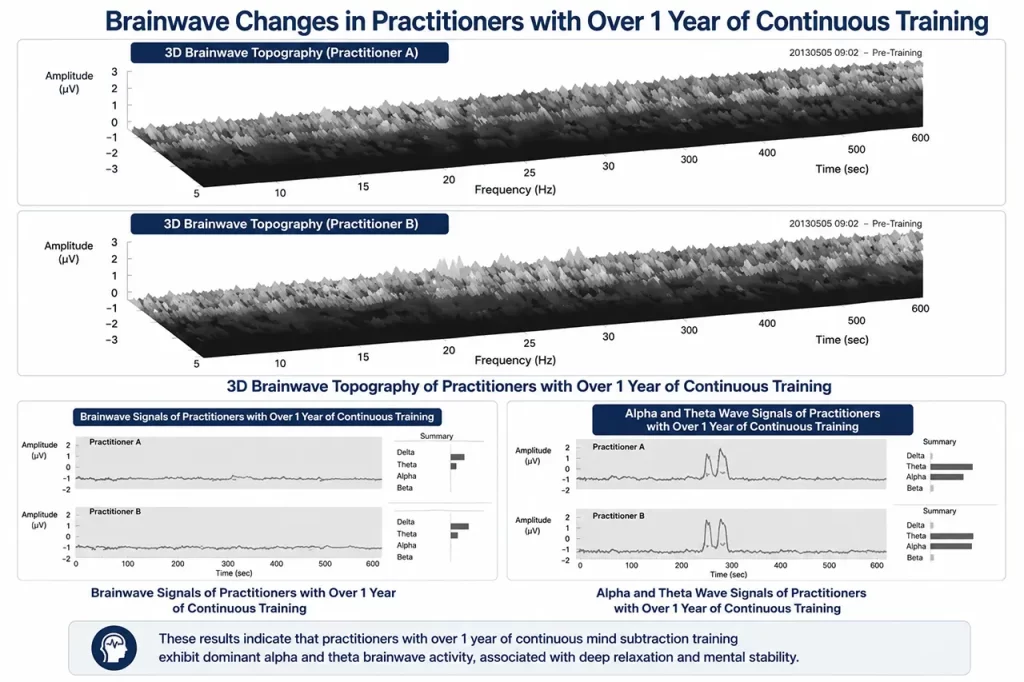
By converting raw brainwave signals into 3D graphs, researchers tracked profound long-term neurological stabilization:
- Subject I (16-Week Follow-up): Displayed an overall deeply stabilized EEG wave pattern. Crucially, the subject’s comprehensive Brain Function Index rose sharply from 62 to 77, indicating an objective upgrade in cognitive efficiency.
- Subject H (4 to 16-Week Follow-up): After just 4 weeks of mind subtraction, a perfectly balanced state between the left and right brain hemispheres was achieved. By the 16-week mark, the subject’s raw EEG signal patterns reached total systemic stability.
💡 Conclusion: Institutional Implications for Higher Education
The neuroscientific data confirms that Ma-eum Su-ryun fundamentally optimizes university students’ neurological health. By raising the attention quotient and anti-stress quotient, mind subtraction expands concentration spans, improves analytical capacity, and provides structural immunity against academic burnout. The researchers conclude that this program is exceptionally suitable as an institutionalized educational tool for young adults transitioning into full adulthood.
For local college students and young adults in California seeking to unlock their full cognitive potential and eliminate anxiety, the guided sessions at Santa Clara Meditation provide immediate access to these exact methods. Rooted firmly in the foundational mind subtraction principles pioneered by Master Woo Myung, these programs offer a scientifically verified framework for lasting emotional stability and peak brain function.