
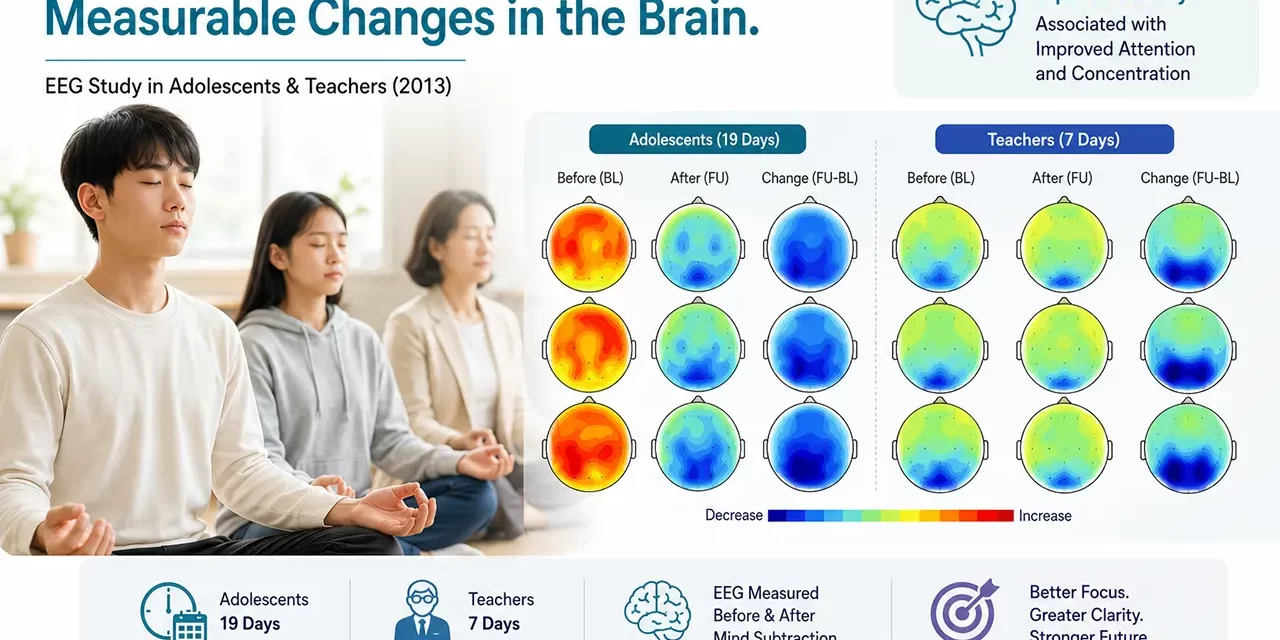
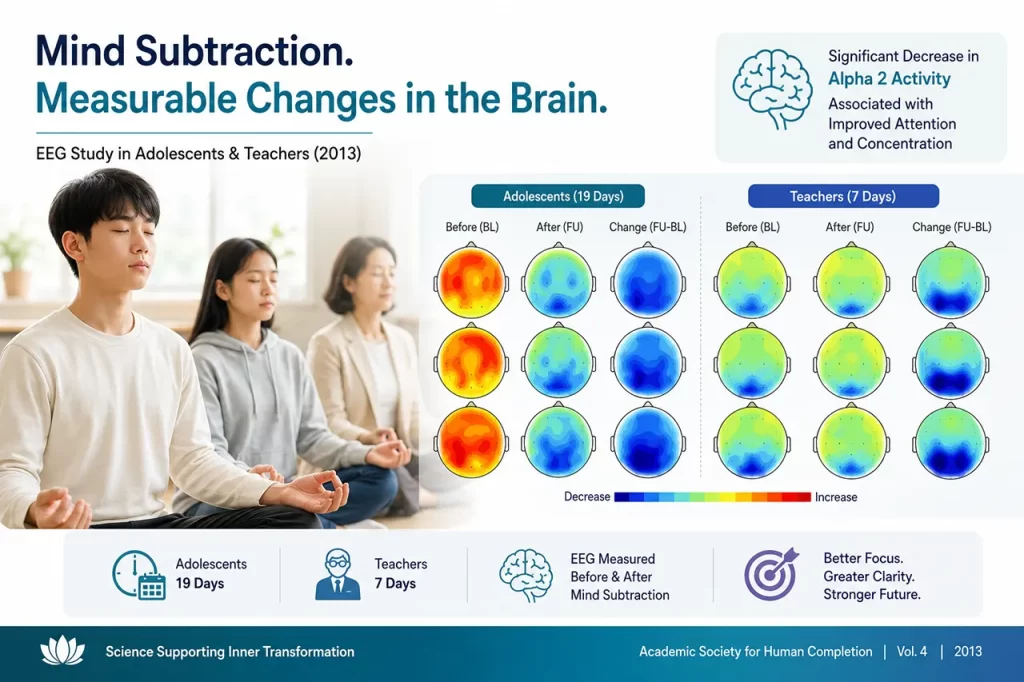
This EEG-based scientific study investigated how Ma-eum Su-ryun mind subtraction practice affects attention, concentration, and overall brain activity in both adolescents and teachers. Researchers found statistically significant improvements in brainwave patterns associated with enhanced focus and cognitive functioning following participation in Ma-eum Su-ryun programs.
In today’s educational environment, both students and teachers face increasing mental and emotional challenges. Adolescents often struggle with academic pressure, emotional instability, social stress, and constant digital distractions. Teachers, meanwhile, must balance the demands of educating students while managing their own workloads, stress, and professional responsibilities.
As concerns about youth mental health, school violence, anxiety, and burnout continue to grow worldwide, educators and researchers have increasingly searched for effective methods that can improve both psychological well-being and cognitive performance.
This scientific study examined whether Ma-eum Su-ryun, a systematic method of mind subtraction founded by Master Woo Myung, could produce measurable changes in brain activity among adolescents and teachers. Using electroencephalography (EEG), researchers evaluated brainwave patterns before and after participation in Ma-eum Su-ryun programs.
The findings revealed statistically significant improvements in attention and concentration in both groups. Particularly remarkable were the widespread brain changes observed among adolescents, especially within the frontal lobe, an area associated with higher-order thinking, decision-making, and self-regulation.
The results provide objective physiological evidence that systematically discarding accumulated mental burdens through mind subtraction may positively influence brain function and cognitive performance.
🛑 WHY THIS STUDY WAS IMPORTANT
In recent years, issues such as youth suicide, school violence, anxiety, depression, and emotional instability have become growing concerns in many countries.
Researchers noted that these challenges extend beyond schools and reflect broader social and psychological difficulties affecting modern society.
According to the principles of Ma-eum Su-ryun, people accumulate countless remembered thoughts, experiences, emotions, and mental images throughout their lives. These stored memories continue to influence behavior, emotional reactions, and perception of reality. Through mind subtraction, individuals systematically discard these accumulated mental images, allowing emotional burdens to be released and enabling recovery of their original mind.
While previous studies had reported positive psychological outcomes associated with Ma-eum Su-ryun, relatively few studies had examined objective physiological changes through EEG measurements—particularly among both students and teachers within educational environments.
This study sought to fill that gap.
👥 STUDY PARTICIPANTS AND METHODS
Adolescents
- 16 adolescents initially participated in a 19-day Ma-eum Su-ryun Youth Camp.
- Participants completed Levels 1, 2, and 3 of the Ma-eum Su-ryun program.
- Final EEG analysis included data from 8 participants.
Teachers
- 16 teachers participated in a 7-day professional training program.
- Participants completed Level 1 of the Ma-eum Su-ryun method.
- Final EEG analysis included data from 5 participants.
EEG Measurements
Researchers measured brain activity before and after participation using a clinical EEG system.
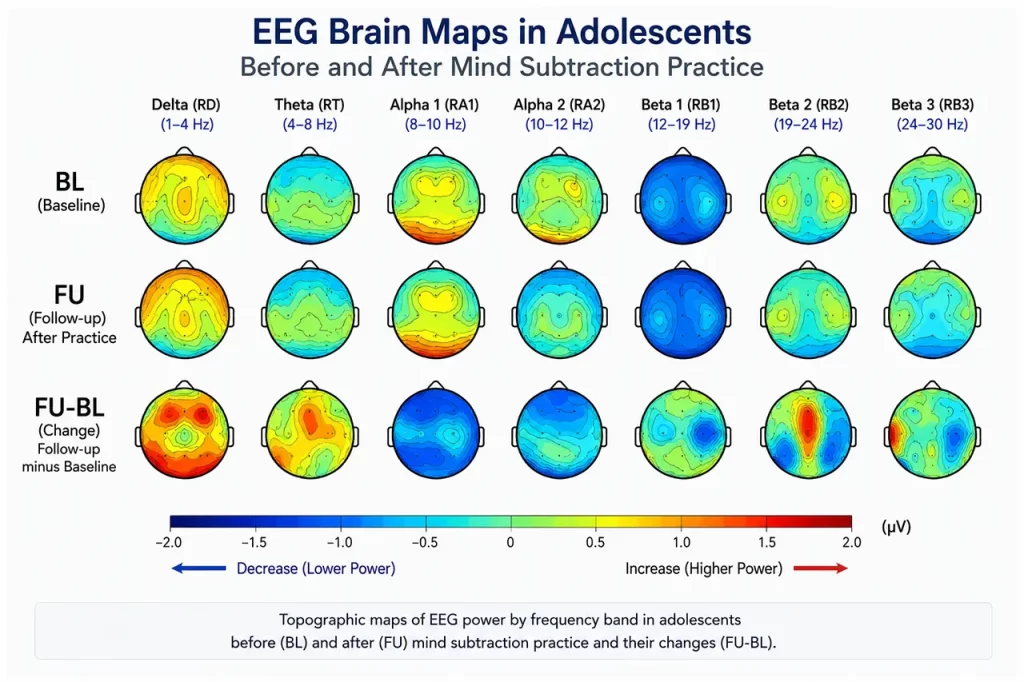
Brainwave activity was analyzed across seven frequency bands:
- Delta
- Theta
- Alpha 1
- Alpha 2
- Beta 1
- Beta 2
- Beta 3
Particular attention was given to Alpha 2 activity, which is strongly associated with attention and concentration.
⚡ THE SCIENTIFIC RESULTS: IMPROVED ATTENTION AND CONCENTRATION
The most significant finding was a statistically significant reduction in Alpha 2 brainwave activity among both adolescents and teachers following participation in Ma-eum Su-ryun.
According to the researchers, this change reflects improved attention and concentration.
1. Significant Improvements in Focus
Both groups demonstrated measurable changes in Alpha 2 activity, indicating enhanced attentional capacity and cognitive engagement.
2. Whole-Brain Changes in Adolescents
Among adolescents, EEG changes appeared throughout the brain.
The strongest changes were observed in the frontal lobe, a region responsible for:
- Decision-making
- Planning
- Self-control
- Executive functioning
- Higher-order cognitive processing
3. Positive Brain Changes in Teachers
Teachers also demonstrated significant EEG changes.
The strongest effects appeared in the occipital region, though researchers suggested that longer training periods might produce broader frontal lobe changes similar to those observed among adolescents.
🌱 WHAT MAKES THIS STUDY UNIQUE?
Many previous meditation studies relied primarily on questionnaires and self-reported experiences.
This study is different because it used objective physiological measurements to evaluate changes in brain function.
Even more remarkable, participants demonstrated measurable EEG changes after relatively short training periods despite having no extensive prior meditation experience.
The findings suggest that positive neurological changes may continue beyond the meditation sessions themselves, resulting in lasting improvements in attention and concentration.
🌿 CONCLUSION: OBJECTIVE EEG EVIDENCE FOR ENHANCED BRAIN FUNCTION
This study provides compelling EEG evidence that Ma-eum Su-ryun can improve attention and concentration in both adolescents and teachers.
Researchers observed statistically significant changes in Alpha 2 brainwave activity following mind subtraction practice, indicating enhanced cognitive performance and improved focus.
Particularly noteworthy were the widespread brain changes observed among adolescents, especially within the frontal lobe, a critical center for learning, decision-making, and self-regulation.
The findings suggest that systematically discarding accumulated mental burdens through the mind subtraction method developed by Master Woo Myung may produce measurable improvements in brain function and support healthy cognitive development.
As scientific interest in meditation continues to grow, studies such as this provide valuable evidence that Ma-eum Su-ryun can contribute not only to psychological well-being but also to objectively measurable neurological change.
— End of Research Summary —
If you or your children struggle with distractions, stress, anxiety, or difficulty concentrating, a practical solution may be closer than you think. Through the systematic practice of mind subtraction taught by Master Woo Myung, people of all ages have discovered greater clarity, focus, and inner peace. Experience the benefits of Ma-eum Su-ryun for yourself at Santa Clara Meditation.
🔬 RESEARCH DOCUMENTATION INFO
Researchers
- Prof. Deok-Joo Lee (KAIST)
- Prof. Jae-Moon Kim (Chungnam National University)
- Prof. Ki-Young Jung (Korea University)
- Jin-Young Song (Korea University)
- Eun-Jin Lee (Jeonju Art Therapy Education Center)
- Prof. In-Soo Lee (Korea National University of Transportation)
Publisher: Academic Society for Human Completion, Vol. 4
Year Published: 2013
Study Title: Analysis of EEG Changes in Adolescents and Teachers Through Mind Subtraction
