
Welcome to Santa Clara Meditation! 🌿 Modern life can sometimes leave us feeling exhausted and depressed in the face of an uncertain future. But what if the secret to overcoming these challenges and healing our bodies lies within our own minds?
Recently, the renowned KBS documentary program The Secrets of Life, Old Age, Illness, and Death explored this very question. In a special episode, they highlighted how Ma-eum Su-ryun (mind subtraction) meditation is being used to cultivate a resilient, grateful, and positive mindset. Read on to discover the profound scientific and personal transformations featured in the broadcast! 🌻
🌟 The Power of Positivity, A Mind of Gratitude
On January 25th, the KBS New Year’s Special of The Secrets of Life, Old Age, Illness, and Death—titled “The Power of Positivity, A Mind of Gratitude”—introduced Ma-eum Su-ryun meditation as a practical method for cultivating the power of positivity. (Producer: Son Jong-ho / Writers: Choi Geun-ju, Park Han-sori) 🎬
For the 2017 New Year, the production team set out to find actionable ways to cultivate a healthy and happy life, even in difficult environments.
⚖️ The Difference Between Those Who Find Happiness and Those Who Don’t
What separates the people who manage to find happiness even in difficult or frustrating situations from those who do not? The production team believed the secret lay in “positivity and a mind of gratitude.” 🌈
Regarding meditation, they specifically focused on the Ma-eum Su-ryun method. Their interest was piqued by actual research papers showing that “even diseases like cancer heal faster when a patient changes to a positive and grateful mindset.” The broadcast referred to this as the “Pygmalion Effect,” explaining that positive expectations and interest directly lead to favorable physical results. 📈
To showcase an example of someone who overcame personal hardships through the power of positivity, the crew interviewed Kim Myung-hee, who practices Ma-eum Su-ryun meditation at the Daegu Daecheon Meditation Center.
Kim Myung-hee, a former teacher, was diagnosed with stage 2 stomach cancer. She had to undergo major surgery to remove her entire stomach, connecting her esophagus directly to her duodenum. During this process, she naturally struggled with the fear of death, depression, and despair. However, she shared that as she emptied out her agonizing mind through meditation, the empty space was filled with gratitude for her situation and the people around her. ❤️🩹
“As I meditated, I realized I had lived my life thinking only I was right, judging and criticizing people from a self-centered perspective. Acknowledging this, my attitude toward life became humble. Suddenly, I felt so grateful for everything. Meditation played a huge role in helping me change my despairing mindset after getting cancer.” — Kim Myung-hee
🔬 The Impact of Positive Mental Changes on Health Through Meditation
According to research, having a positive mind actually boosts the immune system, helping the body overcome cancer cells. Naturally, this also enhances the effectiveness of medical treatments. Following Kim Myung-hee’s story, the broadcast featured an interview with Professor Yoon Mi-ra. 🩺
Professor Yoon Mi-ra (Chung-Ang University, Department of Nursing) worked as an oncology clinical nurse specialist for 17 years, constantly searching for ways to aid cancer patients in their treatment. After personally experiencing the effects of Ma-eum Su-ryun meditation, she continued to research its impact on patient recovery. 📊
She has authored papers such as “The Effects of Ma-eum Su-ryun Meditation on the Psychological Well-being of Breast Cancer Survivors,” and previously appeared as a panelist on the KBS special Yeo-yu-man-man to share wisdom on “Overcoming Cancer Wisely with the Power of the Mind.”
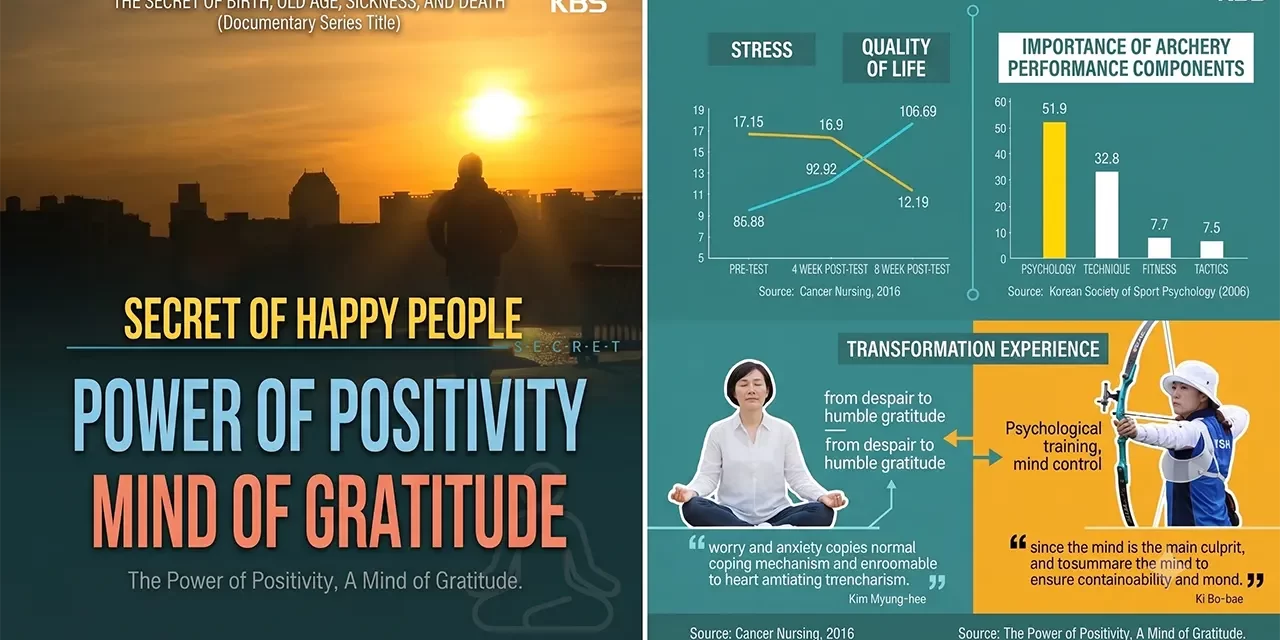
The broadcast presented the results of an 8-week meditation program conducted with breast cancer patients, which showed reduced stress and improved quality of life. Professor Yoon explained that as patients empty their anxious minds and transition to a mindset of positivity and gratitude, their physical symptoms naturally improve as well. 🌸
“Worry and anxiety about pain actually make the pain worse. But as excessive worry and anxiety disappear through meditation, your coping mechanism shifts to a positive one: ‘I have some pain, but that’s normal. Maybe I should exercise a little.’ Because of this shift, the symptoms inevitably improve. Since the mind is the main culprit behind all stress, pain, depression, and anxiety, subtracting and discarding those minds is a fundamental treatment.” — Professor Yoon Mi-ra
🌱 People Striving to Increase Their “Positive Resources”
The reporting crew followed Kim Myung-hee for an entire day, accompanying her to her home and the fitness center. That evening, they also visited the Ma-eum Su-ryun Meditation Center in Dalseo-gu, Daegu, which Kim attends daily. There, they interviewed individuals who were looking back on themselves, emptying their minds, and striving for personal transformation. 🧘♂️
The broadcast highlighted the stories of various people actively changing their lives by striving for positivity and gratitude. This included Park Sang-young (Rio Olympics Fencing Gold Medalist), Jang Hye-jeong (three-time gold medalist in Dance Sports at the National Para Games), people writing gratitude letters and journals, and meditators who reflect on and empty themselves daily. 🥇
The difference between a person who faces every moment with a positive and grateful mind and one who does not is immense. Research suggests that positive and negative people even differ in their brain activity; positive individuals possess a brain structure that can quickly cut off negative stimuli. 🧠
Such a mindset is not entirely innate. The broadcast emphasized that the conscious effort to increase one’s “positive resources” is the most crucial factor determining life’s happiness—including the practice of being grateful for what is given in one’s life.
“While people with a high positivity index or resilience might have some innate traits, they likely put in a lot of effort to raise that positivity. If you have high positive resources in your mind, you can quickly overcome illnesses or difficult situations when they strike.” — Chae Jung-ho / Professor of Psychiatry, Catholic University of Korea Seoul St. Mary’s Hospital
“Whatever it is we are grateful for, the feeling of gratitude itself makes magical things possible. Changes in people and relationships all start with gratitude.” — Paul Mills / Professor of Public Health and Family Medicine, UCSD
🎯 Ma-eum Su-ryun Meditation as Psychological Training for Archery Athletes
The broadcast also featured an interview with archer Ki Bo-bae at the Taereung National Training Center archery range. 🏹
What is the biggest factor affecting archery performance? It’s easy to assume it is pure skill, but surprisingly, psychological state accounts for more than 50%. In major tournaments, the outcome is largely determined by how well an athlete controls their psychology. Therefore, archery athletes focus just as much on mind-control training as they do on shooting practice. 🏅
As part of this psychological training, a camp utilizing Ma-eum Su-ryun’s “Mind Subtraction Method” was conducted for the athletes of the Hyundai Steel and Hyundai Department Store archery teams.
“My mind became peaceful, and before I knew it, I saw myself thinking positively.” — Feedback from the Ma-eum Su-ryun Meditation Camp for Hyundai Archery Teams
📼 A Legacy of Mindful Living
Since 2002, KBS 1TV’s The Secrets of Life, Old Age, Illness, and Death has been taking a holistic approach to our lives, proposing “healthy lifestyles” that simultaneously elevate our “health index” and “happiness index.” (It was also selected as a “Good Program” in November 2016.) 🏆
Notably, back in the 2010 New Year’s Special, [Choices for a Happy Life, Part 1: Let’s Live by Emptying], the program previously broadcasted an experiment demonstrating the concrete, life-changing effects of Ma-eum Su-ryun. 🕊️
