
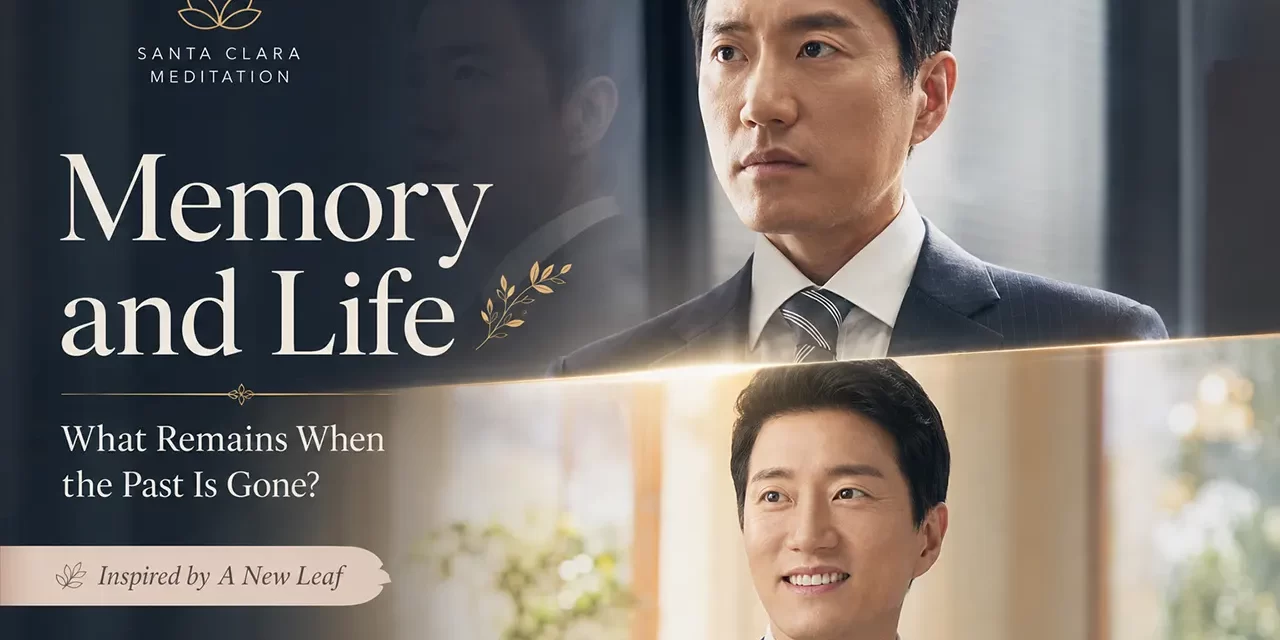
🌱 Who Would You Be Without Your Past?
Welcome back to the Santa Clara Meditation blog! We often ask ourselves a profound question: Who would I be without the heavy baggage of my past?
At our center, we practice a method of subtracting past memories and attachments to uncover our true, original nature. Interestingly, this exact concept is beautifully explored in one of South Korea’s most praised social dramas.
Let’s dive into MBC’s A New Leaf (Korean title: 개과천선) and see how profoundly our memories impact our lives—and what happens when we finally let them go. ✨
A New Leaf (broadcast April 30 – June 26, 2014) is a human legal drama that tells the story of Kim Seok-joo, the ace lawyer of a massive law firm. Unlike extreme soap operas that use amnesia merely as a provocative plot device, this show brilliantly connects the trope to deep self-reflection.
How do memories affect my life? If I could break free from those memories, how would my life change?
💼 The Cold-Blooded Ace Lawyer
Attorney Kim Seok-joo (played by Kim Myung-min), the protagonist, is the universally acknowledged ace of the nation’s top law firm, Cha Young-woo Firm. Armed with a naturally brilliant mind, persuasive eloquence, and a meticulous personality, he is unstoppable.
- In a civil suit for victims of Japanese forced labor, he defended the Japanese corporations and led them to victory.
- He bribed witnesses to secure an acquittal for a second-generation chaebol in a sexual assault case.
By any means necessary, he won cases and represented the interests of giant corporations and those in power.
Then one day, he suffers a mysterious accident and loses his memory. It is “dissociative amnesia,” where his legal knowledge remains perfectly intact, but his personal memories are wiped clean.
🤔 “Why on earth did I live a life like that?”
The Kim Seok-joo who wakes up in the hospital is a completely different person. He smiles, tells jokes, and his tone of voice softens. The cold-bloodedness that made it seem like he wouldn’t bleed a drop even if pricked has vanished. Instead, he listens to the stories of the elderly he meets in the hospital and tries to help them with their troubles.
He even thinks to himself, “I can’t remember, but I must have lived a life that was at least somewhat helpful to others.”
But that expectation is short-lived. The more he confronts his past life after leaving the hospital, the more bewildered he becomes. He discovers a life that always stood by the strong, turning the weak into unfair victims. A life that relentlessly chased only money and success. A life where even love was a strategic, calculated choice.
The more he learns about his past, the more baffled he is. He asks himself: ‘Why on earth did I live a life like that?’
⛓️ The Trap of Past Memories
Soon, through the mouths of those who know him well, the decisive reason he had no choice but to live that way is revealed. It stems from his painful memories of his father, Kim Shin-il, a human rights lawyer and former National Assembly member.
Seok-joo’s father was a judge during the dictatorship who was forced to step down and subsequently became a human rights lawyer, dedicating his life to the weak. Because of this, he spent a long time in prison, unable to be there for his family. Seok-joo’s only remaining childhood memory was the sad, terrifying, and lonely moment the day his father was taken away.
The specific background behind his extreme lack of sympathy for the weak is also revealed through his boss:
“When his father got involved in the human rights issues of evicted residents, one disgruntled resident broke into their house… The consensus was that the laborer was borderline intellectually disabled and lacked anger management. Kim Seok-joo’s mother was injured in that incident… Later, when he saw his father join the three-party political merger, Seok-joo cynically viewed even the purity of the values his father championed.”
Because of those painful memories, he grew increasingly cold-hearted and ruthless as a defense mechanism.
🕊️ Stepping out of the Dark Tunnel
However, after losing the memories that had so massively influenced him, Kim Seok-joo regains his innate purity and sense of justice. He resigns from the giant law firm, which no longer aligns with his values at all.
The camera lingers on Kim Seok-joo walking out holding a single cardboard box. The deep sigh of relief he exhales as he leaves the building shows a profound sense of liberation, as if he has emerged from a dark tunnel and found a new light.
Afterward, he stands in court again with a new mindset. Now, from the victims’ perspective, he fights against the very powers he once represented. His past self and current self battle fiercely as he forges a new life.
“If I can’t even do what I think is right, what am I studying for, and what am I building my skills for?” — To his friend Park Sang-tae (Episode 7)
“Right now, you might think it’s more beneficial not to tell the truth. But as time passes, the moment will come when you realize you shouldn’t have done that back then. Because I’ve been through it. I tried to create a bigger hell just to avoid a smaller one.” — While persuading a witness to testify (Episode 7)
💡 Fighting the Enemy in Our Own Minds
Kim Seok-joo ultimately never regains his memory. But he shares a tearful reconciliation with the father he had antagonized for so long. He finally realizes the sincerity of the father he had hated and resented so much—how much his father had worried about him, loved him, and felt sorry.
In the final episode, the conversation between the father and Kim Seok-joo is deeply moving:
Father: “I feel like you took a long detour because of my self-righteousness.” Kim Seok-joo: “I wasn’t fighting you, Father. I was fighting the enemy in my own mind that I created.”
Past memories create the present “me.” If we could be free from our memories, and if we could look at our lives objectively from a third-party perspective, what would the “me” of that moment look like?
If you want to break free from the enemy in your own mind and discover your true, original self, we invite you to begin your journey of letting go at Santa Clara Meditation. 🌿
