
Welcome back to the Santa Clara Meditation blog! 🌱
These days, the word “trauma” no longer seems unfamiliar. You hear it everywhere, and it is now commonly used in daily life. This means the concept has become broad. Trauma isn’t only caused by major disasters or life-threatening events; even small, repeated emotional wounds can turn into trauma.
It is said that the probability of a person experiencing trauma in their lifetime is over 50%. If you include experiencing the death of someone close, it exceeds 80%. Fortunately, because humans have resilience, 80-90% of those people recover within a year or two. However, depending on the individual, some fail to recover, and only they can truly know that pain. Furthermore, the sorrow of family members who can only watch them suffer from afar is beyond words.
Trauma is a mental wound that needs to heal as soon as possible. Here is some helpful information to guide you on how to overcome trauma. ✨
🌅 What is Trauma?
Trauma was originally a medical term meaning a physical wound or injury. In psychology and psychiatry, it came to be used to mean “psychological trauma” or a “shock that leaves an impact or disorder on emotions and behavior.” In other words, it refers to the psychological trauma and mental shock experienced after going through or witnessing an event that is physically or emotionally life-threatening.
In the beginning, a person might actually seem calm. This is because they cannot readily accept the event or loss. Therefore, people around them might mistakenly think, “They went through a hard time but overcame it well.”
However, if the event keeps popping into their head as time passes, that is not true recovery. If they are startled out of their wits by a similar sound or smell even after a long time has passed, they must strive for a more complete recovery.
🌻 Let’s Overcome Trauma Like This
When trauma occurs, the first things you experience are an inability to sleep and constant tension. If that state of arousal prolongs, you become sensitive, and naturally, indigestion, headaches, or numbness in the hands and feet may follow. Psychologically, you fall into emotions like anxiety, worry, resentment, anger, sadness, and depression. Due to anxiety about safety, you distance yourself from hobbies or gatherings you used to enjoy. You might become socially isolated or withdrawn.
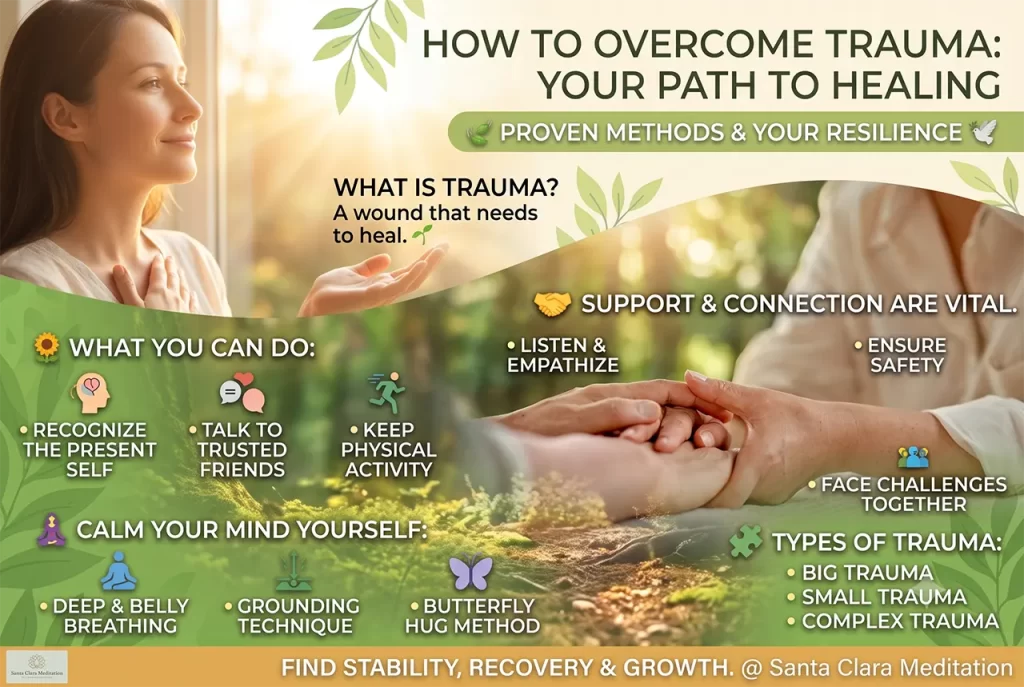
To overcome trauma, try executing these steps one by one with the belief that emotional wounds can naturally be healed:
- Seek help from a mental health specialist: It sounds obvious, but surprisingly, many people endure it alone, thinking it will get better. If symptoms appear and insomnia and anxiety persist, you must seek a professional first. The pain of trauma degrades a person faster than it gives them the courage to heal. Finding stability through professional counseling and prescribed medication is crucial. After that, you can parallel it with things you can try on your own.
- Recognize your present self (“The me of today is not the me of back then”): Trauma is when your present self just wants to live well, but a past event grabs your ankle and torments you. To win that battle with the past, you must recognize that you are a different person now than you were then. Keep recognizing the present by telling yourself, “I am much stronger now, I am an adult now, I am safe now,” and strive to realize that you are no longer the weak person from that time.
- Tell people around you, “I have this trauma”: Repeatedly mulling it over and suffering alone only distorts the memory and engraves it deeper. By speaking it out loud, you can organize the situation and pull yourself out of it. However, if just recalling it is still painful and you don’t want to talk about it, there is no need to force yourself. Take a little more time.
- Think flexibly: Experiencing trauma—that is a fact. However, the trauma itself is not you. It is just an event that happened while living. Think flexibly and positively: “It was something that could happen to anyone, there must be something to gain from this event, I can recover.”
- Keep moving and continuously engage in physical activity: Strive to move a lot within your capacity. Walking, running, and playing your favorite sports are great, as are doing laundry or cleaning. If you move your body, you can feel the tension that made you shrink away slowly disappearing.
- Shift your perspective through self-reflection and Subtraction Meditation: According to research, a time of self-reflection through meditation is necessary to break free from trauma and turn it into an experience for personal growth. Among various methods, Subtraction Meditation is highly recommended. It allows you to repeatedly pull out and discard the negative emotions and thoughts piled up in your mind. Through this process, you gain a consciousness that can look at things more broadly and positively.
🤝 When Someone Close to You is Struggling with Trauma
- Listen and empathize: When someone experiences trauma, it becomes difficult for them to accept help. They become consumed by the thought that no one can understand the pain they have endured. What someone beside them can do at that time is listen and empathize. Resilience improves the most when they can talk to the person they trust the most about how scared, shocked, or wronged they felt.
- Let them know they are safe now: Let the anxious person experience safety. By constantly reminding them that they are safe—not just in their physical space but also in their relationships with others and socially—help them let go of their anxiety.
- Try doing the things they couldn’t do because of trauma together: For fundamental recovery from trauma, one must slowly face it rather than avoid it. Help them try the things they couldn’t do because of trauma, one by one. The sense of accomplishment and self-efficacy they feel every time they make a little progress is a huge help in overcoming trauma. (Reference: Ministry of Health and Welfare, National Center for Mental Health | Dr. Mind Talk, Understanding Trauma)
🧘♀️ 4 Ways to Calm Your Mind Yourself When Tense and Anxious
- Deep Breathing: Breathe in through your nose and slowly exhale completely through your mouth with a “hoo~” sound, as if blowing up a balloon. Exhale slowly, focusing on the feeling of breath leaving your chest.
- Diaphragmatic (Belly) Breathing: When inhaling, make your lower belly inflate like a balloon, and when exhaling, let it deflate. Breathe only through your nose. Inhale and exhale slowly and steadily, focusing on the heavy feeling in your lower belly.
- Grounding Technique: This brings you back to the “here and now” by feeling your feet firmly planted on the ground. Place the soles of your feet on the floor and focus on the sensation of them touching the ground. Lift your heels and drop them down with a thump. Apply pressure to your heels and feel the solid floor beneath you.
- Butterfly Hug Method: Use this when you suddenly feel tense, your heart races, or distressing scenes come to mind. Gently tap and pat your body left and right to reassure yourself. Cross your arms over your chest, place your hands on opposite upper arms, and tap alternately left and right about 10-15 times, like a butterfly fluttering its wings. (Source: National Center for Mental Health, National Trauma Center)
🧩 Types of Trauma
- Big Trauma: Refers to mental wounds caused by massive events that disrupt daily life, such as war, disasters, traffic accidents, sexual assault, and violence.
- Small Trauma: Refers to everyday experiences that make you lose confidence or self-esteem, such as being teased by friends or feeling humiliated after making a mistake during a presentation.
- Single-Incident Trauma: Occurs as a one-time event. Usually, trauma with a high intensity of shock falls into this category. Because the intensity is high, even a single experience has a profound impact.
- Complex Trauma: Refers to trauma from repeatedly occurring events. If you repeatedly experience things like being bullied at school, you lose confidence and become depressed. (Source: Society for Holistic Education | Trauma, Beyond Healing to Growth)
