
Welcome back to the Santa Clara Meditation blog! 🌱
This post is for those who:
- Want to actively resolve their feelings of anxiety.
- Want to know the reasons why they feel anxious.
- Wonder if meditation helps eliminate anxiety.
Feeling anxious is a natural occurrence. Just as drinking a lot of water makes you want to go to the restroom, it is completely normal to feel anxious in situations that are overwhelming, burdensome, or that you want to avoid.
“A person without anxiety is a dead person. Anxiety is the force that makes us prepare for an uncertain future.” — Cognitive Psychologist, Professor Kim Kyung-il
You have to go to the headquarters on Monday and present to the CEO, so you must cancel your weekend plans and prepare. The force that makes you prepare like this is anxiety. When people feel a moderate amount of anxiety, they take action.
However, when you feel extreme anxiety, you cannot do anything. Therefore, feeling an appropriate level of anxiety does not mean you are weak. However, in the exact same situation, some people deal with it calmly, while others bolt out of anxiety.
The reason our reactions differ when we feel anxious (assuming there are no physical issues) is that the courses of the lives we have lived are different. The more anxious thoughts or experiences a person has had in their life, the more ‘anxiety’ exists within their mind. They worry more than others and feel excessive anxiety—like sounding a siren even in non-dangerous situations. 🚨
So, how high is your level of anxiety? Read the categories below and see where you fit!
💡 Personality Types That Easily Feel Anxiety
- The Person Who Tries to Be Perfect in Everything: They look like they are working hard because they fear mistakes or failure, but because they don’t know the proper limits, they excessively take on tasks or roles. This can even lead to physical symptoms (e.g., diarrhea, headaches, dizziness, indigestion, etc.).
- The Person with a Strong Need for Control: They want other people to move, work to progress, and the world to run exactly the way they have envisioned.
- The Highly Dependent Person: They feel a unique fear toward authoritarian figures. If they cannot do exactly what such a person tells them, they feel anxious or find it difficult to make decisions on their own.
1. Know Why Your Mind is Anxious
“I really don’t know what’s going to happen next~ What if things go wrong? I might make a mistake~ What if they evaluate me poorly? I have to do everything well! I’m anxious because I don’t know why I’m anxious~” 😫
How about you? Just knowing the true nature of the anxiety you feel solves more than half the problem. Those who practice Ma-eum Su-ryun meditation can find the reasons themselves by looking back. After all, you learned how to look back starting from Level 1 of subtraction meditation! ^^
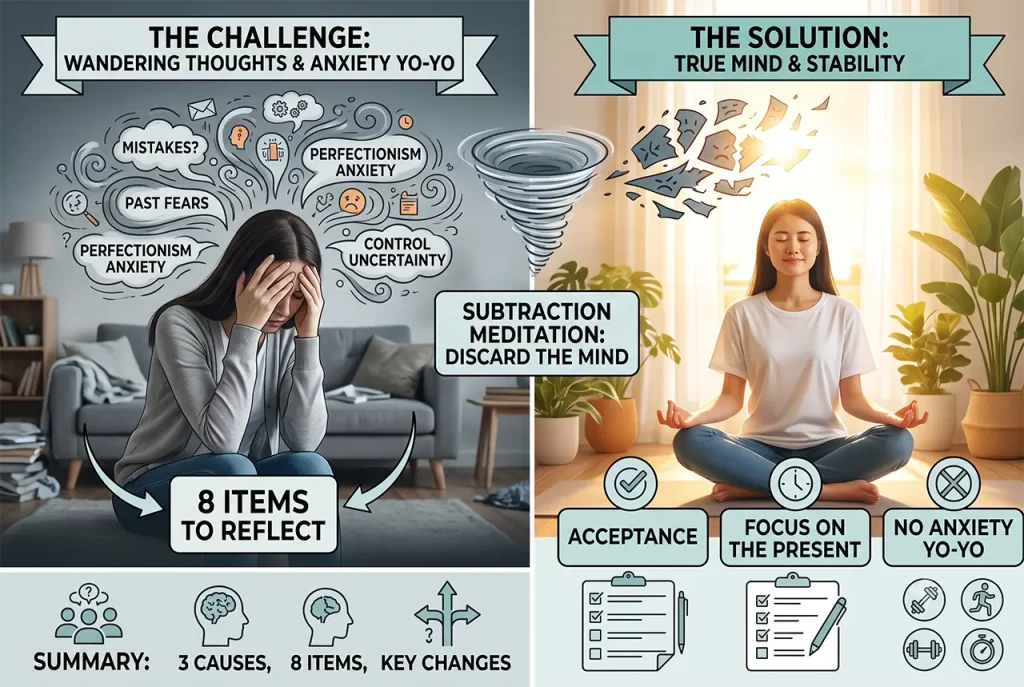
Items to reflect on from your life regarding anxiety:
- When was the very first time you felt anxious?
- Do you have perfectionist anxiety? If so, since when and why did you feel anxious if you weren’t perfect?
- If you are anxious about making mistakes: Have you truly only failed all this time? Do you make mistakes continuously all day long?
- Are your personal standards for mistakes and failure unusually high or abnormal?
- If you were anxious about people’s gazes: Did passersby actually attack you?
- If you are worried that people will hate you if you show your true self: When did this thought start?
- What physical reactions occur in your body when you feel anxious?
- What habitual thoughts do you have when you get anxious?
If you look back on the life you have lived so far, you can find the causes yourself. Did you find them? The reasons for anxiety can be broadly classified into three categories.
1) The Desire to Control Uncertainty
There is an overwhelming amount of information generated by world events like COVID-19. You might feel anxious hearing bad news, worrying it might happen to your family. You might experience economic anxiety or worry about global conflicts. Everyone faces anxious situations. But human life is inherently unpredictable; people who find this hard to accept feel a level of anxiety that makes it difficult to find solutions.
- Tip before doing subtraction meditation: Differentiate between what you can and cannot control. If you cannot control it, boldly let it go. You cannot control what will happen tomorrow. Boldly let it go and only discard what you CAN control through subtraction meditation: ‘The anxiety I feel’, ‘The feelings and thoughts I have’, and ‘The mind that distracts me from doing what I can do right now’.
2) Past Experiences of Anxiety
You may have felt anxious about grades during school exams, witnessed an accident, or felt anxiety toward people during corporate life. When people have actual experiences of anxiety, they want to avoid similar situations. The reason they want to avoid them is the anxiety that they might look incompetent, that a project might fail like last time, or that they might ruin an exam. It’s just that some people get anxious, while others come up with solutions.
- Tip before doing subtraction meditation: People in the world care much less about your mistakes or faults than you think! Look to see if you have a mind that cannot accept this, excessively high standards for yourself, or a habit of unconditionally doubting yourself.
3) The Perfectionism That You Must Excel at Everything
A single person is given various roles. At work, you are a team leader but also a subordinate; at home, you think you must perfectly fulfill your roles as a child and a parent. This is a case of perfectionist anxiety.
- Tip before doing subtraction meditation: Are you overly conscious of others’ evaluations? If you adopt the mindset, “If it works out, great; if it doesn’t, it can’t be helped,” it becomes a little easier to let go. You will feel more comfortable once you admit that you are not that perfect of a person, and you cannot be perfect in the first place.
Alright, by reflecting, thinking, and writing down these things, you should now know when and why you became anxious! 🌱
2. Acknowledge It
Accurately see and accept your state. It’s difficult for a first grader to solve calculus. Because you don’t accurately know your current state, you might be anxious because you took on a task you cannot handle yet, or because you think you must do everything perfectly on your own.
If you are a 3-month probationer, it is naturally difficult to work like a 5-year team leader. If you hold onto the thought that you shouldn’t make mistakes while never asking for help, you will inevitably be anxious.
If you look at your current situation, you will definitely be lacking. “So what? That’s me!” You must acknowledge and accept that in order to grow. Even if you don’t like your current self, you must look straight at that version of yourself without avoiding it. Only then can you make decisions. Surprisingly, once you make a decision, anxiety often disappears easily! ✨
“Humans have an instinct to see tasks through to completion. Therefore, if a task is not finished, they feel tension… It is a natural phenomenon to remember the plays where you made mistakes rather than the good plays after a game.” — Wikipedia
3. The Solution
Make an anxiety list before doing subtraction meditation. 📝
The opposite of anxiety is comfort. A state without anxiety has a center and a sense of stability in the mind. If you find it hard to write down the reasons why you are anxious, try writing down the reasons why you are not comfortable and discard them through subtraction meditation.
For example, if you feel anxious when you open your eyes in the morning, write down what thoughts make you uncomfortable! Even very trivial things are fine. Write down what minds need to be gone for you to be in a comfortable state. When doing subtraction meditation, look at that memo and meditate. Try discarding each item 30 times~ The more you discard, the more it disappears. ^^
Q. What happens if I discard anxiety through subtraction meditation?
A1. You naturally accept the anxiety. “Ah! I am anxious right now.” Then, you look back on your life to find the cause. If you look back, you can know the reason for the anxiety yourself. This is possible because your power of self-reflection has been developed.
A2. You focus on the present. There is no way to just “stop” anxiety. That is why psychology experts advise focusing on something else. When anxiety clears up, you clearly see what you can do right now. You can differentiate between what you can and cannot control, prioritize tasks, and manage your time. Because you aren’t wasting your energy on being anxious, you have energy left to do what is necessary! 💪
A3. There is no ‘anxiety yo-yo’. When you lose weight and your eating habits revert, you experience a yo-yo effect, right? If you discard anxiety through subtraction meditation, there is no anxiety yo-yo effect! If you find the pattern yourself and discard the underlying mind, your mind becomes comfortable and free of anxiety. That state is the True Mind within you.
When we acknowledge our anxious lives and understand and accept the causes, we can slowly walk out of the anxiety. ☁️
- Continue to work hard, but don’t overdo it.
- Reflect, but let’s not blame ourselves.
- Don’t be sad that others don’t recognize your efforts.
- You know what you did, and the world knows it too.
- Others originally don’t know anyway, haha. 😄
When you consistently practice Ma-eum Su-ryun meditation for over 6 months, you will gradually break free from anxiety. Your mental strength to calmly resolve issues will grow stronger! To avoid becoming a slave to anxiety, start Ma-eum Su-ryun meditation today! 🌻
★ Summary for the Busy Reader:
- 3 Fundamental reasons for anxiety: Desire to control uncertainty, past experiences, and perfectionism.
- 8 Items to reflect on: To truly understand why you are anxious.
- The changes: What happens after discarding anxiety through subtraction meditation (Acceptance, focus on the present, and no anxiety yo-yo!).
