
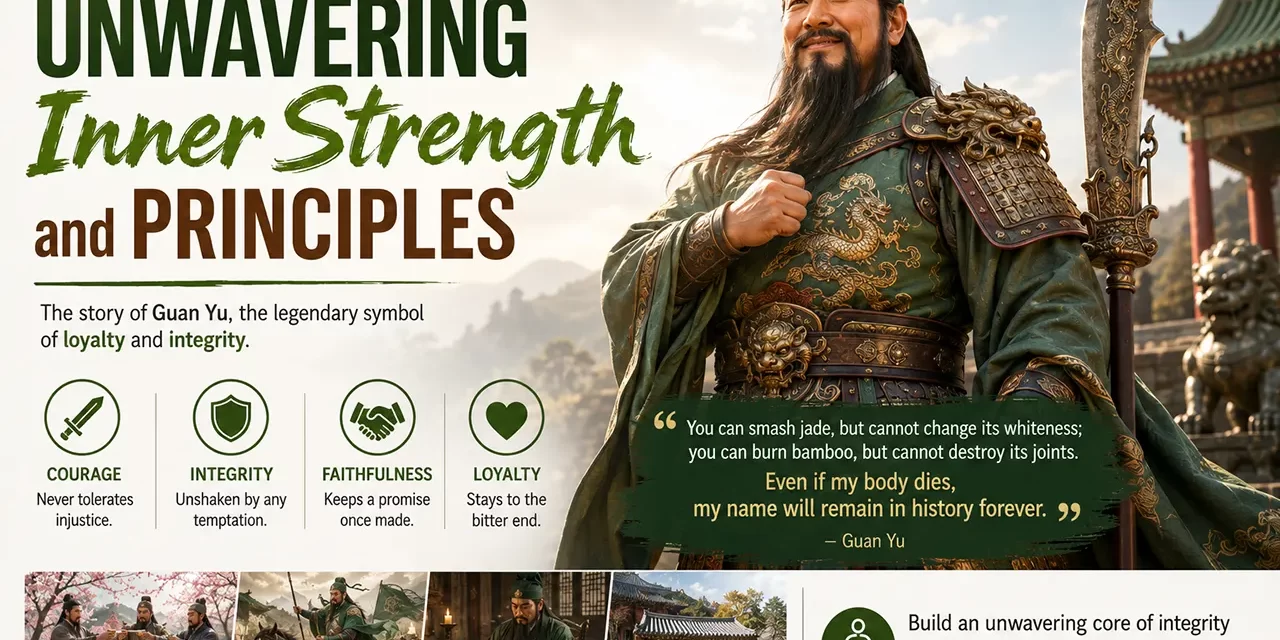
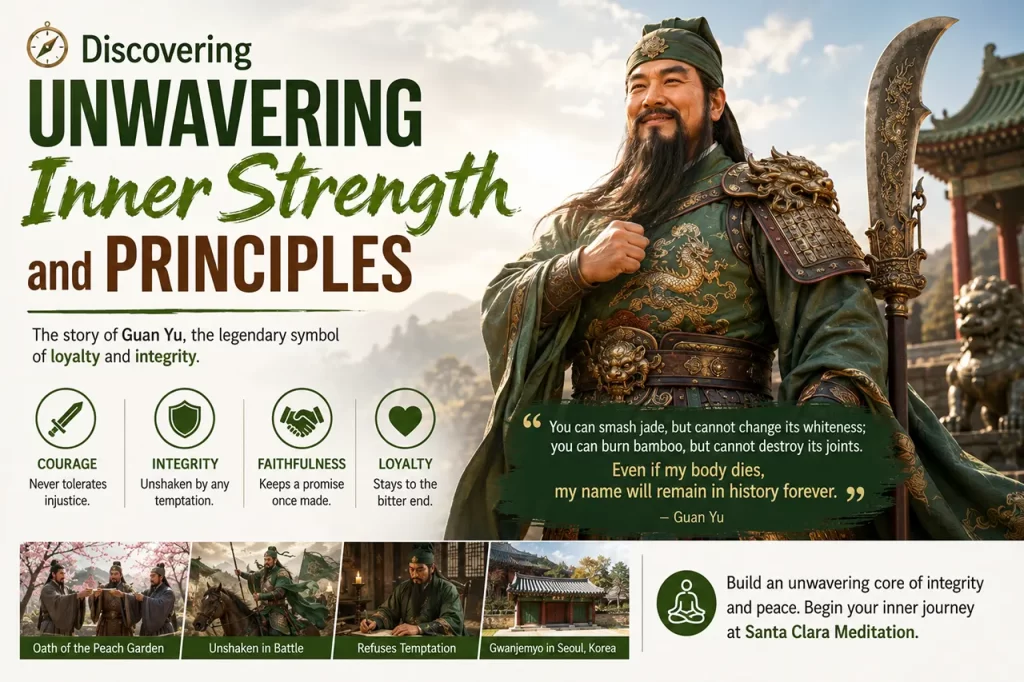
🧭 Discovering Unwavering Inner Strength and Principles
Welcome back to the Santa Clara Meditation blog! In a previous post, we explored the Korean “Euri” (loyalty) craze sparked by actor Kim Bo-sung and how living a principled life leads to true success. Today, we are taking a step back into history to look at a figure who embodied this unwavering mindset on an absolute, epic scale.
At our meditation center, we guide individuals toward finding a centered, steadfast mind that remains unshaken by the chaotic world around them. Historically, few people have demonstrated this level of unbreakable inner focus and loyalty better than the legendary general, Guan Yu.
Let’s explore why this historical figure became a symbol of ultimate integrity, and how his magnificent loyalty (“Euri-euri”) can inspire our own inner journey today. ✨
🏛️ The God of Loyalty: Who is Lord Guan?
Among the countless characters that appear in the classic Romance of the Three Kingdoms, there is only one who became an object of worship: Guan Yu.
Everywhere you go in China, you can easily encounter statues of Guan Yu, and the public reveres him, calling him Lord Guan (Guan Di, 關帝). Not only in China, but shrines have been built in various countries like South Korea, Japan, Taiwan, Thailand, and Singapore, where he is revered as a figure of faith.
Why has a mere military commander—not even the head of a state—been respected by people for such a long time and elevated to the status of a god?
Na Chae-hoon, the author of Guan Yu’s Theory of Loyalty, finds the profound reason in Guan Yu’s unwavering loyalty.
👊 Guan Yu’s Loyalty: The Ultimate “Euri”
“Dae-do-mu-mun. If you walk the righteous path, nothing can stand in your way. It means do not resort to Machiavellian tricks. The greatest move in this world is Mu-su (no calculation)… You just keep moving forward without overthinking. Just with loyalty.”
Kim Bo-sung, the man who sparked the modern Euri craze, shared this powerful philosophy. In a word, if Kim Bo-sung brought about the Euri craze, Guan Yu can be described as a historical giant of an “Euri-euri” (magnificent/grand) era who showed where the absolute limit of that loyalty lies! (^^)
Just as Kim Bo-sung described, Guan Yu was the very incarnation of loyalty, living only by righteousness and faith without ever resorting to trickery. He possessed a character so steadfastly honest that once he made a friend, he stayed with them to the bitter end.
He was a man entirely without pretense, equipped with:
- ⚔️ Courage to never tolerate injustice.
- 🛡️ Integrity to remain unshaken by any material temptation.
- 🤝 Faithfulness to keep a promise once made.
After making the famous Oath of the Peach Garden with Liu Bei and Zhang Fei, Guan Yu never betrayed that loyalty under any circumstances, dedicating everything he had to fight for them.
🏔️ Unshaken by Temptation or Threat
Throughout his life, Guan Yu’s loyalty was severely tested. Cao Cao showed him every possible sincere devotion to make Guan Yu his subordinate, showering him with gifts and titles, but Guan Yu never gave in and maintained his loyalty to Liu Bei.
Later on, Sun Quan also tried to tempt him using every means necessary. There is a famous anecdote regarding this:
It was when Guan Yu was in the direst of situations, relying on a small fortress called Maicheng while waiting for reinforcements. Sun Quan, from the enemy camp, sent Zhuge Jin to persuade him, suggesting a marriage alliance to defeat Cao Cao together.
Guan Yu’s response at that time was nothing short of legendary:
“I am but a nameless warrior from Xiezhou, yet I have received the grace of being cared for like a brother’s own hands and feet by my lord, Liu Bei. How could I abandon righteousness and go to an enemy state? If this city falls, I will merely die. Is there not an old saying: ‘You can smash jade, but you cannot change its whiteness; you can burn bamboo, but you cannot destroy its joints.’ Even if my body dies, my name will remain in history forever, so do not speak another word and leave this place quickly.”
Ultimately, Guan Yu was beheaded by Sun Quan in the 12th month of the 24th year of Jian’an. He was 60 years old.
🌟 A Timeless Symbol of Integrity
Although Guan Yu exited the stage of history in a lonely manner, he took root in the hearts of the people as the ideal human being and the ultimate image of a leader.
Successive emperors of China sought to make his virtues of faith, loyalty, and righteousness widely known as an exemplar for the people. Thus, elevated from a general and a marquis to a king, an emperor, and eventually a god, he stood tall as an object of worship. Exactly as he predicted, his name has remained in history forever.
Think about the sheer power of a mind that possesses:
- Loyalty that does not change in the face of any temptation.
- Courage to stand up against injustice.
- A heart that repays grace even at the risk of one’s life.
- A dignified presence that does not waver even in perilous situations.
Just thinking of someone like Guan Yu makes you feel incredibly secure. Conversely, thinking of a betrayer like Lu Bu leaves a bitter taste.
In our current era, the person we deeply desire and miss the most might just be someone like Guan Yu. Looking at his life makes us reflect once again: How should we live? Which path is the right one?
If you want to clear your mind of selfish calculations and build an unwavering core of integrity and peace, we invite you to begin your inner journey with us at Santa Clara Meditation. 🌿
📚 Reference:
This article was summarized based on Why We Must Look at Guan Yu Again Now (Guan Yu’s Theory of Loyalty) (Na Chae-hoon | Boas).
P.S. Did you know that there are also shrines housing Guan Yu’s ancestral tablets, called Gwanjemyo (Shrines of Lord Guan), right here in Korea? “Dongmyo” (Donggwanwangmyo, meaning the Shrine of King Guan in the east of Seoul), located in Sungin-dong, Jongno-gu, Seoul, is one of them. It is the largest and best-preserved architectural relic among all existing shrines dedicated to King Guan. The city of Seoul recently designated 37 artifacts within Donggwanwangmyo as tangible cultural properties of Seoul.
