
Welcome back to the Santa Clara Meditation blog! 🌱
These days, many people practice meditation as part of their daily routine. It is common to hear that just 5 minutes of morning meditation can clear your head and change the quality of your life.
With just a few deep breaths, the brain begins to move and create new substances; even a few minutes of maintained stability changes the structure of the brain. Today, let’s explore exactly why these changes occur and uncover the incredible effects of meditation revealed by neuroscience! 🕊️
🌿 1. Meditation Relaxes the Mind and Body
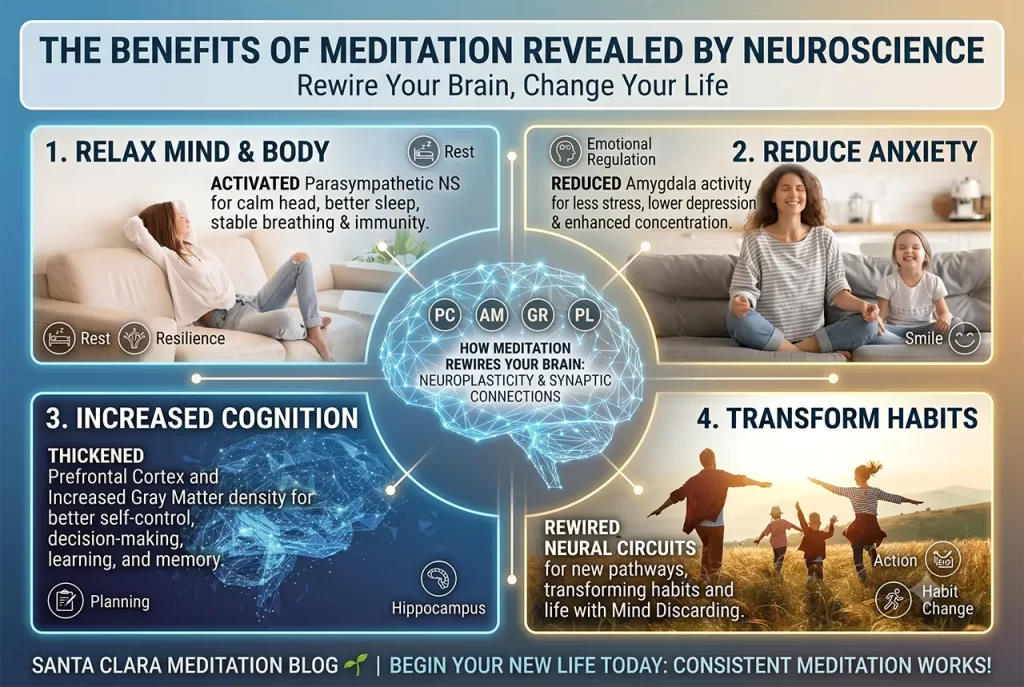
The primary effect of meditation is the relaxation of the body and mind. When the body and mind relax, the parasympathetic nervous system is activated, softening the heartbeat and adjusting the body to a state of relaxation.
Let’s examine the effects of activating the parasympathetic nervous system:
- Your head becomes clear: Our brains are filled with thoughts all day long. When there are too many thoughts, fatigue accumulates. When you meditate, random thoughts disappear, naturally making your head clear and improving your memory.
- Insomnia is improved: Sleep deprivation disrupts the immune system and makes life feel lethargic. By practicing Ma-eum Su-ryun meditation, you can discard thoughts. This relaxes the entire body and releases tension, allowing you to sleep comfortably.
- Blood pressure normalizes: Activities related to blood pressure, heart rate, and respiratory regulation increase, which is highly beneficial for high blood pressure and heart disease.
- Breathing stabilizes: Immersion in breathing stops thoughts, releases tension, and changes brainwaves. Slow and regular brainwave changes bring about psychological stability.
- Immunity is boosted: The secretion of the stress hormone cortisol decreases, strengthening resistance to disease and brightening the mind.
💡 What is the Parasympathetic Nervous System? The autonomic nervous system is divided into the sympathetic (fight-or-flight) and parasympathetic (rest-and-digest) systems. When you rest or meditate, the parasympathetic nervous system is activated. It softens the heartbeat, dilates blood vessels, and relaxes the mind and body, leading to improved health.
😌 2. Meditation Reduces Feelings of Anxiety, Fear, and Stress
We feel anxiety and fear because the amygdala is activated. The amygdala is activated when we face unfamiliar situations or when unpleasant past experiences come to mind.
When you meditate, you objectify the situation and distance yourself from your life experiences. By escaping from your own emotions, you break free from anxiety, deactivating the amygdala and leading to these ripple effects:
- Stress and depression decrease: When the activity of the amygdala decreases, your anti-stress index rises, depression decreases, and your emotional regulation ability improves. By discarding the mind (thoughts) through meditation, feelings of anxiety and stress are discarded along with them.
- Concentration improves: What hinders concentration are countless random thoughts. When the body is comfortable, alpha waves flow smoothly. When alpha waves appear, endorphins are secreted, enhancing brain functions such as memory, attention, and creativity.
💡 What is the Amygdala? The amygdala is called the ’emotional brain.’ It processes emotions and plays an important role in the learning and memory of fear, dread, and anxiety.
🎯 3. Meditation Enhances Problem-Solving and Self-Control
Damage to the frontal lobe leads to cognitive impairment and decision-making disorders. However, regular meditation leads to structural changes in the brain, such as the thickening of the prefrontal cortex.
- Positive emotions are developed: Neuropsychologist Richard Davidson reported that meditation leads to greater dominance of the left prefrontal cortex, showing psychological satisfaction and optimism.
- Cognitive ability and problem-solving skills improve: When you meditate, the thickness of the cortex increases, and cellular activity occurs vigorously.
- Emotions are regulated and self-awareness improves: Through regular training, emotional regulation ability by the prefrontal cortex is greatly improved.
💡 What is the Frontal Lobe? The frontal lobe is related to high-level cognitive functions. It is involved in planning and executing tasks, decision-making, self-control, and social behaviors.
📈 4. Meditation Increases Brain Function and Activity
Meditation is a brain activity focused inward. It is known that this activity increases the density of gray matter in the brain. More gray matter means more nerve cells, allowing you to efficiently receive, classify, process, and store information.
- Learning ability improves: The hippocampus is involved in memory and learning. When stress decreases, the gray matter density of the hippocampus increases, improving learning ability and resilience.
- Physical senses develop: The higher the gray matter density of the brain cortex, the more developed physical senses and motor functions are.
- Brain plasticity activity becomes active: Higher gray matter density leads to more active brain plasticity through new nerve cell and synapse activity.
💡 What is Brain Plasticity (Neuroplasticity)? It is the ability of the brain to reorganize information through learning and change neural circuits on its own. The brain’s circuits become dense and broad with stimulation, and sparse and narrow without it.
🌅 Rewire Your Brain and Change Your Life
All human activities are performed by the brain’s commands. If the brain changes, life can change. Meditation continuously promotes neuroplasticity by generating and increasing substances that promote new neurons and synaptic connections.
When you persuade the brain through repeated effort and new paths are created, you finally begin to live the new life you desire.
The most effective way to persuade your brain is meditation. Ma-eum Su-ryun (Mind Subtraction) helps you repeatedly discard the mind that created your old habits. If thoughts change, actions change; if actions change, habits change; and if habits change, your life changes.
We hope you meditate consistently and enjoy the life you truly want! ☕✨
