
Sleep accounts for about one-third of our lives and is an essential time for recovering and regenerating the brain and body.
- During sleep, the brain removes toxic substances accumulated throughout the day, organizes and forms memories, and maintains various cognitive functions such as attention, concentration, creativity, emotional processing, and judgment.
- It also plays a crucial role in strengthening immunity and forming long-term immune memory.
However, excessive stress in modern society, a culture of late-night drinking, and the use of smartphones and computers disrupt high-quality sleep. The number of patients with sleep disorders in South Korea has skyrocketed from 100,000 in the 2000s to about 750,000 in 2023. Because temporary relief through sleeping pills can lead to tolerance and worsening of symptoms in the long run, effort is needed to restore deep and comfortable sleep through natural methods without side effects.
🌙 The Scientific Mechanism of Meditation and Sleep
Recently, as scientific research on the effects of meditation has been conducted, many medical professionals and scientists are paying attention to meditation as a method to improve sleep quality without side effects.
To understand this principle, we first need to understand our body’s autonomic nervous system.
- The autonomic nervous system is divided into the sympathetic nervous system and the parasympathetic nervous system.
- The sympathetic nervous system is responsible for activity and arousal, while the parasympathetic nervous system handles rest and recovery.
- During the day, the sympathetic nervous system is activated, and at night, the parasympathetic nervous system is activated for rest.
- Our bodies are surprisingly and delicately designed so that this transition occurs in a balanced and natural way.
However, excessive stress, irregular lifestyle patterns, and an overload of stimulating information keep our brains in a constant state of arousal, preventing an easy transition to rest mode even when we lie in bed at night. The endless stream of thoughts in our heads continuously activates the sympathetic nervous system, leaving the parasympathetic nervous system powerless. If this state persists for a long time, the balance of the autonomic nervous system is ultimately broken, leading to sleep disorders.
Consistent meditation helps restore the broken balance of the autonomic nervous system to its original state.
- As distracting thoughts and stress disappear, the mind and body stabilize, and the suppressed parasympathetic nerve regains its strength, naturally activating at the right time.
- It has been confirmed that meditation reduces the secretion of the stress hormone cortisol and instead increases the secretion of serotonin and melatonin, which provide feelings of happiness and tranquility.
- Melatonin, in particular, is a key hormone that regulates our body’s biorhythms and plays a crucial role in restoring a natural sleep-wake cycle.
📊 The Effect of Ma-eum Su-ryun Meditation on Improving Sleep Quality
Many people who have experienced Ma-eum Su-ryun meditation, which fundamentally resolves stress, report that their quality of life has transformed due to its effect on improving insomnia. These effects have been verified through scientific research.
A research paper on the effect of Ma-eum Su-ryun meditation on improving sleep quality was published in the American journal Cancer Nursing.
- This study was conducted on breast cancer survivors at a university hospital in South Korea, involving medical staff such as nursing and medical school professors from home and abroad, as well as specialized meditation education institutions.
- Even after medical treatments are completed, cancer survivors suffer psychological distress due to the fear of recurrence and memories of the pain experienced during the treatment process.
- According to the researchers’ analysis, this is due to causes such as lowered self-esteem, negative body image, fear of recurrence, anger toward oneself and others, and uncertainty about the future.
- Because of this mental distress, many people complain of physical fatigue and insomnia even after being declared fully cured.
The research method was a randomized controlled trial involving 52 female volunteers between the ages of 30 and 60 who had completed breast cancer treatments within the past 2 years and 6 months.
- Fifty-two volunteers were assigned via a simple randomization procedure: 26 to the Ma-eum Su-ryun meditation group (MSM) and 26 to the Self-Management Education group (SME).
- Each group received guidance through their respective programs for 2 hours per session, twice a week for 8 weeks.
- The Ma-eum Su-ryun meditation group was guided to reflect on and discard their difficult minds according to the meditation method.
- The Self-Management Education group underwent a lecture program on relationship improvement, communication skills, stress management, and breast self-examination.
Research Results:
- In the Ma-eum Su-ryun meditation group (MSM), 90.9% (20 people) reported poor sleep quality before meditation, and only 9.1% (2 people) reported having no sleep problems.
- However, after meditation, the proportion reporting poor sleep quality decreased to 54.5% (12 people), and 45.5% (10 people) reported good sleep quality.
- Out of the 20 people who reported poor sleep quality, 8 of them shifted to experiencing good sleep quality after meditation.
- In contrast, 70.9% of the group that received Self-Management Education reported poor sleep quality in the pre-test, but this figure actually rose slightly to 83.4% after the education program.
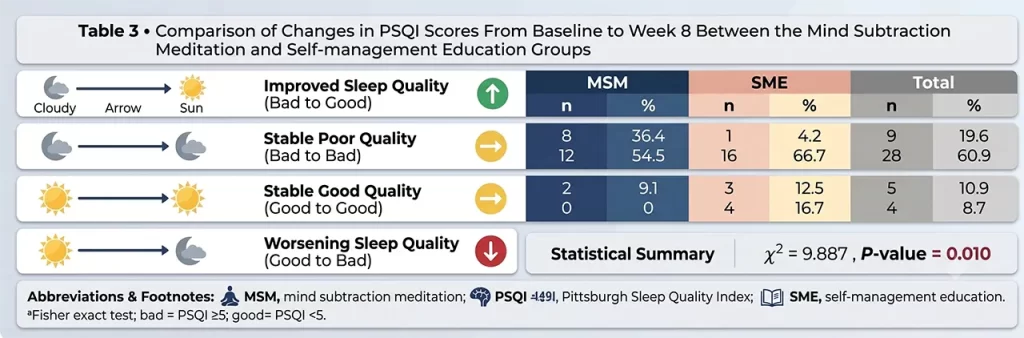
These results showed a statistically significant difference (χ2=9.887, P=.010), meaning that while self-management education failed to improve sleep quality, meditation demonstrated a substantial effect on improving sleep quality. In addition to sleep quality, the Ma-eum Su-ryun meditation group demonstrated superior effects across all items regarding depression, anxiety, perceived stress, evaluation of cancer treatment, life satisfaction, and post-traumatic growth.
Based on these research results, the researchers suggest that Ma-eum Su-ryun meditation could be useful in managing psychological and spiritual distress and improving the quality of life and sleep in clinical settings for breast cancer survivors.
✨ A Refreshing Morning and a Vibrant Day with Ma-eum Su-ryun Meditation!
When insomnia improves, your quality of life changes dramatically. The very first thing you notice is the refreshing feeling when you wake up in the morning. The feeling of waking up from a refreshing sleep and feeling ready to start the day is a miraculous experience for those who have suffered from insomnia for a long time.
Many people who have escaped insomnia through Ma-eum Su-ryun meditation speak of happy changes in their lives, noting that they fall asleep quickly, their chests feel clear, their minds are lighter, headaches disappear, and their sensitive personalities soften.
Improving insomnia requires an overall improvement in lifestyle habits, such as a regular and healthy diet, moderate exercise, reducing caffeine, and staying away from smartphones before bed. However, it is truly not easy to change lifestyle patterns that have been habituated for a long time.
While Ma-eum Su-ryun meditation is effective in improving insomnia on its own, it also provides tremendous help in changing bad habits that were previously difficult to break. Just as consistent exercise builds body muscles, consistent meditation is like building the muscles of the mind, giving you the mental strength to move yourself exactly as you desire.
Day by day becomes a month, becomes a year, and becomes your life. Start another precious day given to you today refreshingly and vibrantly with Ma-eum Su-ryun meditation!
