

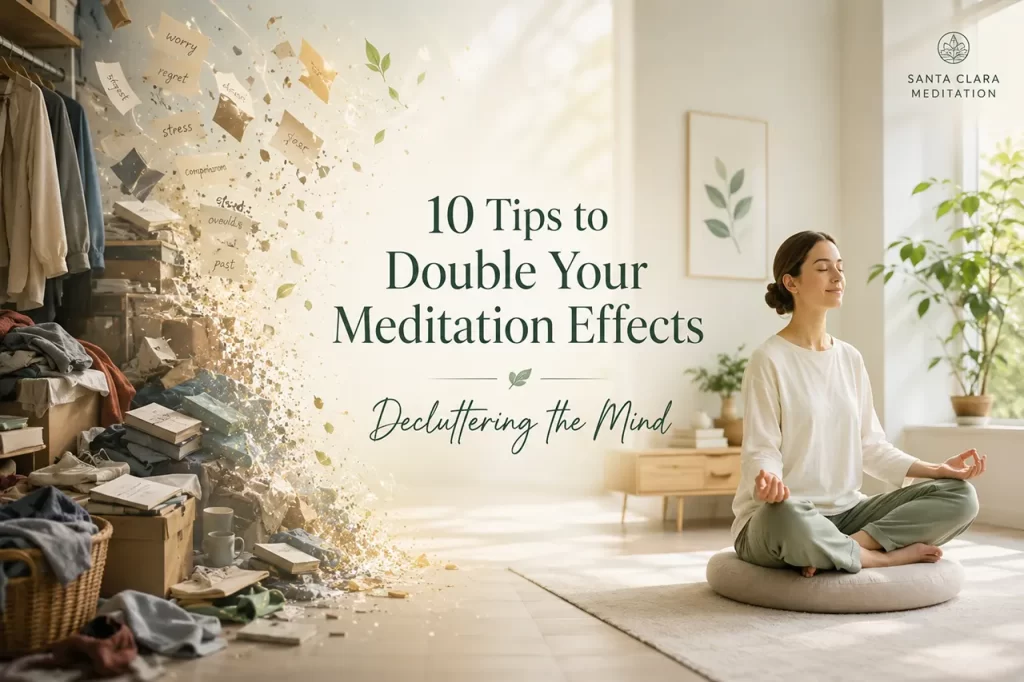
Welcome to Santa Clara Meditation! 🧘♀️ When you first sit down to meditate, you might find yourself flooded with doubts: “Am I really doing this right? Is my mind actually emptying?” Since the mind is invisible, the process of letting go can feel abstract and overwhelming at first. But what if emptying your mind was just like cleaning out a cluttered closet?
Recently, the minimalist bestseller Goodbye, Things by Fumio Sasaki highlighted the profound joy of discarding unnecessary physical possessions. Reading it, one beautiful truth becomes clear: discarding physical things and discarding the heavy baggage of the mind are remarkably similar! Today, we are sharing 10 powerful tips inspired by the rules of decluttering. Apply these to your meditation practice, and you will likely see your results more than double! 🚀
“Am I really meditating properly right now?” “Is this meditation actually working?” “How can I empty my mind well?”
These are common questions people might have when they first start Ma-eum Su-ryun meditation. Since the mind is invisible, it might feel even more difficult at first.
Recently, a book caught my eye at the bookstore: Goodbye, Things (by Fumio Sasaki). It was a bestseller in the self-help section. It is a book about the process of finding oneself and happiness by discarding the possessions that once filled one’s room. Reading it, I realized that discarding things and discarding the mind are not so different. 📖
So today, linking it to the rules for people decluttering for the first time as written in that book, I will share 10 tips that will help those just starting meditation. If you just check these tips and meditate today, your results will probably more than double. Haha. 😄
🗑️ 1. Discard the thought that you cannot discard it
How many things are in my room, my office, or on my desk? Many books, clothes, appliances, utensils… Usually, the items we effectively use make up only 20%. They say the remaining 80% are rarely used and just take up space. 📦
However, when it comes time to actually throw things away, we often can’t even dare to begin or fall into a sense of helplessness, thinking, “I can’t throw this away.” Decluttering begins with discarding that very thought: “I can’t discard it.”
Discarding the mind is exactly the same. When you first start meditating and look back at your mind, you see countless minds you’ve piled up unnecessarily. As you see them, you might feel overwhelmed, wondering, “Can I really discard all this?” But it is important to discard that thought. If you piled it up, you can discard it. Anyone can discard their mind. 🌬️
🛠️ 2. Discarding is also a skill
They say throwing things away requires skill, too. On the first day, throw away obvious trash; next, reduce books and CDs; then, discard appliances; then, process furniture as large waste… Just like that, in discarding the mind, it is important to properly understand the meditation method and do it in order. 🪜
In Level 1 of Ma-eum Su-ryun meditation, you initially repeat recalling the life you have lived in chronological order. At this time, it is important to recall accurately. It is important to repeat it. That is because only then can you see the minds you have piled up in detail. After that, you subtract those minds sequentially according to the method.
If you feel it’s not working well, you must check yourself: “Am I doing it according to the method right now?” If you aren’t sure, ask the meditation center’s Doum-nim (instructor) for help. Even if you are clumsy at first, as you check and try to follow the meditation method, the subtraction technique will automatically become ingrained in your body. Then, not only at the meditation center but also in your daily life, you can exercise the skill of mind subtraction whenever you encounter various problems. 💪
🎁 3. It’s not losing, it’s gaining
“What if I need it again?” “Is it really okay to throw it away?” People often hesitate to throw things away due to such fears.
However, those who have thrown things away say that if you boldly discard them, you actually gain a lot. A more spacious room, easier cleaning, time saved making choices, the freedom of not being obsessed with things… Discarding the mind is exactly the same. 🕊️
A free and comfortable mind, a clear head, the power to focus on the moment, the space to be considerate of others first, a new perspective to see things… I could go on endlessly about what I’ve gained as an effect of meditation that empties the mind. But the best thing of all was that, rather than struggling because I expected things from others or compared myself to them, I could focus on my inner self and become a confident person on my own. 🌟
🔍 4. Clearly figure out why you can’t discard it
There is this dilemma: no matter how many clothes are in your closet, you always feel like you have nothing to wear. Yet, you can’t easily throw away clothes you haven’t worn in years. You clearly don’t wear them, and you know you won’t wear them, so why can’t you throw them away? 👗
Is it because you bought it for a high price? Because someone gifted it to you? Because you feel like you might wear it someday? Because it feels like throwing away a memory? Out of vanity? Because it’s bothersome? It’s the same for other items. If you quietly ask yourself why you can’t throw it away and look into that mind, you strip away the useless bubbles and gain the power to actually discard it.
You started Ma-eum Su-ryun meditation to discard your mind. But why isn’t it being discarded? You need to ask yourself the reason. Is it because you feel like you’ll lose something if you discard this mind? One thing is certain: only the fake mind is discarded, and the true mind remains no matter how much you discard. 💎
🛑 5. It’s not that you can’t discard it, you just don’t want to
“When a man says he cannot do a thing, he is actually deciding that he does not want to do it.” — Spinoza
There may be many reasons why you can’t throw an item away, but if you look deep down, the biggest reason is that you don’t want to. Because it’s already a familiar lifestyle pattern, deep down you think, “Do I really have to change this?” 🛋️
If you look deeply into your mind, there is a mind that doesn’t want to discard these minds that have constituted “me.” Even though it’s a mind that makes you suffer. Also, due to the anxiety that you might lose something if you discard it, the thought “I don’t want to discard it” might reside in your subconscious.
Another way of saying “I can’t discard this mind” is “I don’t want to discard this mind.” Ask yourself sincerely if you really want to discard it. If you want to discard it, you can. 🗝️
⏳ 6. Discard it right now
“I’ll throw it away when I have free time after this urgent stuff,” “I’ll throw it away when things settle down a bit,” “I’ll throw it away someday.”
People often think this way while looking at their piled-up things. But unless you make up your mind right at this moment, that “someday” will never come. People who have decluttered say: it’s not that you can discard things when you are stable, but you become stable because you discard things; it’s not that you can discard things when you have time, but you gain time because you discard things. ⏱️
Discarding is the beginning of everything.
The mind is the same. If your attitude is, “I’ll discard it when I have some room to breathe, I’ll discard it when I get some time,” you will never be able to discard it. If you muster the will and discard it right now, you will begin to taste the joy of gaining breathing room, gaining time, and becoming free. 🌈
🚫 7. There is not a single mind you will regret discarding
“Compared to the past, I have reduced my possessions to about 5 percent. If I had 1,000 items, I threw away 950. Among them, there is not a single item I regretted throwing away.” — Fumio Sasaki, author of Goodbye, Things
While meditating, it’s hard to count in numbers, but I think I’ve discarded over 1,000 minds. If someone asks me, “Were there any minds you regretted discarding through meditation?” I can firmly say, “None.” It’s only a shame when you can’t discard them; once you discard them, you become incredibly comfortable. 😌
🕰️ 8. Do not obsess over the past
They say if you obsess over the past, nothing new will happen. Because if you don’t cleanly cut ties with items you needed in the past, the most important “present” will always be ignored.
The thing people starting meditation find hardest to discard is good memories of the past. A good time, happy memories with good people… They feel anxious that if they discard them, those moments will disappear. But don’t worry. You are discarding the remembered thoughts that only existed in your mind; the memory itself doesn’t disappear. 📸
If you keep a good time in your heart, you always judge the present against it. “I was so happy then, but I’m not now~” “Those were the good days…” Even happy memories of people, if constantly harbored in the mind, interfere with present human relationships. “They used to treat me well, why are they acting like this now?” “My old coworkers weren’t like this, these new coworkers are weird…” You are always living in the past.
Once you discard the mind of the past, you accept the present situation exactly as it is, and you fully meet the people you encounter in this moment. New encounters and new opportunities will come to you. 🌱
🖐️ 9. If you hesitated about 5 times, discard it
Even if it’s not a serious, firm resolution like, “Alright! Let’s throw it away!”, there are items you suddenly think about throwing away or items that casually catch your eye. They say if that thought has crossed your mind about five times, you can go ahead and throw that item away now. Because those five casual passing thoughts will undoubtedly develop into a hundred or a thousand times later. 💭
During daily life, the thought “I need to discard this mind…” often crosses your mind. Honestly, five times is quite mild. In my case, there were many times it crossed my mind dozens of times. If it has crossed your mind even once, let’s boldly discard it. The moment you act on that strong will to discard, you begin to break free from it. ✂️
❓ 10. Ask your mind if it’s truly necessary
“If this item were stolen, would you want to buy it again?” Let’s ask ourselves this to confirm if it’s truly necessary and precious. By asking this, you can tell whether it was an item you really needed or not.
Try asking your mind, too. “If this mind you wanted to discard disappeared, would you want to have it again?” I think I would vigorously shake my head “no.” 🙅♀️
💖 “Once you discard everything, the most precious thing becomes visible”
The author of Goodbye, Things said he discovered what was precious in life by reducing his possessions to a minimum. By breaking free from the suffocatingly piled-up items to the point of losing himself, and creating empty space in his home, he was finally able to find his own true value. 🏡
Actually, the reason why the principle of discarding things and discarding the mind must be the same is that discarding things is not just about the object, but a process of reflection—discarding the mind attached to the object.
Right now, I hope you empty the “mind piled up so full that you lose yourself,” and experience the joy of finding what is most precious to you, and the happiness of being filled exactly as much as you have emptied~^^ ✨
💡 Bonus TIP: Is my mind really discarded? (For those who are wondering)
I’d like to give a bonus tip for one of the most frequently asked questions by those just starting Ma-eum Su-ryun meditation: “Is the mind I discarded really gone?”
Yes, if you discarded it according to the method, it is truly discarded. However, the reason this doubt arises is that even though you discarded it, the same mind comes up again. But the truth is, it’s not the same mind! It is another mind that you had been piling up layer by layer all this time coming to the surface. 🌊
Let’s say there is a box of Kleenex here. 🤧 It’s a tissue box containing the minds you need to discard. No matter how many tissues you pull out and throw away, another tissue comes out. Just because a tissue comes out doesn’t mean it’s the same tissue. The tissues you pulled out are definitely discarded, and what remains are the minds you had piled up and haven’t discarded yet. For some minds, you’ve piled up so much that the amount of tissues might feel endless.
(For example, I had a very introverted personality and a lot of inferiority complexes. Because there were so many moments where I piled up inferiority in my mind, I realized it was inevitable that completely discarding my inferiority complex would take a lot of time.)
But as you discard and discard again, eventually there comes a moment when you can say, “Ah, the box is completely empty.” How light and free it feels to completely break out of that mind! Because you piled up a lot, discarding it requires an equal amount of patience. If you familiarize yourself with the 10 rules above and consistently do them one by one, the result will be truly invaluable. 🌅
