
Character education for youth is one of the most pressing social topics today. As students face unprecedented levels of stress and academic pressure, how can we equip them with the inner strength needed for true success?
A feature published by the Dong-A Ilbo explores how the answer is being found in meditation. By improving a critical psychological trait known as “intrapersonal intelligence,” mind subtraction meditation is proving to be a game-changer for youth development.
Here is a closer look at the research and real-world results.
✨ The Secret to Success: Intrapersonal Intelligence
According to Howard Gardner, a renowned educational psychologist at Harvard University, successful people commonly share one distinct trait: high intrapersonal intelligence. This is the ability to deeply understand oneself, recognize one’s own emotions, and accurately assess one’s strengths and weaknesses.
But can this intelligence be taught?
In 2015, Professor Lee Duk-joo of KAIST’s Department of Aerospace Engineering tested this theory. He uploaded a course titled ‘Engineering Self-Reflection for Human Completion’ on Coursera, a global massive open online course provider.
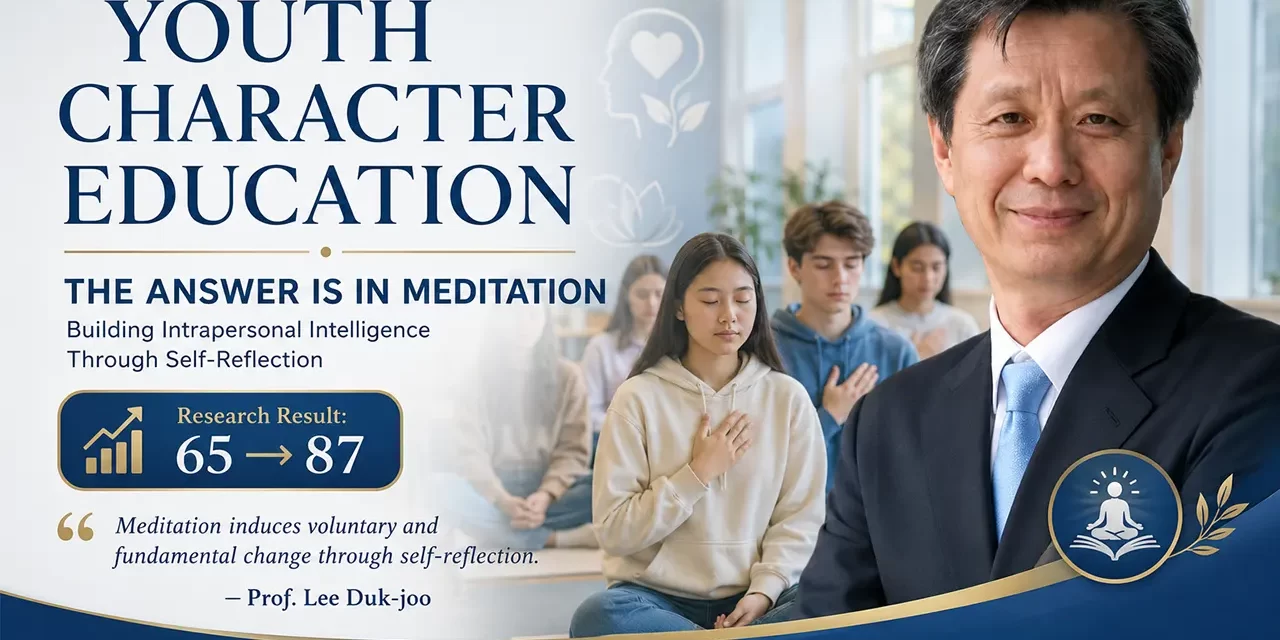
During the course, students learned mind subtraction meditation methods and actively practiced them. When Professor Lee surveyed the students regarding their intrapersonal intelligence before and after the course, the results were astounding: the average score jumped from 65 points to 87 points.
🔬 The Science of Mind Subtraction
Professor Lee, who has practiced mind subtraction for over 10 years and serves as the President of the Society of Human Completion Education, explains that mind subtraction means finding happiness by erasing the “images” stored in the brain—the heavy memories of the life one has lived.
“Meditation induces voluntary and fundamental change through self-reflection.” – Professor Lee Duk-joo
This method proved its immense value during a difficult time in 2011 when a series of student suicides occurred at KAIST. In response, Professor Lee opened special meditation lectures titled ‘Now is the Turning Point of My Life’ and ‘Exploration and Recovery of Human Nature’ to help students navigate their stress. His ongoing efforts will even see the opening of the Meditation Science Research Institute at KAIST.
🏫 Transforming Middle Schools
The positive effects of this practice are not limited to university students. During the 2017 Autumn Academic Conference sponsored by the Ministry of Education, educators presented empirical evidence of meditation’s success in younger students.
At the conference, titled ‘Character Education, Finding the Answer in Meditation’, several key figures shared their findings:
- Professor Kim Sung-chul (Dongguk University) delivered a keynote on how meditation builds character.
- Principal Lee Kang-il (Cheonan Ipjang Middle School) explained the transformative effects of meditation education currently operating under the free semester system.
- Professor Yoon Mi-ra (Chung-Ang University) presented her research paper confirming the measurable effects of school-based meditation education.
By allowing youth to voluntarily reflect on themselves and subtract their stress, meditation is providing the character education our society desperately needs.
Want to help your child develop the intrapersonal intelligence needed for a successful, happy life?
Contact Santa Clara Meditation today at 408-615-0435 to learn more about our mind subtraction programs tailored for students and families.
📰 About the Article
- Publication: Dong-A Ilbo
- Article Title: Youth Character Education, The Answer is in Meditation
- Published: November 24, 2017
- Reporter: Ji Myung-hoon
