
Welcome back to the Santa Clara Meditation blog! 🌱
“Am I the lead actor in my life, or a supporting role?”
To have a healthy mind, you must understand self-esteem, the “core muscle” of the mind. Self-esteem is vital because it is the mental strength that protects you. Just as a deep-rooted tree does not sway in the wind, a person with high self-esteem does not blame themselves harshly even when they make mistakes. They view failures or mistakes as a part of the learning process and focus on their own problems to try and solve them effectively.
When discussing self-esteem, it is often confused with pride (ego). First, shall we look at the difference?
Self-esteem refers to the perspective from which you view yourself. It is the mindset of acknowledging yourself exactly as you are in any situation. Ultimately, self-esteem is your answer to the question, “How do I see myself?” While pride is conscious of how others might treat you, self-esteem places “you” at the center. ✨
📊 1. Measure Your Self-Esteem
What is your level of self-esteem?
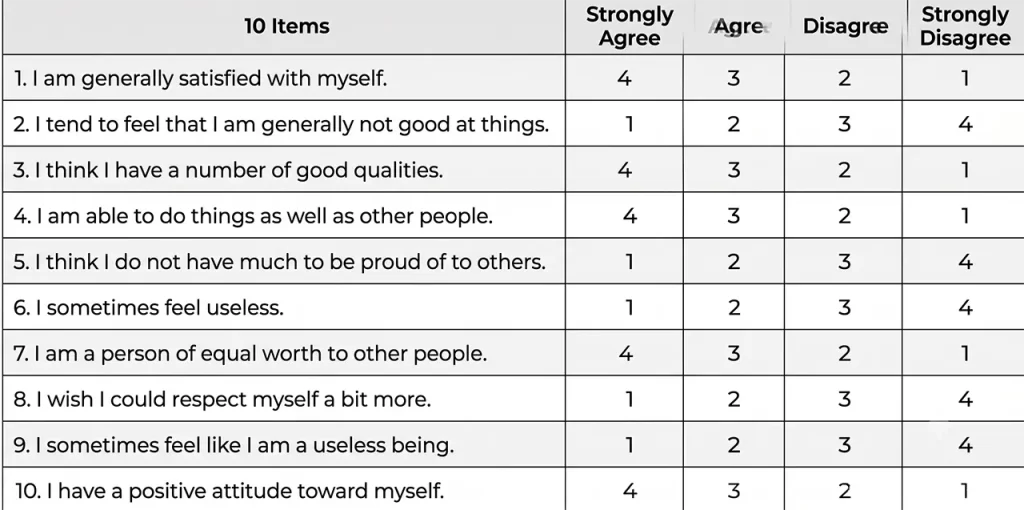
Devised by sociologist Morris Rosenberg, he defines self-esteem as a “positive evaluation or attitude toward one’s own value.” While the full test consists of 10 items, here is a quick look at how the measurement scoring works:
| Score Range | Self-Esteem Level |
| 10–19 points | Low level of self-esteem |
| 20–29 points | Average level of self-esteem |
| 30 points or more | High level of self-esteem |
🌧️ 2. Characteristics of People with Low Self-Esteem
- They are constantly conscious of others’ gazes.
- They accept external standards and the words of others as if they were everything in life.
- They blame themselves and fall into an inferiority complex, thinking, “Why can’t I do it like that person?”
- They package themselves because they are afraid of being honest.
- They avoid life’s problems or give up prematurely.
🌻 3. Ways to Boost Self-Esteem
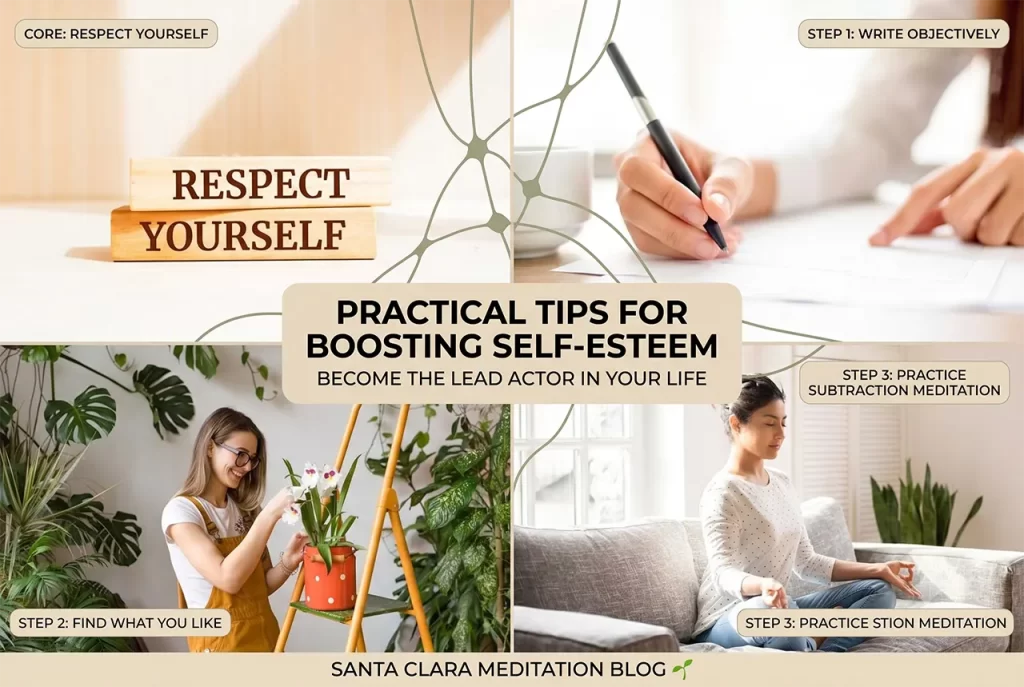
1) Write objectively about yourself
Having low self-esteem means the balance of your perspective is broken. This is because you are more conscious of external gazes than your own, causing your perspective to be biased to one side.
To regain this balance, you must understand why you are so conscious of others. Take time to look at yourself objectively by writing down what words and situations make you sensitive:
- The family environment you grew up in and your relationship with parents.
- Peer relationships during school days and interpersonal relationships at work.
- People who made life difficult for you, a specific remark, or past trauma.
2) Find what you like
Now, focus on your own voice. Keep asking yourself what you like and what you want. Because you haven’t listened to your inner voice while paying attention to others’ gazes, this might feel unfamiliar and difficult at first. Explore these areas:
- Things you like vs. things you do not like.
- Things you are good at vs. things you struggle with.
- Moments when you feel truly happy and joyful.
If you don’t know what you like or want right now, it is important to try various experiences. Try even very small hobbies like taking photos, visiting exhibitions, or riding a bicycle. The method of boosting self-esteem is no different from the process of finding yourself. Just as you naturally want to know more about someone you like, your self-esteem recovers the more you learn about yourself.
3) Practice Subtraction Meditation
Have you ever experienced acting without realizing it, or acting unconsciously? A person’s behavior is determined by their unconscious mind.
As you practice Ma-eum Su-ryun (Mind Subtraction) meditation, you realize that due to life experiences and genetic factors, you had no choice but to act and live as you did. Therefore, for your behavior to change, you must discard the thoughts and habits of the life you have lived.
Try discarding the minds accumulated through the life experiences and habits that you objectively wrote down about yourself. Just as you must empty a container to fill it, you must subtract your mind to transform into a person with a solid inner self and high self-esteem.
4) Accept yourself “as you are”
Through the three processes above, your center of gravity, which had been tilted toward others, gradually finds its balance. In the process of realizing, “I am this kind of person,” you gradually recover your lost self-esteem.
At some point, you realize that the gap between “me” and “you” is not a deficiency, but simply a difference. As your own standards emerge one by one to replace the standards of others, you are no longer easily shaken. You gain the mental strength to accept yourself exactly as you are. 🕊️
🎬 Be the Lead Actor in Your Life
The lead actor on the stage of life is you. However, haven’t we sometimes been living as supporting actors in the corner of the stage? Have you neglected your stage and allowed others to stir it up?
A person with high self-esteem is the “lead actor.” Standing in the middle of the stage, they might feel nervous, but they stand firmly and face it head-on. Even if they make a mistake and fall, they view it as a part of the learning process and get back up.
We all have different environments and backgrounds. That is why the way to get back up after falling is different for everyone. Nevertheless, we often live as if other people’s methods are the only correct answer. What if we poured that energy into finding our own way instead? Only then can we finally face our confident selves. In this way, we are all special beings! ⛵✨
