
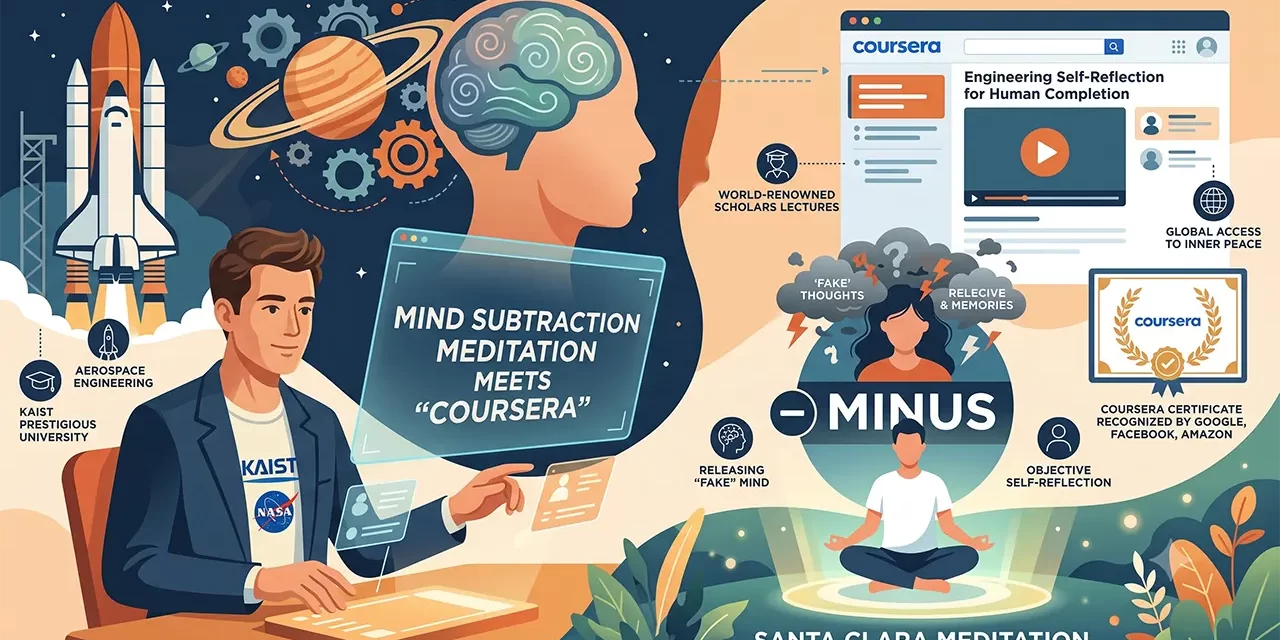
What happens when a world-class aerospace engineer turns his attention from space launch vehicles to the inner workings of the human mind?
According to a feature published by Newswire, a groundbreaking self-reflection meditation course launched by Korea’s prestigious KAIST on Coursera has drawn massive global attention. The course, titled ‘Engineering Self-Reflection for Human Completion’, bridges the gap between hard science and profound inner peace.
Here is a look at how this unique program is introducing the science of mind subtraction to the world.
🌐 A Global Classroom for Self-Reflection
Coursera is a premier online education platform featuring lectures from world-renowned scholars at leading universities like Stanford, Harvard, MIT, and KAIST. With over 1,500 courses and more than 17 million members, it is a hub for global learning.
Professor Lee Duk-joo of KAIST—an authority in aerospace engineering—took to this platform to teach a 6-week, 46-lecture course in English. The curriculum introduces the necessity of self-reflection, its foundational principles, and the mind subtraction methodology for self-transformation. By combining philosophy with engineering and brain science, the course explains the human mind in a clear, easy-to-understand way.
🚀 From NASA to Inner Peace: Who is Professor Lee?
Professor Lee Duk-joo is not your typical meditation instructor. After receiving his master’s and doctoral degrees from Stanford University, he worked as a researcher at NASA before joining KAIST in 1988. He has played a major role in Korea’s aeronautical engineering, participating in the development of Surion (Korea’s first helicopter) and the launch of Naro (Korea’s first space launch vehicle).
So, why did an aerospace engineer begin teaching meditation?
Four years prior to the course launch, following a series of tragic student suicides at KAIST, Professor Lee recognized a desperate need for character education. He launched on-campus meditation courses titled ‘The Turning Point of My Life’ and ‘Exploration and Recovery of Human Nature’. The tremendous response from students laid the foundation for his global Coursera program.
💡 The Power of Mind Subtraction
The core of Professor Lee’s teachings revolves around the mind subtraction meditation method, a scientific practice popularized since 1997.
During the course, students experienced profound shifts:
- Releasing the “Fake” Mind: One student shared that after recalling an unhappy memory during a lecture, they realized the feeling was simply an illusion—or “fake.” This realization left their body and mind feeling lighter, leading to a day filled with tranquility.
- Profound Simplicity: A working professional noted that while the principle of subtraction is simple, truly grasping it is profound, even requesting a next-level course.
Professor Lee explains the mechanism simply:
“Through the mind subtraction meditation method, which is based on self-reflection, one can objectively look back on the life they have lived. If you eliminate negative minds through meditation, the positive power within you will be revealed, and you will be able to learn how to live a free and complete life.”
🏅 The Value of “Human Completion”
This self-reflection meditation is categorized under the humanities, education, and engineering fields on Coursera. Beyond personal growth, completing courses on this platform carries significant real-world value. Innovative companies like Google, Facebook, and Amazon recognize Coursera certificates during the hiring process, and academic credits can be granted by international education councils.
By taking the time to empty the mind, students are not only gaining a competitive edge in their careers but are taking the most important step toward Human Completion.
📰 About the Article
- Publication: Newswire
- Article Title: Mind Subtraction Meditation Meets ‘Coursera’, an Online Course Platform by World-Renowned Scholars
- Published: January 19, 2016
