


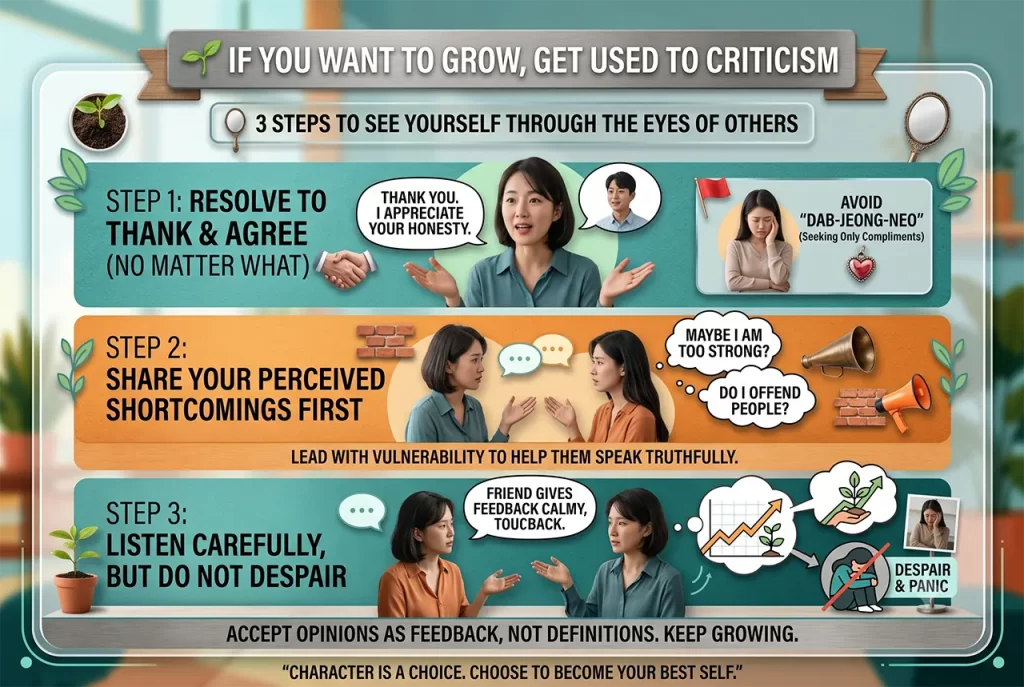
🪞 3 Steps to See Yourself Through the Eyes of Others
Have you ever wondered what people really think of you when you leave the room? Do they see you as a strong, capable leader? A warm, approachable friend? Or… perhaps something entirely different?
In our previous post on the Santa Clara Meditation blog, we explored how the global leaders we respect and love simultaneously exhibit two key elements: strength and warmth.
But this brings up a crucial, sometimes uncomfortable question: How are you truly reflected in people’s eyes? What do you need to fix in order to communicate better with the world around you?
The Harvard communication experts who authored Compelling People (What Kind of Person Rises to the Top) share a hard-hitting truth in their chapter on “How Great People Are Made”: If you want to grow, get used to criticism.
They suggest the absolute best way to start is by asking a close friend for an honest assessment of yourself. Here are 3 steps to do it right, without ruining the friendship!
🛡️ Step 1: Resolve to Thank and Agree (No Matter What)
A close friend can see you much more objectively than you see yourself. However, getting an honest assessment from them might not be easy. They might be reluctant to speak truthfully for fear of hurting your feelings.
So, when you ask, you must first resolve to unconditionally thank them and agree with them, regardless of what their opinion is. Approaching them like a Dab-jeong-neo (a popular Korean slang meaning “The answer is already decided, you just need to give it to me”) is highly dangerous!
Secretly hoping for compliments, wanting to be reassured, or asking for an assessment while being highly sensitive is a huge No-No!
🚩 A common ‘Dab-jeong-neo’ situation you should really avoid:
You: “Hey… what do you think my problem is? It feels like people are avoiding me lately.” Friend: “What? Problem? Um…” You: “No, don’t worry, just tell me honestly… Do you really think I have a problem?” Friend: “Um… (reading the room slightly) The thing about you, from what I see…” (Your expression suddenly becomes sensitive and starts to darken…) Friend: “Actually, from what I see, you have no problems at all. Yeah… absolutely not… If people are avoiding you, those people are the ones who are really weird!” (Your expression suddenly brightens…) You: “Thank you… You really are my best friend who knows me best…”
🗣️ Step 2: Share Your Own Perceived Shortcomings First
Make it easier for your friend by explaining exactly why you are asking and sharing where you think you might be falling short.
“I feel like I haven’t been communicating well with people lately. So I’m trying to figure out the cause. Maybe I’ve been offending people. Or maybe I’m showing too strong an attitude and severing relationships. But I really can’t pinpoint a specific reason. It’s just a general feeling.”
By starting the conversation and presenting possible problems yourself, your friend can talk about you much more comfortably. If your guesses are wrong, they can put your mind at ease while gently guiding you to the real problem.
💡 Step 3: Listen Carefully, But Do Not Despair
If you went through steps 1 and 2 sincerely, there’s a high chance you received an incredibly honest assessment. But wait a minute! If you are a naturally timid person, there’s a huge possibility you’ll get caught up in those words, think “I’m full of problems,” and end up floundering in a pit of despair.
Absolutely do not do that.
Accept your friend’s opinion seriously, but remember: no matter how reliable your friend’s thoughts are, it is just one opinion. If you heard something important during that assessment, explain to your friend what you think about what you heard and ask if your thoughts are correct.
Even if you hear a heap of highly constructive criticism, there is no need to panic. There is no need to struggle to solve all your problems at once. Just be happy that you can finally see yourself properly!
🌟 Character is a Choice
“Ultimately, character is not a matter of how you were born, but a matter of choosing what kind of person you want to become. People evaluate your character based on how you act, especially how you communicate with others.” — From Compelling People (p.119)
Hearing about yourself accurately and objectively requires considerable courage. The very fact that you are willing to try the steps above means you have ample potential to grow. Now that you’ve figured out what needs to change, the only thing left is to actually make those changes.
At Santa Clara Meditation, we know that stepping back to objectively view yourself is the core of self-reflection. We send our cheers to everyone trying to build great communication and genuine human relationships! ^*^
(Reference: This article was summarized based on ‘Compelling People’, written by John Neffinger and Matthew Kohut, translated by Park Soo-sung, Tornado Books).
