
Teachers play one of the most important roles in shaping the future.
They do more than deliver knowledge. They guide students’ character, support emotional growth, encourage confidence, and help young people learn how to live well with others.
But teachers themselves also need time to reflect, rest, and recover.
A 2015 summer training program introduced by the Society of Holistic Education focused on this important truth:
Happy teachers can become the beginning of true character education.
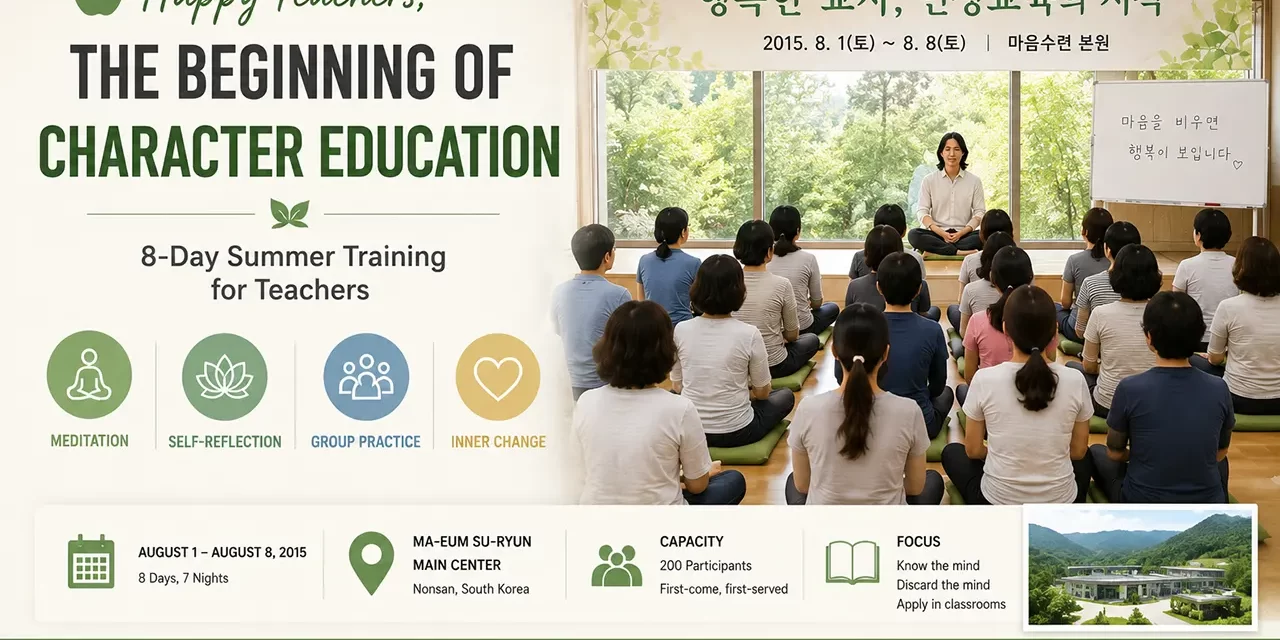
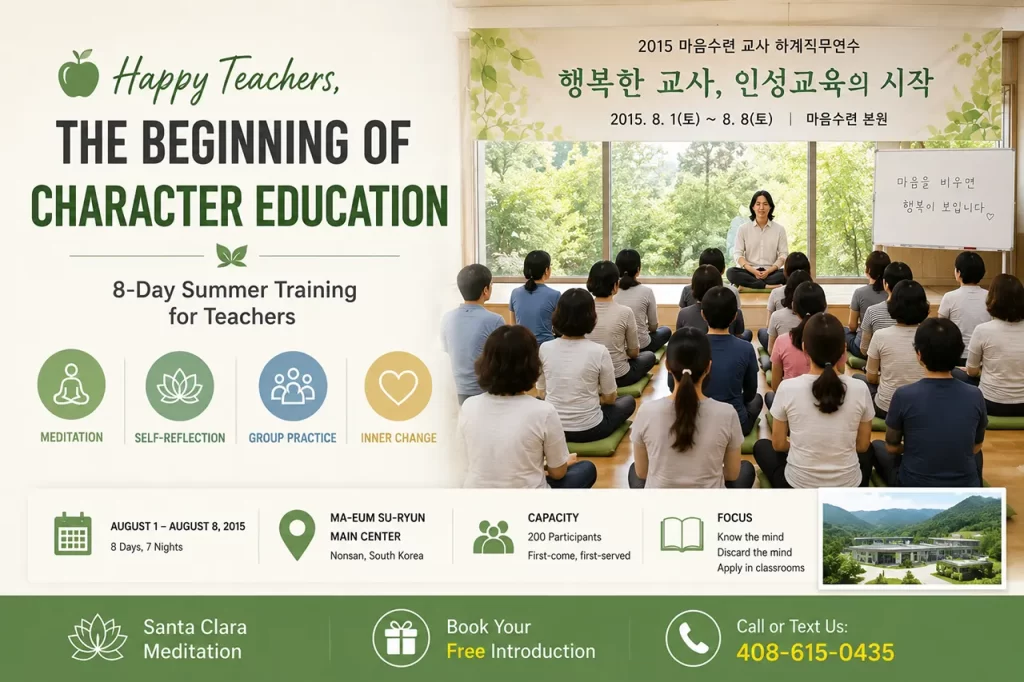
According to the article, the 2015 Ma-eum Su-ryun Summer Job Training for Teachers was scheduled to be held for eight days and seven nights, from August 1 to August 8, at the Ma-eum Su-ryun Main Center in Nonsan, South Chungcheong Province.
The training was titled:
“Happy Teachers, The Beginning of Character Education.”
🌱 HAPPY MEDITATION FOR TEACHERS
The subtitle of the program was:
“Happy Meditation, Looking Back at Myself.”
This phrase captures the heart of the training.
Before teachers can guide students with wisdom and warmth, they also need time to look back on themselves.
Teaching can be deeply meaningful, but it can also be emotionally demanding. Teachers often carry stress from classroom management, student relationships, parent communication, administrative responsibilities, and personal expectations.
The Ma-eum Su-ryun teachers’ job training was designed to help educators reflect on the mind, let go of accumulated stress, and recover inner happiness.
Rather than focusing only on teaching techniques, the program placed self-reflection and meditation practice at the center.
🔍 KNOWING THE MIND
The 2015 summer training included a substantial program focused on understanding the mind and practicing meditation in daily life.
The training covered topics such as:
• Knowing the mind
• The principles of how the mind is formed
• The effects of the mind
• Discarding the mind
Through these sessions, teachers could examine how thoughts, emotions, memories, and fixed ideas influence their daily lives and their relationships with students.
When the mind is filled with stress, judgment, pressure, or emotional burden, it can become difficult to teach with patience and openness.
But when teachers understand the mind and learn how to let go, they can become lighter and more peaceful within.
This inner change can naturally influence the atmosphere of the classroom.
💙 SELF-REFLECTION AT THE CENTER OF TRAINING
The article emphasized that the training was customized and centered on meditation practice.
The program was structured in diverse formats, including:
• Lectures
• Group meditation
• Small group meditation
• Individual meditation
This allowed teachers to learn not only through explanation, but also through direct experience.
Self-reflection was not treated as a theory. It was practiced step by step.
Through Ma-eum Su-ryun meditation, teachers could look back on the minds they had accumulated and practice discarding them.
This process helped participants move beyond temporary relaxation and experience a deeper kind of inner change.
🌿 CHARACTER EDUCATION BEGINS WITH THE TEACHER
The title of the training, “Happy Teachers, The Beginning of Character Education,” expresses a powerful educational message.
Character education does not begin only with curriculum.
It begins with the person who teaches.
When teachers become calmer, more self-aware, and more joyful, they can guide students with greater understanding.
When teachers let go of stress and emotional burden, they can communicate with students more warmly.
When teachers recover their original nature through deep self-reflection, they can become living examples of the character they wish to teach.
This is why the training connected teacher happiness with character education.
A teacher’s inner state can shape the emotional climate of the classroom.
📚 RESEARCH AND FIELD APPLICATION
The training was hosted by the Society of Holistic Education, which was established in 2008 to research and support holistic education and character education.
The society had developed expertise through academic research and field applications in areas such as:
• Pedagogy
• Psychology
• Nursing
• Preventive medicine
According to the article, the society had also published numerous research papers on teachers’ emotions and stress management.
Through continued studies on character education, it supported teachers who completed the job training in applying character education more substantially in real school environments.
This connection between research and classroom practice was one reason the training received strong evaluations from participating teachers.
🎒 PRACTICAL SUPPORT FOR THE CLASSROOM
The article noted that the Ma-eum Su-ryun teachers’ job training was highly evaluated because of both the effects of mind subtraction meditation and the practical structure of the program.
Teachers did not simply learn meditation for themselves.
They also explored ways to apply character education after returning to their schools.
The program included alternatives and guidance to help teachers bring what they experienced into the educational field.
This made the training meaningful not only as personal development, but also as professional development.
Teachers could return to their classrooms with a deeper understanding of themselves and practical tools to support students’ character growth.
🌟 A TRAINING PROGRAM WITH WIDE PARTICIPATION
The Ma-eum Su-ryun teachers’ job training began in July 2002.
According to the article, approximately 3,000 teachers had participated in the program by 2015.
The article also reported that around 85 schools nationwide were practicing character education through mind subtraction meditation, led by teachers who had completed the training.
This shows that the program was not limited to one-time personal experience.
It had grown into a broader educational movement, connecting teacher self-reflection with school-based character education.
🏞️ A NATURAL SETTING FOR DEEP REFLECTION
The 2015 summer training was scheduled to take place at the Ma-eum Su-ryun Main Center in Nonsan, South Chungcheong Province.
Surrounded by nature, the location provided an environment where teachers could step away from daily busyness and focus more deeply on self-reflection.
The training was planned as an eight-day, seven-night residential program.
With a capacity of 200 participants, registration was available on a first-come, first-served basis.
This setting allowed participants to fully immerse themselves in meditation practice, reflection, and renewal.
🍎 HAPPY TEACHERS CREATE HAPPIER CLASSROOMS
The article reminds us that education is not only about what teachers teach.
It is also about who teachers are within themselves.
When teachers are overwhelmed, students can feel that stress.
When teachers are peaceful, students can feel that peace too.
Through self-reflection and Ma-eum Su-ryun meditation, teachers can begin to let go of the minds that create stress and recover a more natural sense of happiness.
From that place, character education becomes more than a lesson.
It becomes something students can feel through the teacher’s presence, attitude, and example.
Happy teachers can create happier classrooms.
And happier classrooms can become the beginning of deeper character education.
📰 ABOUT THE ARTICLE
Article Title: Happy Meditation for Teachers, Summer Schedule Announced for Ma-eum Su-ryun Teachers’ Job Training
Published: May 7, 2015
