Welcome to Santa Clara Meditation! Surviving cancer is a monumental physical victory, but for many, the journey to true healing doesn’t end when the treatments stop. Often, the physical battle is replaced by a silent psychological one, filled with lingering anxiety, insomnia, and fear of recurrence. How do we care for the minds of those who have already fought so hard? In this profound post, we explore the inspiring results of a specialized Ma-eum Su-ryun (mind subtraction) meditation program designed specifically for cancer survivors. Read on to discover how guided self-reflection and meditation are helping survivors break free from depression, reclaim their inner peace, and step confidently into their new lives.
“It is so hard to fall asleep. Is there any way to sleep well?” “What if it recurs? What if it metastasizes somewhere else? If I die, who will raise my child… I constantly suffer from insomnia because of these fears.”
These are the psychological difficulties many patients experience after cancer treatment. The mental anguish suffered from the moment of a cancer diagnosis does not disappear even after being declared fully cured and continues to torment them.
How can one break free from that cycle and live a happier life?
We are in an era with over 1 million cancer survivors. It is a time when psychological treatment programs for cancer patients to care for their minds are desperately needed. Last December, a meditation program for cancer patients was held at the Songpa-gu Public Health Center in Seoul.
It was designed to treat post-treatment anxiety and depression using the Ma-eum Su-ryun meditation method, teaching participants how to control their minds in daily life and improve their quality of life. Officials state this holds great significance as the ‘first welfare program for cancer patients’ conducted by a public institution. What kind of changes did the participants experience?
‘A Happy Meditation Hope Program for You Who Overcame Cancer’(November 10 ~ December 11, 2015, 5-week course, 2 sessions per week, 10 sessions total)
Organized as part of a local cancer patient welfare program, it was jointly hosted by the Songpa-gu Public Health Branch, Visiting Health Care Center, Catholic University Department of Preventive Medicine, and the Society for Holistic Education. 16 survivors of breast, stomach, thyroid, oral, and lung cancer participated.
The program consisted of learning how to control the mind, meditation lectures, meditation practice, 1:1 counseling, and occupational therapy.
1. Recovery to Normal Levels of Depression and Insomnia After 10 Meditation Sessions
This meditation program ran for 5 weeks, twice a week, for 2 hours a day. As a result, all participants who showed mild depression before the program recovered to normal levels afterward, and insomnia symptoms also returned to normal. The participants’ life satisfaction, life expectancy index, and happiness scale all improved. For a change occurring in just 10 sessions, the effect was so significant that even the health center staff were highly surprised. They are reportedly considering running the meditation program for cancer survivors again this year.
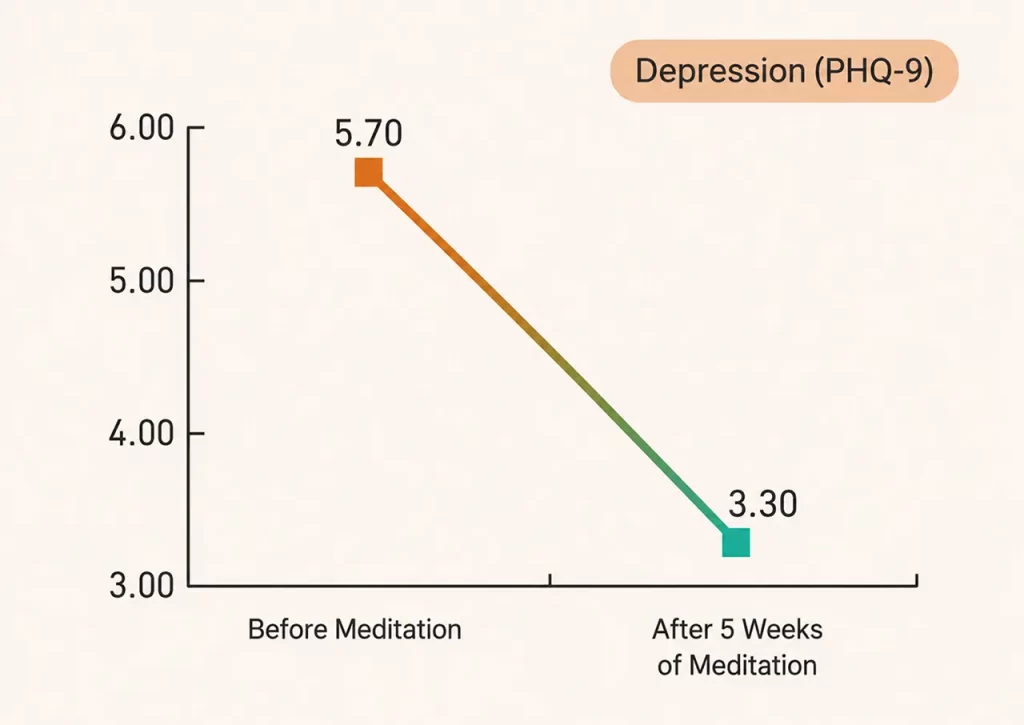
Depression: According to the Patient Health Questionnaire-9 (PHQ-9) results (where 5 points or higher is considered depression), participants recovered from mild depression (5.70) to a normal level (3.30). (p=.108)
“Through the meditation classes, my physical pain slowly began to decrease. It is so fascinating and unbelievable that my mind became peaceful and my pain eased just by recalling and discarding old memories. Thank you to the health center staff, instructors, and professors who planned such a good program for us to participate in.” — Kim / 44 years old, Songpa-gu Public Health Center Meditation Program Participant
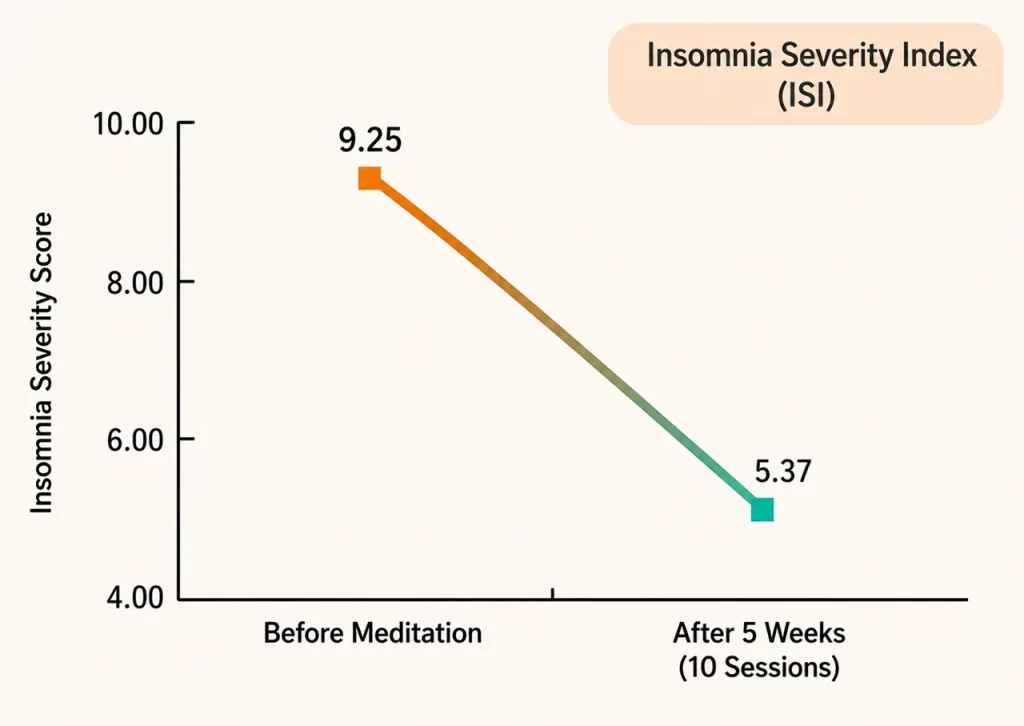
Insomnia: According to the Insomnia Severity Index (ISI) survey results (where 8 points or higher is considered insomnia), all returned to a normal level (5.37). (p=.115)
“Going through the pain, I felt like the sky was falling. Meditation led my mind to peace. I can sleep easily and deeply, so my dreams have disappeared. In particular, my feelings towards my husband, which were full of resentment, have changed. Now I can see his strengths and occasionally even compliment him, making our family harmonious. This program was a truly great opportunity to open my heart, which was closed due to pain, forget the past, and have a pure mind. Thank you, teachers.” — Heo / 62 years old
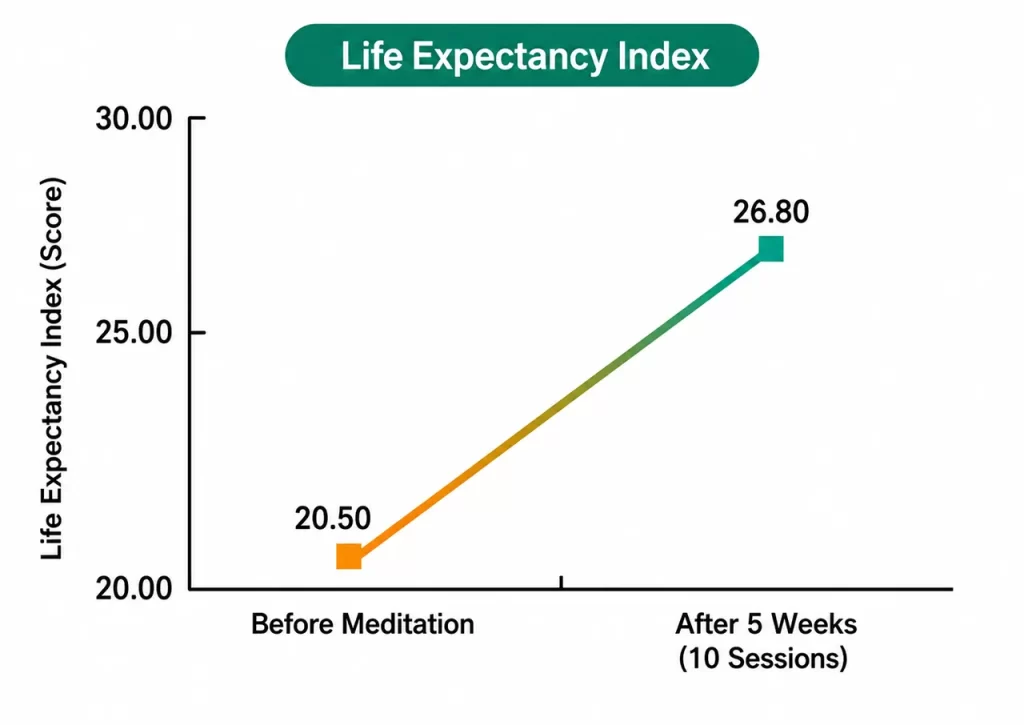
Life Expectancy: Life expectancy refers to the hope for the future that one’s life will get better. This improved to a significant level after meditation. (p=.001)
“I had heard the word ‘meditation’ a lot, but doing it for the first time, I felt, ‘This is really exactly what I need!’ I realized I had lived my life piling things up without ever throwing anything away! That’s why my mind was so complicated, agonizing, and exhausting! I see hope for the rest of my life to live freely and simply, controlling my mind, just as I had so desired.” — Kim / 67 years old
2. Why? The Process of Ma-eum Su-ryun’s ‘Subtraction Meditation’ That Discards Anxiety and Depression
Why could such a massive change occur? Professor Yoon Mi-ra of the Chung-Ang University Department of Nursing, who oversaw this meditation program, says the answer lies in Ma-eum Su-ryun’s subtraction meditation. Because you can look back on your life, examine the root causes of the minds that have tormented you, and discard them, you experience changes yourself.
“By discarding the feelings of hatred, resentment, and anxiety about the disease, my hatred decreased and my anxiety about the disease also disappeared. Once I die, greed and hatred will all be useless, so I don’t know why I kept my mind so full of them. After training to discard my mind, I practice it moment by moment in daily life, and my mind becomes so light.” — Lee / 49 years old
3. Attitude Towards Coping with Cancer: “Do Not Despair in a Difficult Mind Anymore”
Professor Yoon Mi-ra (the general program director) worked as an oncology clinical nurse specialist for over 10 years and is an expert in ‘nursing intervention programs for cancer survivors’, having received her Ph.D. from Seoul National University for her research on ‘The Effects of a Ma-eum Su-ryun Meditation Program for Breast Cancer Survivors on Psychological Well-being’. Professor Yoon is also a meditation expert who has meditated for a long time. Here is what she felt while running this program.
“Will my anxious and agonizing feelings really disappear if I meditate? I can’t sleep well, will that be resolved? Will my mind become peaceful?”
These were the questions participants asked most when the program first started. I tell them, “Yes, it is possible.”
There is a Korean proverb that says a person startled by a softshell turtle will be startled by a black pot lid. Even if a person is completely cured of cancer, if their body feels even slightly uncomfortable, they suffer from anxiety, wondering if it has recurred or metastasized. Once worry begins, it snowballs, and because of those worries, the body hurts even more.
After living diligently and then getting cancer, life feels futile, and feelings of resentment or disappointment toward one’s spouse, in-laws, and children grow. Because of those feelings, many people feel even more depressed and unhappy even after their long treatment ends.
In the meditation program, we guide them to discard these minds one by one. The psychological conflicts experienced during treatment, fear of recurrence, anxiety and worry, disappointment and resentment toward people around them… I was truly grateful to see people saying thank you, expressing that they became much more peaceful and free after reflecting on themselves and emptying their minds.
Because they were people who experienced the desperate situation of cancer, ironically, they had nothing but hope. They were people who knew how to turn even the smallest ember into hope. I learned a lot from them. Do not let your mind be imprisoned by the disease called cancer. You can absolutely overcome it.
References & Further Exploration:
An Alternative for Psychological Healing of Cancer Patients, Ma-eum Su-ryun Meditation / Interview with Professor Yoon Mi-ra
Hope Program! You Who Overcame Cancer / TBS ‘Seoul Today’
Yes, I am a cancer survivor. But that doesn’t define me. / TED Talk by Debra Jarvis
Debra Jarvis, who was diagnosed with cancer while working as a hospital chaplain for 30 years, says not to be trapped by the trauma of being a ‘cancer survivor’, but to use it for deep internal reflection, making it the beginning of a new, more authentic self being born.

![💚 How to Break Free from Depression and Anxiety After Cancer Treatment [Meditation Stories of Cancer Patients] | Santa Clara Meditation](https://santaclarameditation.org/wp-content/uploads/2026/07/025.암-치료-후-우울과-불안에서-벗어나는-법-암-환자들의-명상-스토리-1280x640.webp)