
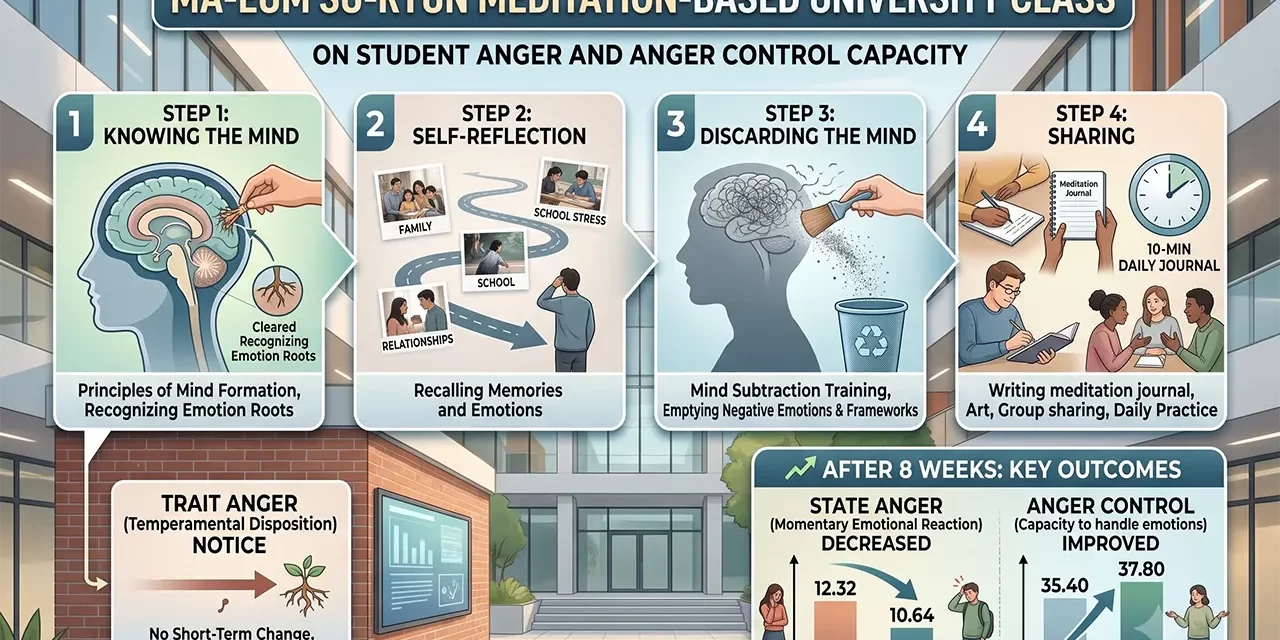
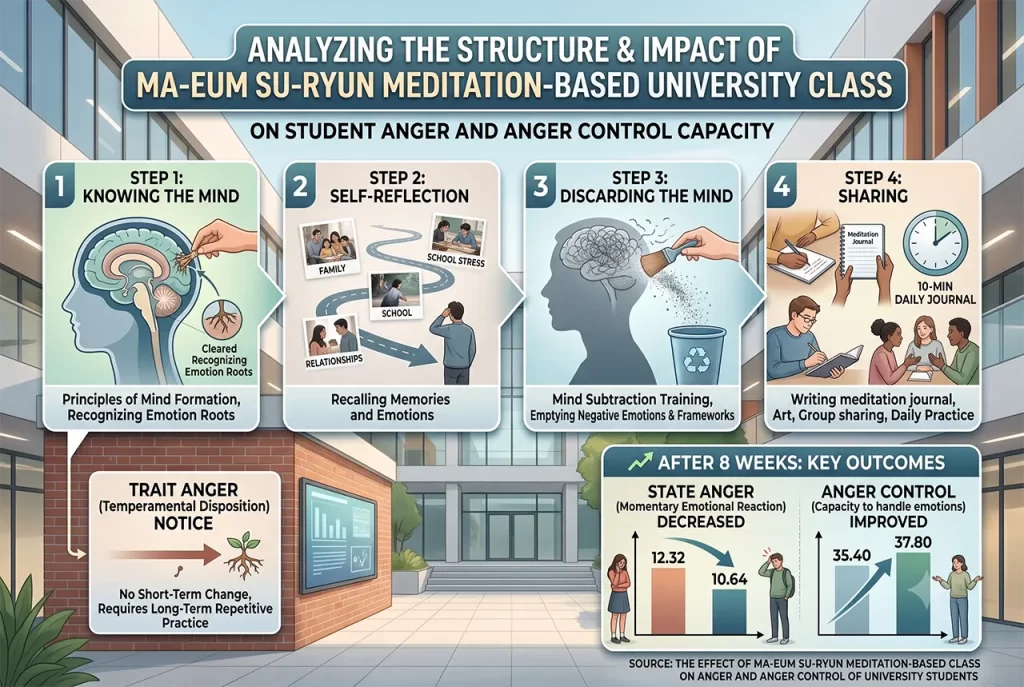
The core principles of Ma-eum Su-ryun meditation—”Self-Reflection” (looking back at oneself) and “Mind Subtraction” (discarding the mind)—were restructured to fit the developmental stage of university students. The program proceeded in the following 4-step flow:
- Knowing the Mind: Understanding the principles of how the mind is formed and recognizing the roots of the emotions one is feeling right now.
- Self-Reflection: Recalling the memories and emotions accumulated within family, school, and relationships one by one.
- Discarding the Mind: Emptying negative emotions and fixed frameworks of thought through meditation training.
- Sharing: Continuing self-reflection through writing a meditation journal, expressing oneself through writing or drawing, and group sharing.
In addition to class time, students were asked to write in a meditation journal for 10 minutes every day to ensure that self-reflection continued in their daily lives.
📈 After 8 Weeks, What Changed?
The research team measured three indicators before and after the class: ‘State Anger’ (a momentary emotional reaction), ‘Trait Anger’ (an individual’s temperamental disposition), and ‘Anger Control’ (the capacity to handle emotions).
- Decrease in State Anger: The feeling of anger that arises momentarily in specific situations decreased with statistical significance in the meditation group. The experimental group’s state anger score dropped from 12.32 to 10.64, whereas the control group showed almost no change.
- Improvement in Anger Control: The regulatory ability to recognize and express anger in a healthy way also significantly increased. The experimental group’s anger control score improved from 35.40 to 37.80, while the control group’s score actually decreased slightly.
- Trait Anger (Temperamental Disposition): Trait anger—the underlying anger tendency one constantly carries—did not show a significant change in either group. This demonstrates that temperamental traits are difficult to change in the short term. The researchers explain that changing trait anger requires long-term, repetitive meditation practice, and prior studies suggest the possibility of temperamental changes through intensive and continuous training.
💡 The Question This Research Asks Us
A major characteristic of this study is that meditation was operated not as an extracurricular or special program, but as a part of the regular curriculum. The fact that it was structured so that students could participate naturally within the semester without any barriers to entry raises the practical value of this research.
Furthermore, unlike many existing meditation-related studies that measured comprehensive indicators like stress, depression, and self-esteem, this study focused on a specific and everyday emotion: ‘anger’. This reveals the effects of Ma-eum Su-ryun meditation much more clearly and in a way that is closely tied to real life.
What Ma-eum Su-ryun meditation refers to as ’emptying’ might just be the most difficult, yet most important, practice in life.
Source: The Effect of Ma-eum Su-ryun Meditation-Based Class on Anger and Anger Control of Emergency Medical Service Students, 2025
