
Everyone probably has one or two unforgettable memories of emotional wounds. It could be a major, shocking event, or a seemingly trivial experience from a single remark or a passing glance. These memories can unexpectedly pop up out of nowhere, regardless of your will, plunging you into deep depression or anger.
Even though it is a past event that no longer exists, it occupies your current emotions and thoughts and ultimately attempts to dominate your life. Your future will change depending on how you live in the present; it is deeply unfair if you cannot properly live and enjoy your current time because you are tethered to the past.
🧠 What is Post-Traumatic Stress Disorder (PTSD)?
The condition of continuously suffering in one’s present life due to the experience of a large, shocking event (trauma) is medically diagnosed as Post-Traumatic Stress Disorder (PTSD).
- One feels the pain of a past event that has already disappeared exactly as it was, as if it were replaying in reality.
- In severe cases, it reaches the point where daily life or interpersonal relationships become impossible.
- The American Psychiatric Association recently added the concept of ‘PTSD due to complex trauma’ to the DSM-5, meaning emotional problems caused by large and small traumas in daily life can also be defined as PTSD.
- Despite extensive research and various treatment methods, a definitive treatment method that can completely overcome PTSD has not yet emerged, and the risk of relapse remains high.
🌱 Post-Traumatic Growth (PTG) & Deliberate Rumination
During PTSD research, scholars discovered cases where patients did not simply recover to their pre-trauma state, but changed into a much more mentally grown and mature state.
- Psychologists Richard Tedeschi and Lawrence Calhoun synthesized these cases and established the ‘Post-Traumatic Growth (PTG) model’.
- They found that PTSD patients could only move on to PTG after inevitably going through the process of ‘rumination’.
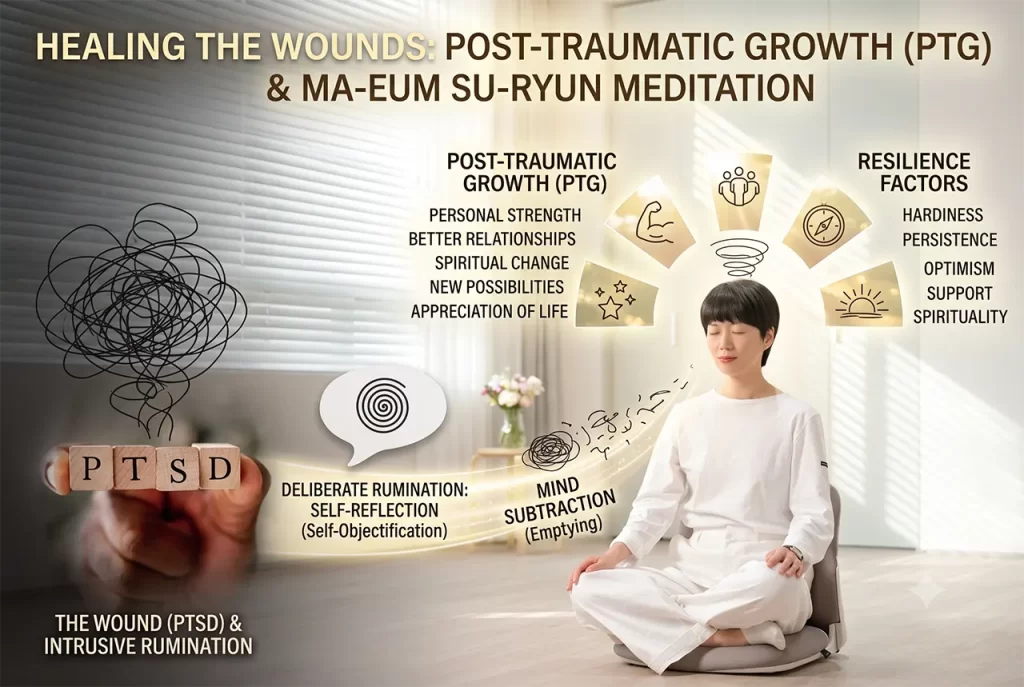
- While ‘intrusive rumination’ involves thoughts that automatically pop into one’s head, ‘deliberate rumination’ means actively recalling and thinking about the past event with a proactive will to understand its cause and meaning.
- Transitioning to deliberate rumination is not easy, but those who successfully navigate this process escape the pain of the trauma and mature significantly.
🪞 Deliberate Rumination as Self-Reflection
If we express ‘deliberate rumination’ in more everyday terms, it could be called self-reflection.
- Self-reflection is a proactive and active behavior aimed at objectifying, reflecting upon, analyzing, exploring, and understanding both oneself and others.
- Objectifying means stepping away from one’s subjective perception to view and perceive things objectively.
- When you objectively view the entire situation, you can accurately understand the cause and meaning, finding a clue to escape negative emotions.
- If we are well-trained in self-reflection in our daily lives, we can more easily escape emotional wounds and become future-oriented people who advance toward greater growth.
✨ Self-Reflection and Mind Subtraction in Ma-eum Su-ryun Meditation
There are truly many testimonial cases of people who not only overcame trauma but also mentally matured and transformed into a better life through Ma-eum Su-ryun meditation.
- Self-Reflection (Introspection): The self-reflection process in Ma-eum Su-ryun guides you through a special method to achieve self-objectification more easily. This helps achieve disidentification, which separates the negative emotions created by the event from your present self.
- Mind Subtraction (Emptying): In this process, you are guided to recognize that the disidentified emotions and the event itself are illusions that no longer exist in the present, allowing you to discard them. As you discard the mind, you realize with certainty in your heart that the things tormenting you are illusions and phantoms that do not actually exist.
Through a systematic 8-step process, you can resolve all problems remaining in your memory—from small stories to deeply rooted major wounds—and meet a completely cleansed, new version of yourself.
📊 Scientific Verification: Meditation, PTG, and Resilience
A research study led by professors from Korea National University of Transportation, Sungshin Women’s University, and Kunsan National University studied the effects of Ma-eum Su-ryun meditation on 119 paramedics.
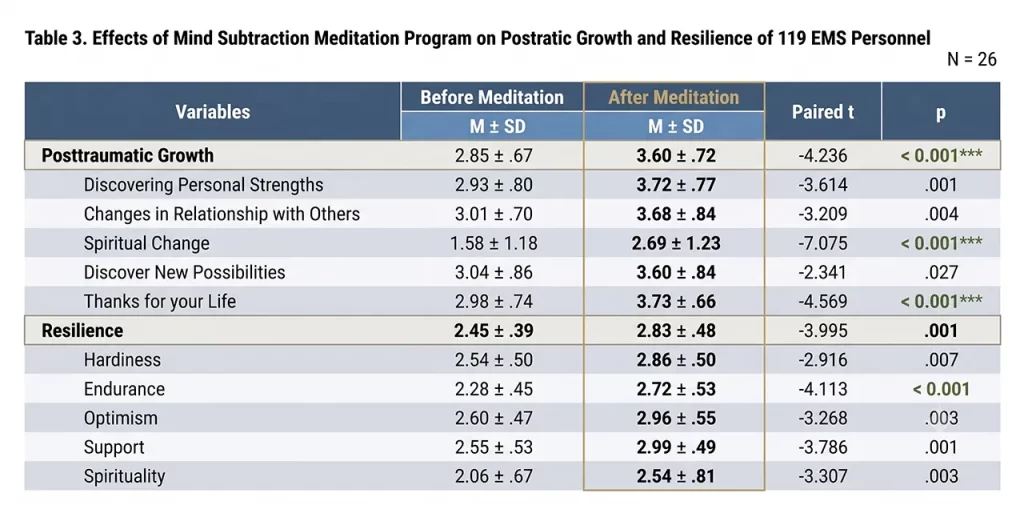
- After participating in a 3-day (12-hour) Ma-eum Su-ryun meditation program, the 26 paramedics who participated in the experiment showed significant improvement in both post-traumatic growth and its related resilience.
- Significant improvements were seen in all PTG sub-factors: discovering personal strength, changes in relationships with others, spiritual change, discovering new possibilities, and appreciation of life.
- Significant improvements were also shown in all resilience sub-factors: hardiness, persistence, optimism, support, and spirituality.
- Post-traumatic growth and resilience exert a mutually positive influence on each other, becoming inner strengths that push us to overcome wounds and despairs.
A free mind that is not bound or swayed by any emotions or concepts stemming from the past becomes the source of courage to take on any challenge, resilience and patience to rise again from any frustration, and high self-esteem that supports all of this. Begin a journey of the mind to meet a new you with Ma-eum Su-ryun meditation.
