
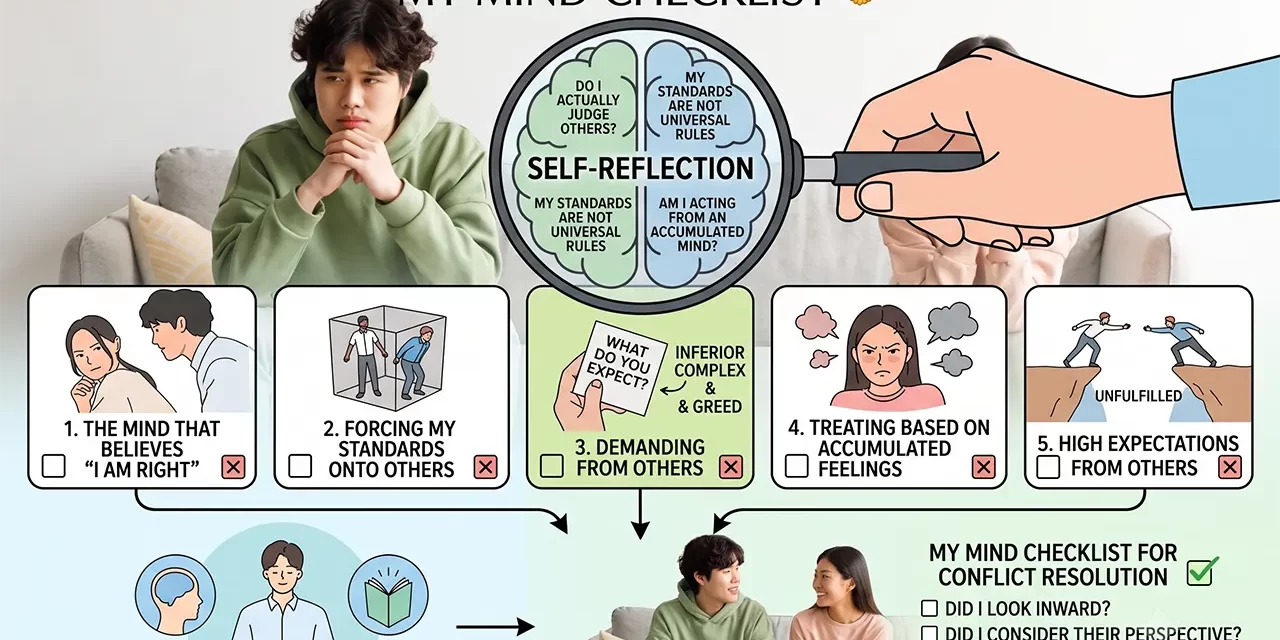
From the moment we are born, we live by forming various relationships with family, friends, coworkers, and romantic partners. While these interpersonal relationships can give us a sense of happiness and satisfaction in life, they can also be difficult, complex, and inevitably lead to conflict.
Because everyone has lived a different life, we hold different values and standards, which causes our desires to clash. To resolve these conflicts, rather than blaming others, we first need a mindset that looks inward. Reflecting on oneself means adopting an attitude that tries to look at and understand the other person’s perspective.
Among the many people who practice Ma-eum Su-ryun meditation, there are countless cases where relationships have dramatically improved by breaking free from a self-centered mind and stepping into the other person’s shoes. Therefore, based on the experiences of those who have practiced Ma-eum Su-ryun meditation, I would like to share a “mind checklist” to reflect on during interpersonal conflicts. I hope this helps you resolve conflicts and maintain good relationships.
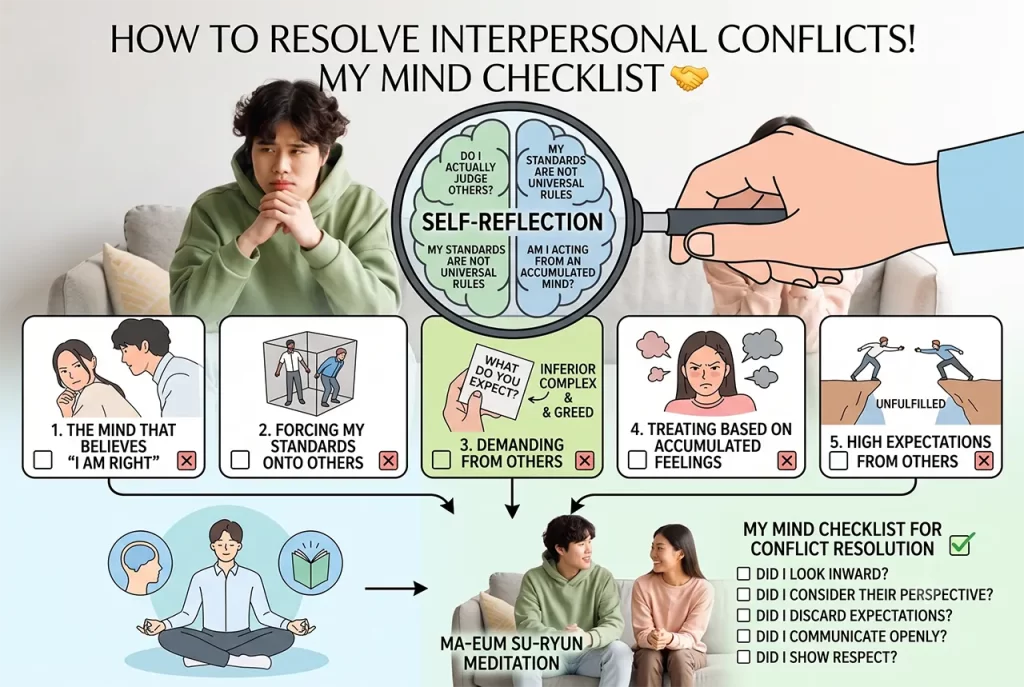
Top 5 Minds to Reflect on for Resolving Interpersonal Conflicts 💭
1. The Mind That Believes “I Am Right”
Have you ever thought, even once, that you might be wrong?. Actually, admitting your own fault is not easy. It is far easier to think, “I am right, and this conflict happened because of the other person’s mistakes”. Practicing Ma-eum Su-ryun meditation shifts your thinking from a self-centered perspective to the other person’s point of view. As a result, you can view the situation objectively and reflect on what you did wrong. Many people come to the realization: “Ah, I was judging the situation and the other person based solely on my own self-centered thoughts”.
The story of office worker Choi Jung-in:
- He realized his mistake of shifting the burden of his father onto his wife, acknowledging he wasn’t even treating his father well himself.
- He took it for granted that his wife would adjust, but when he put himself in her shoes, he realized how incredibly hard it must have been for her.
- He was supposed to be the person she was most comfortable talking to, but he was a husband who couldn’t even listen to her.
- He felt endlessly guilty and sorry for his actions.
- The cause of their family discord was his fault because he couldn’t mediate; he only demanded that his wife fit his standards.
- Growing up, watching how his father treated his mother, he thought, ‘I will never be like that,’ yet he was doing the exact same thing.
2. The Mind That Tries to Force Others to Fit My Standards
“Why is that person so lazy?” / “Is that all they can do?”. My standards are simply the criteria I have accumulated throughout my life, believing only I am right; they are not universal rules. If you view and judge others based on your own standards like this, it is only natural that arguments and division will arise. Moreover, the other person will sense all of your judgment and inevitably feel uncomfortable. You must discard your own standards and develop a broad mind to truly accept others.
The story of Mok Kyung-soo, a former executive at LG Chem’s Daesan Plant:
- He learned that knowing things only with his head and through knowledge was useless for developing a servant leadership mindset.
- To acknowledge and accept the other person exactly as they are, his mind’s capacity had to be that large, and that only became possible after practicing Ma-eum Su-ryun meditation.
- As he discarded his greed, selfishness, and all his standards regarding notions, customs, and value judgments, his mind actually broadened.
- Naturally, he could see the other person’s perspective, understand them, and accept them.
- Because he discarded ‘himself,’ it happened naturally without him having to force it.
3. The Mind That Demands Things from Others to Fill My Own Shortcomings
There are times when we unilaterally demand certain behaviors from our spouses or children—not based on what they want, but to fill our own inferiority complexes or greed. We often justify this by thinking it is “for their own good,” and when they do not act according to our demands, we sometimes lash out with harsh words or actions. This is when conflict begins. Practicing Ma-eum Su-ryun meditation allows you to reflect on what kind of mind you are operating from when dealing with others.
The story of housewife Song Eon-joo:
- Asserting her parental authority, she ignored her children’s natural aptitudes and forced them into academies she deemed necessary according to her own plans.
- She recalled a time she hit her child with a school bag when they complained of a mild fever and headache, saying they couldn’t go to school.
- The more she recalled and discarded those memories, the more she had to admit that under the guise of ‘doing it for the child,’ she was actually trying to compensate for her own feelings of inferiority.
- She remembered showing her dad a report card where she ranked 10th out of 60 students, expecting praise, only to shrink back hurt when he said, ‘Come on, you should be first!’.
- She also remembered the embarrassment and humiliation of friends teasing her when she gave the wrong answer to a teacher’s question.
- Those childhood memories had turned her into a timid person lacking confidence, which manifested as a stubborn greed to raise her child to be confident and smart no matter what.
- The moment she realized that the actions she considered ‘love’ were actually unnecessary interference and obsession, tears flowed endlessly out of guilt.
4. The Mind That Treats Others Based on My Accumulated Feelings
If you have a lot of dissatisfaction and anger built up inside, you will inevitably end up constantly getting angry and expressing dissatisfaction toward others. Ma-eum Su-ryun meditation allows you to look back on the life you have lived, uncover the root causes of the mind you have accumulated, and discard them.
The story of former career soldier Jung Hwan-chul:
- He realized he used to treat others with pride and anger, living solely for his own pride.
- As he practiced Ma-eum Su-ryun and discarded that mind, his consciousness expanded, and he could clearly see his place within the military organization.
- He realized his existence was only possible because he had subordinates.
- The lower ranks did not exist just so he could rule over them.
- He finally realized that an ‘officer’ exists for the members of the organization.
- He deeply repented for believing that his subordinates should blindly follow his orders just as he blindly obeyed his superiors.
- He understood that each soldier is a precious human being, and he felt truly sorry.
5. The Mind That Expects Things from Others
People live with many expectations of each other. This is especially true the closer the relationship is. The greater the expectation and attachment, the more inevitable clashes and conflicts become.
The story of Kim Sung-hwan:
- He noted that the reason he fought so much with his girlfriend after he joined the military was due to his mind of expecting and wanting things.
- Because military life was hard, he wanted to lean heavily on his girlfriend, but she also had a strong desire to lean on him, so they constantly clashed.
- When he discarded the memories of both their good moments and their painful times, a corner of his mind felt at peace.
- Because his mind was at peace, recalling any moment caused no emotional turbulence.
- Previously, he thought love meant ‘only looking at me,’ but now, if someone asks him about love, he wants to say it is ‘cherishing the other person as much as myself’.
- It is about treating others with that exact mindset.
- He hopes people reflect on whether they listen to their parents as closely as they do to their partners, whether they do their best for their neighbors, and whether they truly put themselves in the other person’s shoes.
- Therefore, he concluded that his girlfriend is his mirror.
My Mind Checklist for Interpersonal Conflicts ✅
These are the mindsets that those who have experienced Ma-eum Su-ryun frequently reflect on during relationship struggles. If you are experiencing conflict, please check your own mind using this list:
- Did I think only my own thoughts were right?
- Did I only state my position without ever considering the other person’s perspective?
- Did I act based on expectations and desires for the other person?
- Did I treat the other person as my possession and act however I pleased?
- Did I force my own standards onto them?
- Are there areas where I misunderstood the other person by failing to judge the situation objectively?
- Did I have a mind that genuinely respects and cares for the other person?
- Did I acknowledge and respect our differences?
- Did I expect the other person to just “know” how I feel without me expressing my emotions?
- Did I have the open mind needed to truly listen to the other person’s story?
If you sincerely reflect on and discard even one of the mindsets listed above, you will surely find a way to resolve your conflict.
