
Take a moment for yourself after running non-stop. Learn how to rest properly and recharge your energy. How do you usually take a break?
You make up your mind to go on a weekend trip, or you spend Saturday binge-watching delayed Netflix movies and YouTube videos, and suddenly it is Sunday evening. It would be wonderful if, after resting like that, your body and mind were fully recovered and recharged with the energy to start the week in a good mood.
Watching a constant stream of stimulating scenery and videos on your phone probably felt fun in the moment due to the instant gratification. Strangely, though, rather than feeling rested, you are left feeling distracted, empty, and physically heavy. You have probably experienced the sensation of having taken a break, but not actually feeling rested at all.
Rest is about recharging your energy and breathing new motivation into your life. However, because you often end up spending more energy during that rest time, you can feel even more tired than when you were working. Inevitably, we are surrounded by countless stimuli, meaning our brains cannot fully rest.
True rest happens when your brain rests. Simply resting your body or not working does not mean you are actually resting.
For those who definitely took a break but somehow feel even more tired and unrefreshed, here is how to rest properly so your brain can fully recover.
4 Ways to Rest Properly 🧘♀️✨
1. Step Away from Stimulation 📵
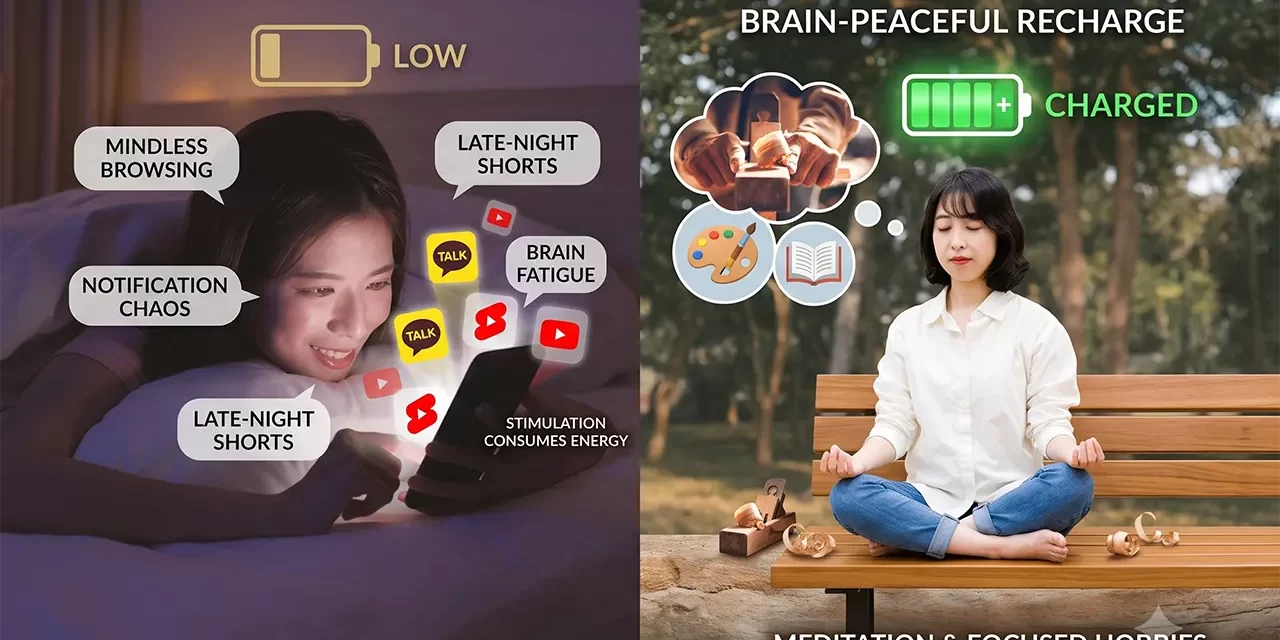
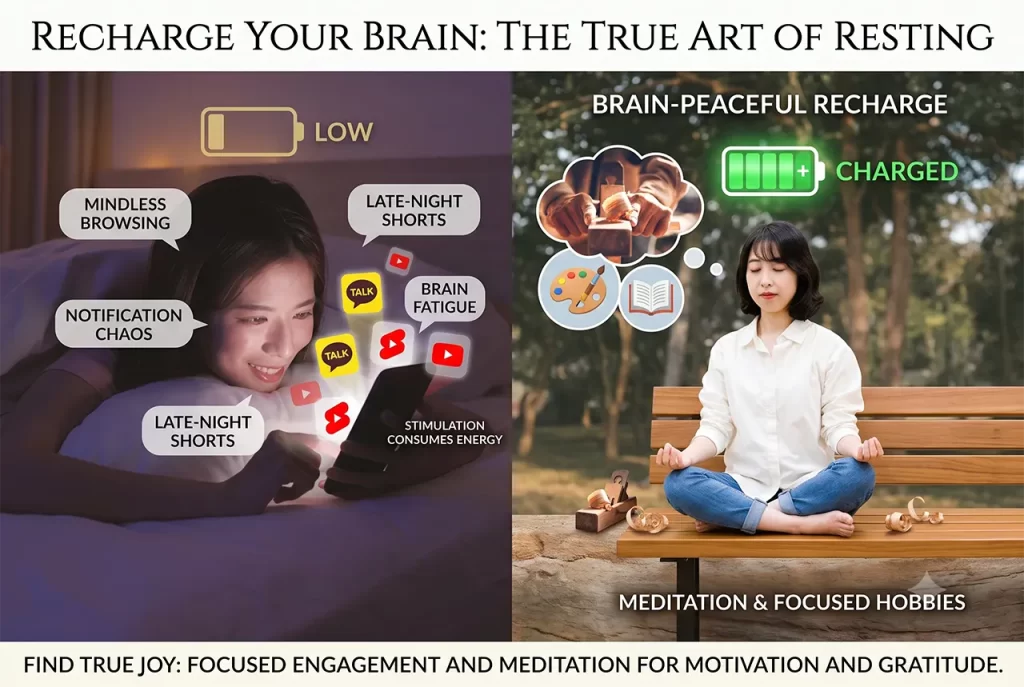
Are you lying in bed with your phone? KakaoTalk sounds and notifications stimulate your brain and force it to react, causing fatigue. Also, after work or on weekends, you might lie in bed endlessly watching YouTube Shorts to “relax.” Try turning off your phone notifications and minimizing your phone usage as much as possible.
Videos are a continuous stream of stimulation. With sounds, images, and provocative topics, they force the brain to react endlessly, and our brains increasingly crave stronger stimulation. The brain consumes energy even when doing nothing. The more it reacts to stimulating videos, the more energy it uses, ultimately leaving it exhausted. This is why you feel even more tired after rolling around in bed all weekend.
2. Rest in a Different Environment and Posture from Work 🚶♂️
Sometimes, you pause work to take a break and sit in the exact same spot, watching videos, checking social media, or listening to music on your phone. When you do this, the brain reportedly cannot distinguish between working and resting. Therefore, even though you stopped working, it perceives that you are still working without a break.
It is said that the brain only considers it “rest” when you leave your workspace, change your posture, and put your body and mind in a comfortable state. Just changing your posture shifts your brain into a resting mode. You do not necessarily have to go far away; just step away from your desk for a moment. Do it so your brain knows, “Ah, I’m resting now.”
3. Do Something You Can Pleasantly Focus On 🎨
When you immerse yourself in a hobby you love, time flies, and you feel your energy recharging. This is entirely different from mindlessly watching stimulating videos. When you pleasantly immerse yourself in something of your own choosing—rather than being bombarded by chaotic stimuli—useless thoughts disappear, and your brain actually gets to rest.
Simply stopping distracting thoughts allows the brain to rest. Engaging in active leisure where you can pleasantly immerse yourself creates a positive chain reaction in other areas of your life as well. When resting, do not force yourself to do something you dislike just because you think it might be “helpful”; instead, focus on what you genuinely love. This is one of the best ways to rest, allowing you to find fulfillment and joy while taking a break.
4. Meditation That Eliminates Distracting Thoughts 🕊️
The positive effects of meditation are already widely known. While earlier practices focused on physical responses, nowadays, greater benefits are recognized from the perspective of brain response and transformation. The biggest factor preventing the brain from resting is distracting thoughts. We are surrounded by so many stimuli that we cannot rest well, and we find it difficult to simply stay still.
The brain is constantly in motion due to the countless distracting thoughts triggered by the need to continuously see and hear something. Distracting thoughts prevent you from focusing on the present. They create worry and anxiety, causing the brain to endlessly consume unnecessary energy.
There are various types of meditation. There is meditation that focuses on physical changes and movements, meditation that calms the mind, meditation that brings up distracting thoughts to quietly observe them, and subtraction meditation, which eliminates countless distracting thoughts one by one right down to the root.
Subtraction meditation helps you systematically discard arising thoughts one by one, thereby reducing mental clutter. As distracting thoughts decrease, you can focus better on your tasks and finish them faster, which ironically creates more free time for your brain to rest.
When you meditate, your emotional regulation abilities are activated, preventing impulsive behavior. When your mind reaches a calm and relaxed state, the desire to fill yourself with more or want more also decreases. When you reach that state of being constantly fulfilled and grateful without wanting anything, your mind is always comfortable and in a state of true rest.
Time to Recharge 💡
Now you know why you didn’t feel refreshed even after rolling around in bed all day, right? If you took a break but somehow feel more down and sluggish, try practicing the methods mentioned above. Because they are not difficult to try, you will likely see effects quickly.
Among them, meditation can yield even greater results if you learn the correct method and practice it properly. Many people try to meditate alone via YouTube but find it doesn’t work well for them. Just as working out with a PT instructor at the gym who teaches you how to use your muscles yields better results, learning meditation systematically with the help of an instructor significantly amplifies the effect.
If you learn how to meditate, you can live your daily life with a comfortable mind, as if you are always resting. Try focusing on your work without distracting thoughts, and fully recharging your energy during your rest time. You will gain motivation for life and begin to think positively.
References:
- Flow (몰입) – Author: Hwang Nong-moon
- Otium (오티움) – Author: Moon Yo-han
