
Welcome to Santa Clara Meditation! 🧘♀️ Navigating human relationships can sometimes feel like an emotional rollercoaster. We all desire smooth, loving, and supportive connections, yet we often find ourselves tangled in misunderstandings, resentment, and exhaustion. Where does this relationship stress truly come from? Is it always the other person’s fault, or is there something hidden within our own minds?
In this insightful post, we explore the reflections of 100 meditation practitioners who bravely looked inward to discover the root causes of their relationship struggles. By identifying these top 10 mindsets, we hope you find clarity and inspiration to untangle your own stress and build more authentic, peaceful connections. 🌱
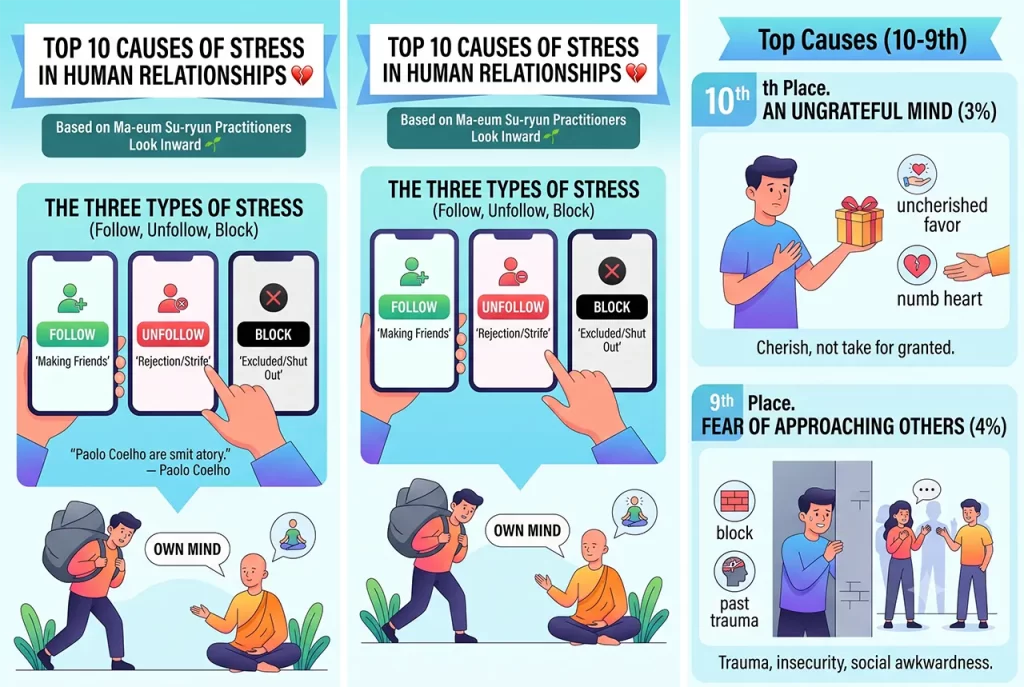
“Love has three stages, just like Twitter: Follow (making friends), Unfollow (cutting ties), and Block.” – Paulo Coelho 📱
There are also three types of stress that come from human relationships: The stress of “following” (making friends), the stress of being “unfollowed” (rejected), and finally, the stress of dealing with relationships where you are blocked or have to block someone. 🛑
Many people who come to meditate have a strong desire to resolve their “stress from human relationships.” They begin meditating while carrying the heavy feelings they’ve experienced with their family, spouses, in the workplace, and in society. 🏢🏘️
After reflecting on their minds, they say they realize the root cause of their stress was actually in their “own mind.” Looking back on their lives—from childhood friends to recently estranged relationships—they retrace their inner thoughts step by step. Through this, they gain insight into what kind of mind made their relationships uncomfortable or how those relationships could have improved. 💡
So, we asked 100 meditation practitioners at the Ma-eum Su-ryun Nonsan Main Center who were looking back on themselves: “What kind of mind was the cause of your stress in human relationships?”
Here are the Top 10 answers we found when looking into those minds. 🔍
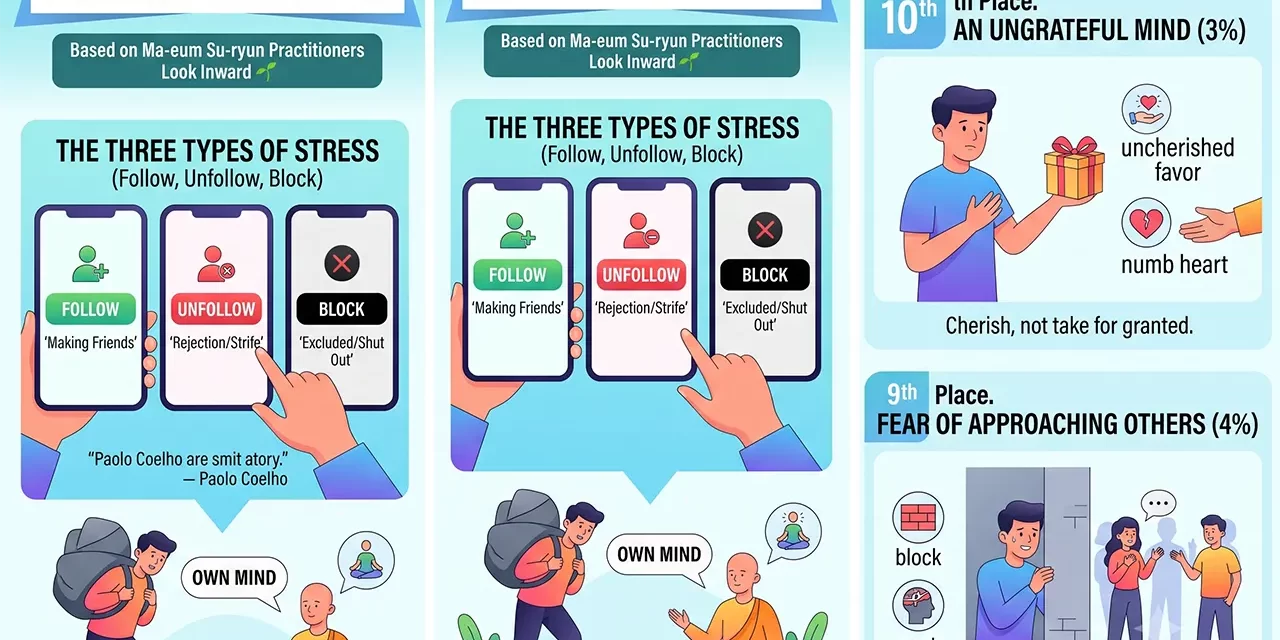
🍂 10th Place. An Ungrateful Mind (3%)
Why is a lack of gratitude a cause of stress? If you think about it, lacking gratitude means you do not cherish the other person. You take what you receive for granted and become numb to repeated favors. Just as we might take our parents’ love for granted, we often take the presence of a colleague helping us for granted. A relationship lacking gratitude will ultimately struggle to develop into a good one. 🥀
“I took it for granted that my parents and my friends were by my side. Because I thought receiving favors was a given, I wasn’t thankful. Without gratitude, I think I ended up getting disappointed and instead got angry at them.” – Lee
🫣 9th Place. Fear of Approaching Others (4%)
This could be called the stress of “following” (making friends). It might stem from the trauma of being rejected when you reached out first, or it could be an innate trait. You can experience stress when you feel intimidated by this mindset or when you form unsatisfactory relationships as a result. 🚧
“I had a fear of people and couldn’t approach them easily. Because of my own thoughts—like ‘That person probably won’t like me…’ or ‘Won’t they hate it if I approach them?’—I couldn’t easily make friends or get close to anyone.” – Choi
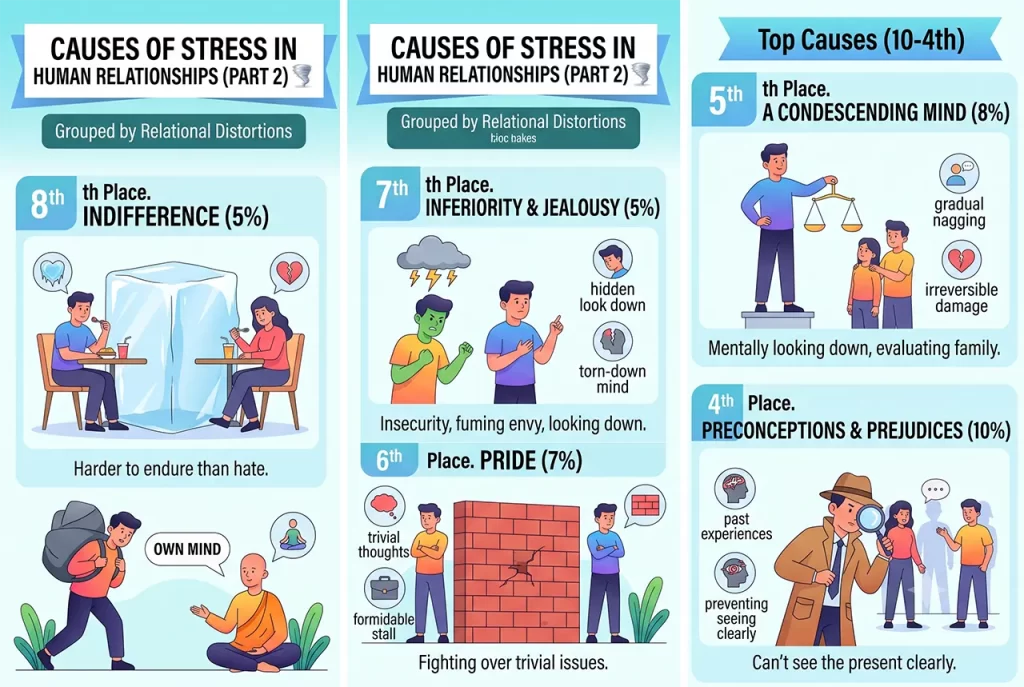
🧊 8th Place. Indifference (5%)
Many shared that they were more indifferent to others than to themselves. This was an area with many self-reflective answers noting that this indifference likely caused pain to others. They say indifference is even harder to endure than being hated. ❄️
“In my daily life, I often felt hurt thinking people had no interest in me. I felt lonely, thinking my husband and kids didn’t care about me. But as I meditated, I realized I was also truly indifferent to the people around me. I only wanted to receive attention, but I was completely indifferent to what kind of day my family had or what kind of friends they had. I realized my family must have felt hurt, too.” – Shin
😒 7th Place. Inferiority Complex and Jealousy (5%)
In social life, you may receive envy and jealousy, but you also become jealous of others. Even while feeling jealous, you subtly look down on the other person. At the same time, you fall into an inferiority complex, thinking, “I guess I can’t do it,” or “I’m not good enough.” When this persists, it becomes stressful. 🌩️
“Because I thought I was inferior to that person and lacked ability, I envied them while simultaneously feeling jealous and hating them. In my mind, I was subtly tearing them down, hoping things wouldn’t go well for them.” – Park
🛡️ 6th Place. Pride (7%)
There are cases where a small issue snowballs into a fight because of trivial thoughts like “I shouldn’t even speak to them” or “Why should I be the first to talk?” Some realized that while they thought the other person’s stubbornness was the problem, their own stubbornness was just as formidable. 🧱
“I acknowledge my mistakes, but since I always thought, ‘You’re at fault in some areas too,’ I almost never apologized first or said I was sorry. My pride was hurt for no reason, and I hated bowing my head first.” – Anonymous
👑 5th Place. A Condescending/Disregarding Mind (8%)
“Still, I’m better than them.” “My way of thinking is better than doing it that way.” We sometimes mentally look down on the family members we live with. Subtle nagging toward husbands and wives gradually increases. Even if you don’t say it out loud, aren’t you evaluating them, thinking, “This is the problem with that person…”? When you unknowingly hold a condescending mind and the other person senses it, the relationship often suffers irreparable damage. What kind of mindset do you have when treating people? ⚖️
“I deluded myself into thinking everyone was beneath me and I was the best, so I looked down on everyone. It was the same with my boyfriend and my parents. Even though they were the people I considered the closest and most comfortable, they were the ones I looked down on and treated the most carelessly.” – Hwang
🕶️ 4th Place. Preconceptions and Prejudices (10%)
Past experiences prevent us from seeing the present clearly. “People who look like this have weird personalities.” “This person used to be like this in the past, so they must be the same now.” With these thoughts, we cannot see the person in front of us accurately. Even among friends, if they repeat a mistake, we often dig up the past and criticize them, saying, “You’re always like this.” 🕵️♂️
“I look at appearances and form preconceptions like, ‘Ah, this person must be like this.’ There are people I struggle to speak to and don’t want to talk to, even when we first meet. I thought there was something wrong with them, but meditating showed me otherwise. I was actively avoiding people who had a similar style to someone I disliked back in school.” – Kim
“Because I thought a person who made a mistake once would forever be a ‘person who made a mistake’ and ‘someone who could make a mistake again,’ it was hard to restore the relationship. Only their past mistakes kept popping into my head, and they became branded in my mind as ‘that kind of person.’ No matter how nice they were to me, it was useless.” – Lim
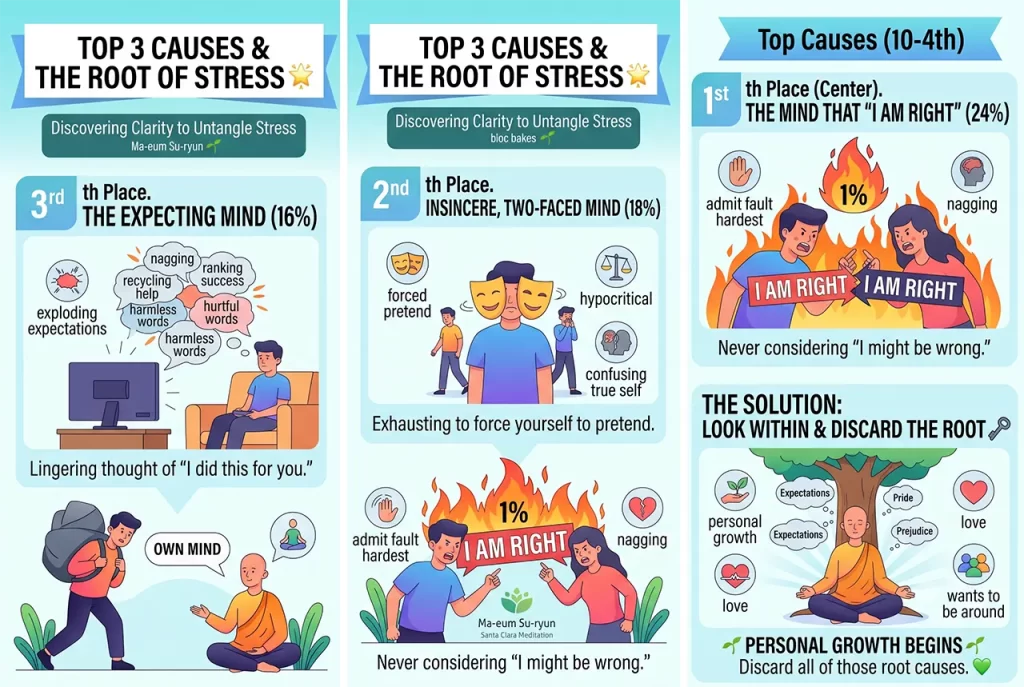
🎁 3rd Place. The Expecting Mind (16%)
Hoping they won’t ask you to do the recycling while you’re watching TV. Hoping they’ll just know and do things without you having to say or ask. Hoping your child ranks in the top 10 in their class. Hoping your parents won’t nag you. Hoping the other person won’t say hurtful things. Hoping the other person won’t get hurt even if you say something harsh. Aren’t we always just “expecting” things from someone? 💭
“I don’t think I ever did a favor for someone without expecting anything in return. Except for times when I simply did something because I wanted to, I always had the lingering thought that ‘I did this for you.’ So the next time that person declined a request of mine, I blamed them, thinking, ‘I did all this for you, how could you do this to me?'” – Park
“I felt pressured when I sensed people expecting and wanting things from me. Expectations from parents or friends—many days were spent worrying: ‘They want this from me,’ ‘I have to meet their expectations,’ ‘What if I fall short?'” – Seo
🎭 2nd Place. An Insincere, Two-Faced Mind (18%)
What does it mean to treat someone with a sincere heart? Am I treating others with a sincere heart? What is a sincere heart anyway? Is it sincere to just spit out whatever you want to say unfiltered? Perhaps we’ve inevitably formed relationships where we hurt and get hurt simply because we haven’t known what a truly sincere mind is. 🪞
“Pretending to like something when I hated it, pretending to be nice, pretending to be okay. It was exhausting forcing myself to pretend. But when people around me said, ‘You’re so nice’ or ‘You’re a good person,’ I would go right back to pretending.” – Kim
“I’ve said ‘Thank you,’ ‘I’m sorry,’ and ‘It’s okay’ the most in my life, but I wonder how many times I actually meant it.” – Lee
“I lost affection for people who showed two-faced behavior. Seeing a drastic difference between how they act with me versus how they act with others, or seeing hypocritical behavior, made me confused about which was their true self. That’s why there are people I’ve grown distant from.” – Choi
🥇 1st Place. The Mind that “I Am Right” (24%)
They say a mind that admits its own faults is the broadest and biggest mind. However, it seems very difficult to admit when we are wrong. The most common answer was experiencing relationship stress because of the mind that “I am right.” Because people only thought the other person was wrong and never considered that they themselves might be wrong, identical situations always escalated into arguments, worsening relationships. 🔥
“I don’t think I’ve ever considered myself to be in the wrong in my entire life. Because I always thought my way of thinking was right, even if I somewhat acknowledged someone else’s opinion, I still thought, ‘But I’m not wrong.’ I always believed I was right, even if just by 1%.” – Ko
“I thought, ‘I didn’t do anything wrong, so why are they acting like that? What on earth did I do wrong to make them say that?’ I think I’ve lost many people because I refused to bend my stubbornness. I also nagged a lot. I thought I was saying it all for their sake, but while meditating, I realized the other person must have had a truly hard time because of my nagging.” – Shin
“Because of my desire to stand out more than others and my fear of being looked down upon, I was afraid to admit that I was wrong.” – Lee
They say you need good human relationships to succeed. Some even say your network is a metric of your success. Because of this, we try to acquire communication methods or techniques to succeed in relationships. However, haven’t we been ignoring the underlying stress from human relationships, trying to win people’s hearts merely with skills or techniques? 🗝️
Everyone needs time to deeply reflect on why stress occurs. If you simply turn away and blame it on “that person,” there will be no further personal growth. 🌱
Now, it seems necessary to look for the cause within your own mind. Out of these 10 minds, which ones felt like your own story? If you could discard all of those root causes, you might just become someone everyone loves and wants to be around. 💚
