
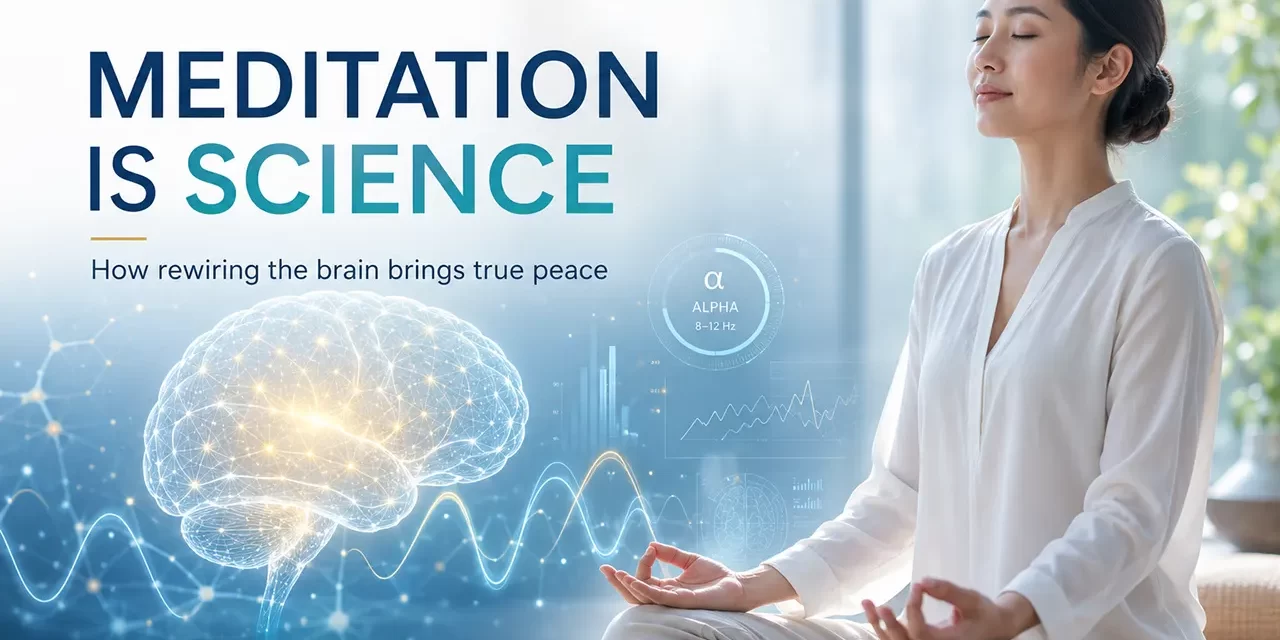
When the Allen Institute for Brain Science in the United States embarked on an ambitious project to understand the human brain, they recruited Caltech’s Professor Christof Koch as Chief Scientist. His team traveled to southern India to meet with Tibetan monks who spend years meditating on the origins of humanity.
What they found was groundbreaking: during meditation, high-frequency signals distinctly different from those of ordinary people appeared in the monks’ brains. We are now living in an era where the mind, consciousness, and ancient wisdom are being actively verified by modern science.
A fascinating feature published in Science Donga explores exactly how this works. Here is a look at the science behind why meditation is so effective.
🌌 Deep Valleys in the Brain Create Memories
The human brain contains about 100 billion neurons, connected by roughly 7,000 synapses each. These networks constantly change and adapt based on our experiences—a phenomenon known as neuroplasticity.
When we repeat the same thoughts or actions over a long period, chemical and electrical patterns resembling “deep valleys” are carved into our neural pathways. Once established, we think and act automatically according to these deep grooves without needing new learning or external stimulation.
While neuroplasticity allows us to learn and grow, it also has a downside. Countless mental frameworks and prejudices are stored in the brain over a lifetime. We unknowingly become stressed or obsessed because we judge all new information through these pre-existing, rigid frameworks.
As The Self Illusion author Bruce Hood notes, what we remember is not an exact perception of external reality, but an adaptation tailored to the specific neural pathways in our own brains.
📉 Mind Subtraction Increases Alpha Waves and Reduces Stress
Meditation is the process of looking back on oneself. When practicing “mind subtraction,” the numerous memories accumulated throughout life pass by like a movie. By systematically subtracting these memories and thoughts, you can objectively identify your own cognitive errors, attachments, and fixed mindsets.
But what actually happens in the brain when you do this?
A research team led by Professor Jaime Pineda of the Department of Cognitive Science at UC San Diego tested this by tracking the brain waves of participants practicing mind subtraction meditation over several weeks. Using 32-channel electroencephalogram (EEG) scans, they observed remarkable changes:
- A Surge in Alpha Waves: Brain wave signals around 10Hz appeared prominently after meditating. These are “alpha waves,” the specific frequencies emitted when the brain is in a deeply relaxed, peaceful state.
- Targeted Growth: The alpha waves increased significantly in the right occipital lobe as the meditation time lengthened.
- Measurable Stress Reduction: While participants initially scored higher on ‘Cohen’s Perceived Stress Scale’ than non-meditators, their stress levels noticeably plummeted as they continued to practice mind subtraction.
🌟 The Era of Scientific Character Education
Because the science is so clear, meditation is no longer just for monks in the Himalayas.
Professor Lee Duk-joo—a former NASA researcher and current professor of Aerospace Engineering at KAIST—has been a major advocate for bringing this practice to the public. As the President of the Society of Human Completion Education, he has opened character education courses at KAIST, proving that anyone can discover the root of their mind and find true peace while meditating in their daily life.
By identifying the “fake” past self that distorts the present, you can discard useless minds, rewire your brain, and experience true freedom.
If you are ready to experience the science of mind subtraction for yourself, reach out to Santa Clara Meditation today at 408-615-0435 to get started.
📰 About the Article
- Publication: Science Donga
- Article Title: Meditation is Science
- Published: June 1, 2017
- Written by: Professor Lee Duk-joo (KAIST Department of Aerospace Engineering)
