
Anger and stress can deeply affect a person’s mind, body, relationships, and daily life.
Many people try to endure emotional pain silently. They may continue working, studying, caring for family, or meeting responsibilities while carrying anxiety, resentment, worry, pressure, and unresolved inner conflict.
A Newswire article published on September 16, 2015 introduced research reported in Stress Research, the journal of the Korean Society of Stress in Medicine.
The study focused on Ma-eum Su-ryun meditation and its effects on stress and Hwabyung symptoms.
Hwabyung is often described as a Korean culture-related syndrome associated with long-term suppressed anger, emotional distress, and stress-related symptoms.
According to the article, the study reported meaningful improvements in anger, stress, emotional symptoms, physical discomfort, and interpersonal relationships after participants completed the Ma-eum Su-ryun meditation program.
🌱 RESEARCH PUBLISHED IN STRESS RESEARCH
The study was introduced in a recent issue of Stress Research, published by the Korean Society of Stress in Medicine.
The paper examined the effects of Ma-eum Su-ryun meditation on stress and Hwabyung symptoms.
The research involved:
• Professor Jung Joon-yong of Duksung Women’s University
• Professor Kim Jung-ho of Duksung Women’s University
• Professor Kim Mi-ri-hye of Duksung Women’s University
• Psychiatrist Dr. Kim Jung-il
The study included 120 ordinary participants, consisting of 65 men and 55 women.
All participants took part in the seven-night, eight-day Level 1 course at the Ma-eum Su-ryun Meditation Main Center.
The article noted that Ma-eum Su-ryun meditation was developed in Korea and was receiving attention as a program for mind-body health.
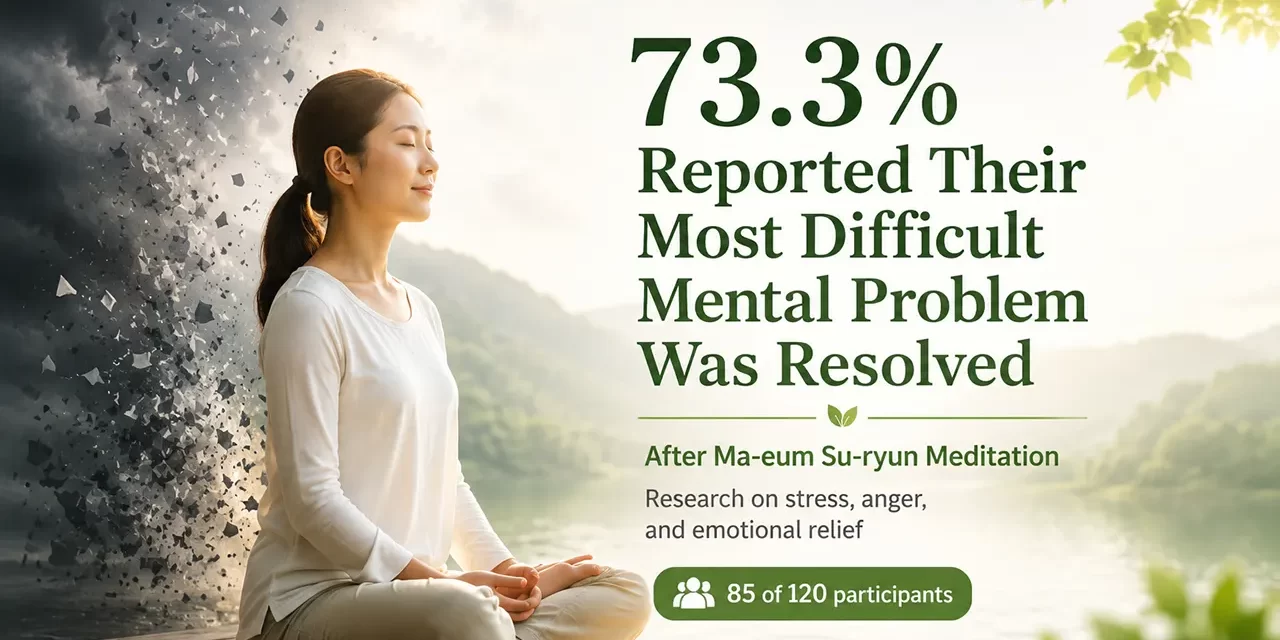
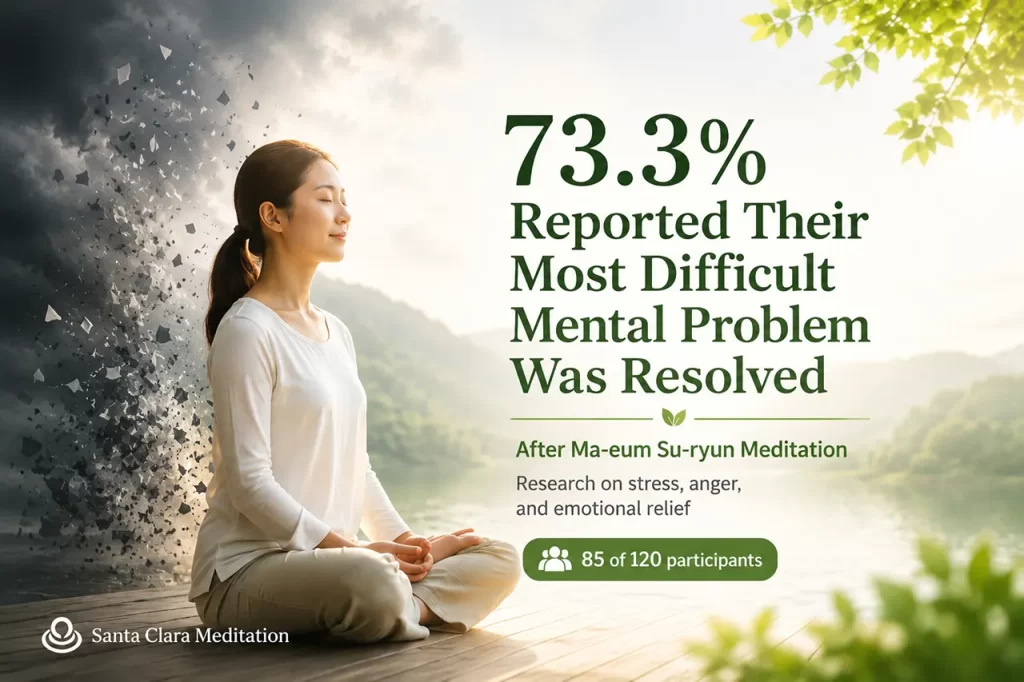
📊 73.3% REPORTED THEIR MOST DIFFICULT MENTAL PROBLEM WAS RESOLVED
One of the most striking results reported in the article was that immediately after the meditation program, 73.3% of participants said the mental problem they had struggled with the most had been resolved.
This represented 85 out of 120 participants.
Among them:
• 5.2% reported complete resolution
• 27.6% reported it was almost resolved
• 40.5% reported it was greatly resolved
These results drew attention because they suggested that many participants experienced meaningful change after the meditation program.
While individual results may vary, the report showed that self-reflection meditation may offer important support for people struggling with stress, anger, and emotional burden.
💙 IMPROVEMENT IN STRESS AND HWABYUNG SYMPTOMS
According to the article, the study reported decreases in symptoms associated with Hwabyung, often referred to as chronic anger-related distress.
The symptoms included:
• Obsessive-compulsive traits
• Interpersonal sensitivity
• Depression
• Anxiety
• Hostility
• Phobic anxiety
• Paranoia
• Psychotic symptoms
Participants also reported psychological improvements in areas such as:
• Depression
• Anxiety
• Fear of the future, failure, and death
• Feelings of burden
• Worry
• Nervousness
• Distracting thoughts
• Impatience
• Feelings of unfairness
• Inferiority
• Guilt
• Daily mental burdens
At the same time, participants reported increased concentration, confidence, emotional stability, mood stability, and peace of mind.
These findings suggest that Ma-eum Su-ryun meditation may help people not only relax temporarily, but also reflect on and release the minds that create stress and emotional discomfort.
🌸 PHYSICAL CHANGES REPORTED AFTER MEDITATION
Stress and anger are not experienced only in the mind.
They can also appear in the body.
The article reported that the study examined physical changes related to:
• Insomnia
• Headaches
• Shoulder and back pain
• Constipation
• Indigestion
• Chest tightness
• Knots in the pit of the stomach
• Lightheadedness
• Facial flushing when angry
• Bodily heaviness
• Feeling a clearer head
When emotional burden is stored for a long time, the body may also feel heavy, tense, or uncomfortable.
The reported changes suggest that letting go of accumulated minds may support both emotional and physical well-being.
🔍 SELF-REFLECTION AND RELATIONSHIP CHANGES
The article also emphasized that participants experienced changes in their understanding of themselves and their relationships.
Some participants reflected on the preciousness of their families.
Others reported gratitude toward family members and parents-in-law.
Some shared that resentment toward family members, spouses, or parents had been resolved.
Others reflected on past mistakes and felt repentance.
This part of the study is especially meaningful because stress is often connected to relationships, memories, expectations, resentment, and unresolved emotional pain.
Through Ma-eum Su-ryun meditation, participants were able to look back on their lives and discard the minds that had caused suffering.
As a result, they could begin to see themselves and others from a different perspective.
🌿 CHANGING ONE’S OWN MIND
The study also included a survey on what Hwabyung patients believed was necessary for healing.
When asked what they thought was needed to cure Hwabyung:
• 47.7% said a shift in thinking and forgiveness
• 34.4% said resolving the cause of stress
• 29.8% said ventilation or hobby activities
• 11.3% said hospital treatment
At the same time, 65.8% believed Hwabyung would be difficult to cure.
The article explained that this is because changing one’s own mind is not easy.
This point is important.
Many people recognize that their suffering is connected to the mind, but they do not know how to actually change or let go of that mind.
The study noted that for Hwabyung and stress-related symptoms, it is important to apply a method suitable for changing the patient’s own mind.
In this context, Ma-eum Su-ryun meditation received attention as a practical method for self-reflection and mind subtraction.
✨ A PSYCHOTHERAPEUTIC PROCESS OF LOOKING BACK AND DISCARDING
The paper introduced Ma-eum Su-ryun meditation as a practice in which concentration and insight are integrated.
From a psychotherapeutic point of view, the Ma-eum Su-ryun method was described as a process of reflectively looking back on one’s past life and discarding the minds formed from it.
The paper noted that this process contains an important psychotherapeutic mechanism.
This means the practice is not simply about calming the mind for a short time.
It is about looking deeply at the roots of one’s thoughts, emotions, reactions, and suffering.
By seeing those minds clearly and letting them go, people may experience meaningful changes in how they respond to stress, relationships, and daily life.
🏙️ WHY THIS RESEARCH MATTERS TODAY
The article also expressed concern about stress in modern society.
It noted that Hwabyung was appearing not only among middle-aged women, but also among middle-aged men.
The paper also pointed to several groups who may be at higher risk of stress-related symptoms, including:
• Job seekers facing youth unemployment
• Teenagers under intense academic pressure
• Emotional laborers in the service industry
• People who must suppress and control emotions at work
These examples remain relevant today.
Many people live under pressure while hiding their emotions, forcing themselves to keep going, or suppressing what they truly feel.
Over time, these unresolved minds can become stress, anger, anxiety, or physical discomfort.
The article suggested that Ma-eum Su-ryun meditation may be used as a method for preventing and managing symptoms related to Hwabyung and stress.
🌍 ABOUT MA-EUM SU-RYUN
According to the Newswire article, Ma-eum Su-ryun meditation began as a non-profit organization in 1996.
It has operated programs to popularize self-reflection through the mind subtraction meditation method.
As of 2015, the article reported that Ma-eum Su-ryun was offering mind subtraction meditation education in 326 centers across 42 countries, including the Main Center in Nonsan, South Chungcheong Province.
This shows how the method developed in Korea expanded into a broader global meditation practice focused on self-reflection and letting go of the mind.
🌿 EMPTYING THE MIND FOR ANGER AND STRESS RELIEF
The Newswire article highlights a powerful message:
Anger and stress are not only problems to endure.
They are minds that can be understood, reflected upon, and discarded.
Through Ma-eum Su-ryun meditation, participants in the study practiced looking back on their lives and letting go of the accumulated minds that caused suffering.
Many reported improvements in emotional symptoms, physical discomfort, self-understanding, relationships, confidence, concentration, and peace of mind.
Meditation is not a replacement for professional medical care when needed.
However, this research suggests that self-reflection meditation may be a meaningful support for people seeking to reduce stress, release anger, and recover a more peaceful mind.
When the mind becomes lighter, life can become more peaceful.
And when people let go of the minds that create suffering, healing can begin from within.
📰 ABOUT THE ARTICLE
Publication: Newswire
Article Title: 73.3% Say “Most Difficult Mental Problem Resolved” After Ma-eum Su-ryun Meditation
Published: September 16, 2015
Location: Nonsan
