
What kind of education helps young people become true global talents?
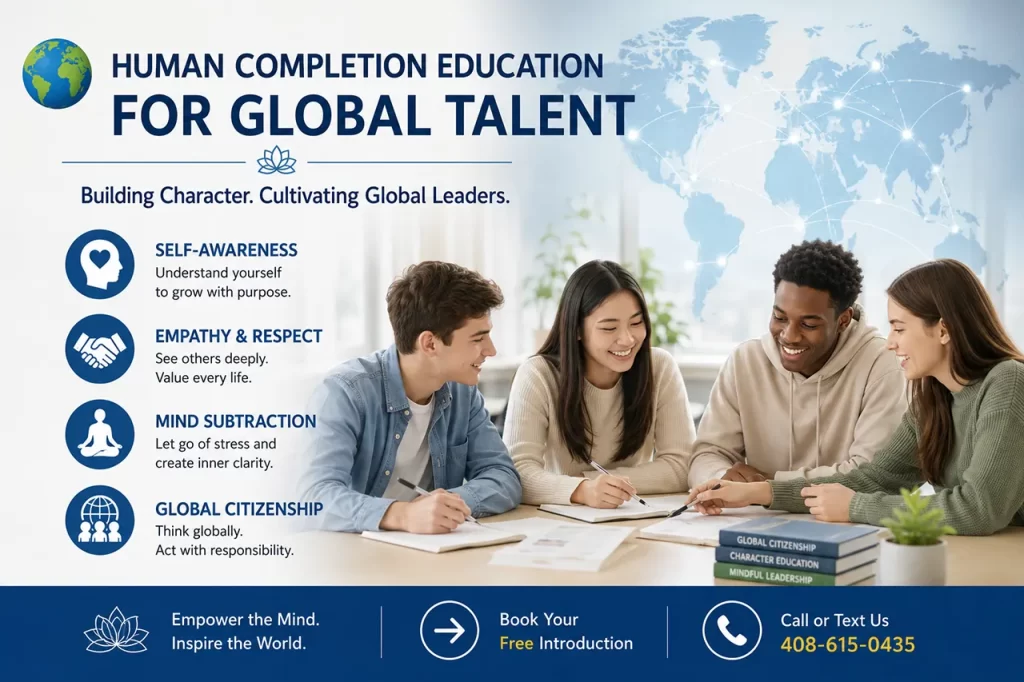
In a rapidly changing world, knowledge and academic achievement alone are not enough. Students also need empathy, communication, emotional stability, self-awareness, respect, and the ability to manage their own minds.
A feature published by Financial News introduced the 2014 Society of Human Completion Education Autumn Academic Conference, held for the first time in Gyeongnam, Korea.
The conference brought together educators, researchers, parents, and citizens to explore an important question:
How can Human Completion Education help young people grow into mature global citizens?
At the center of the discussion was the practice of mind subtraction and its role in self-reflection, character growth, and global communication.
🌱 HUMAN COMPLETION EDUCATION FOR THE FUTURE
The academic conference was held at Changwon National University under the theme:
“Conditions for Global Talent: Human Completion Education is the Future.”
Sponsored by the Ministry of Education, the conference aimed to explore practical ways to help young people develop not only intellectual ability, but also the inner maturity and character needed to contribute positively to the world.
The event included:
• Research presentations
• Field case studies
• Character education program examples
• A special workshop for Changwon citizens
Rather than remaining only in theory, the conference focused on connecting academic research with real educational practice.
This practical approach made the event especially meaningful for teachers, parents, and education professionals who were searching for realistic ways to support students’ growth.
💙 WHY CHARACTER MATTERS FOR GLOBAL TALENT
A global talent is not simply someone who succeeds academically or communicates well in different cultures.
According to the conference, true global talent requires a righteous character supported by:
• Empathy
• Communication skills
• Self-awareness
• Self-management
• Respect for others
• Consideration for the dignity of life
These qualities cannot be developed through information alone. They require inner reflection and the ability to look honestly at one’s own mind.
During a special lecture titled “Mind Subtraction for Global Communication,” Yoo Jin-woo, a former lead professor at the École Internationale de Théâtre Jacques Lecoq, emphasized that one of the most practical ways to develop these qualities is through mind subtraction.
His message pointed to a simple but important truth:
To communicate with the world, we must first understand and clear the mind within ourselves.
🧠 MIND SUBTRACTION AND SELF-MANAGEMENT
One of the key themes of the conference was self-management.
For students, teachers, and adults alike, the ability to manage the mind is one of the most important foundations for a healthy and meaningful life.
When the mind is filled with stress, judgment, comparison, fear, or fixed ideas, it becomes difficult to communicate clearly or act with wisdom.
Mind subtraction offers a way to reflect on these inner patterns and let them go.
Through this process, people can become more calm, focused, open-minded, and considerate.
This is why the conference presented mind subtraction not simply as a meditation practice, but as a practical method for Human Completion Education that can support emotional growth and inner development.
📚 RESEARCH ON MA-EUM SU-RYUN AND GLOBAL CITIZENSHIP
One of the featured research presentations focused on the “Effect of Ma-eum Su-ryun on the Global Citizenship Consciousness of Teachers and College Students.”
The study was jointly conducted by:
• Professor Lee In-soo of Korea National University of Transportation
• Professor Kim Mi of Kyungil University
• Professor Yoo Yang-kyung of Kunsan National University
This research was introduced as an important study because it examined how the self-reflection program of mind subtraction could influence the consciousness of teachers and college students.
The presentation suggested that Ma-eum Su-ryun may help participants develop a broader sense of global citizenship by encouraging them to reflect on themselves, understand others more deeply, and cultivate a more mature inner perspective.
🎒 HUMAN COMPLETION EDUCATION IN SCHOOLS
The conference also highlighted real field cases from schools and educational settings.
Presentations included topics such as:
• Education in a multicultural society
• Literature review of mind subtraction meditation
• Character education practice by the Gyeongnam Ma-eum Su-ryun Teachers’ Group
These presentations showed how self-reflection and mind subtraction could be applied in actual classrooms and educational programs.
According to the article, mind subtraction had been recognized through research papers and school applications for its positive effects on children’s:
• Emotional stability
• Concentration
• Confidence
• Leadership
For educators, this is especially meaningful because education is not only about teaching students what is right.
It is also about helping them develop the inner strength to live with clarity, confidence, and consideration.
🌟 GLOBAL TALENT BEGINS FROM WITHIN
The conference’s special workshop for Changwon citizens was held under the theme:
“Global Talent: Mind Subtraction is the Answer.”
The workshop focused on how people can manage and govern their own minds.
This message remains deeply relevant today.
Before young people can communicate with the world, they must first understand themselves.
Before they can respect others, they must first let go of the judgments and fixed ideas within their own minds.
Before they can lead others, they must first learn how to manage themselves.
True global talent begins not only with knowledge, but with character.
And character begins with self-reflection.
🌏 EDUCATION THAT HELPS PEOPLE BECOME WHOLE
The Financial News article reminds us that the future of education is not only about academic achievement.
It is about helping people become whole.
Human Completion Education helps students grow into individuals who can think clearly, communicate sincerely, respect others, and live with a broader sense of responsibility.
Through self-reflection and mind subtraction, people can begin to remove the inner barriers that prevent genuine understanding and connection.
When the mind changes, education changes.
And when education changes, the future can change too.
📰 ABOUT THE ARTICLE
Publication: Financial News
Article Title: First Human Completion Education Autumn Academic Conference Held in Gyeongnam
Published: November 21, 2014
Reporter: Kang Jae-soon
