
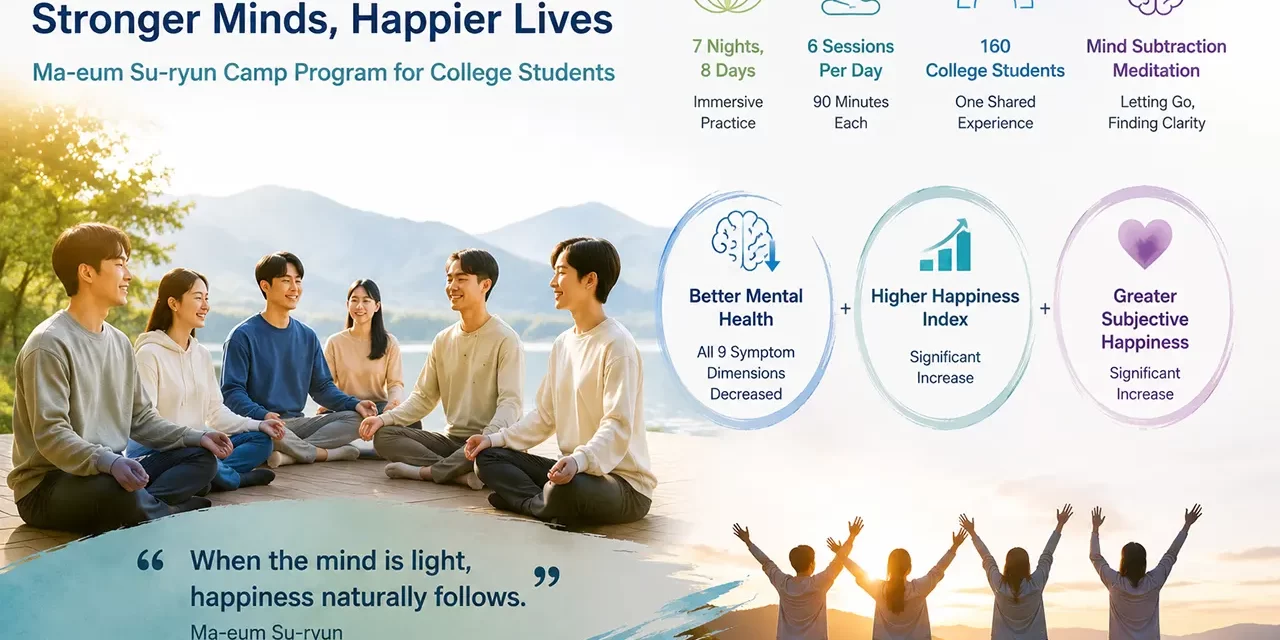
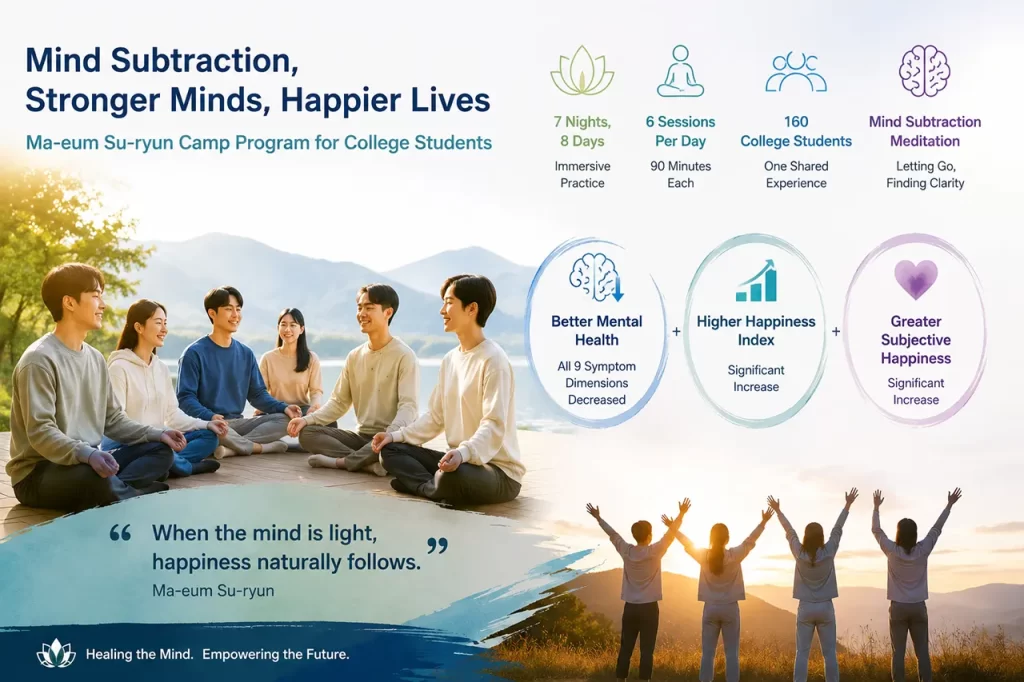
This scientific study examined the effects of an 8-day Ma-eum Su-ryun camp program on college students’ mental health and happiness. Researchers found significant improvements across all nine dimensions of psychological well-being, along with substantial increases in both happiness and subjective happiness following participation in the program.
College life is often portrayed as one of the most exciting periods of life. Yet for many students, it is also a time filled with stress, uncertainty, emotional struggles, and mental health challenges. Academic pressure, relationship difficulties, career concerns, social isolation, and anxiety about the future frequently affect students’ overall well-being.
Research conducted throughout South Korea has shown that college students experience high levels of psychological distress. Surveys have reported alarming rates of depression, hopelessness, and suicidal thoughts among university students. At the same time, happiness levels among college students have been found to be significantly lower than the national average.
Against this backdrop, researchers sought to determine whether participation in a Ma-eum Su-ryun camp program could help improve students’ mental health and overall happiness. The results were striking. Participants experienced significant reductions across every measured dimension of psychological distress while simultaneously reporting higher levels of happiness and life satisfaction.
The findings provide compelling evidence that systematically discarding accumulated mental burdens through the Ma-eum Su-ryun mind subtraction method founded by Master Woo Myung can positively impact emotional well-being and psychological resilience.
🛑 THE GROWING MENTAL HEALTH CHALLENGE AMONG COLLEGE STUDENTS
University counseling centers across South Korea have documented a wide range of concerns affecting students, including:
- Depression and anxiety
- Academic stress
- Relationship difficulties
- Social isolation
- Career uncertainty
- Physical symptoms related to stress
- Substance misuse
- Low self-esteem
- Suicidal thoughts
One university survey found that nearly 70% of students had experienced feelings of despair or sadness within the previous year. Even more concerning, nearly three-quarters reported having experienced suicidal thoughts at least briefly.
Researchers noted that these findings highlight the urgent need for effective interventions that support both psychological health and overall well-being among college students.
👥 STUDY PARTICIPANTS AND METHODS
Research Design
The study used a single-group pretest-posttest design to evaluate changes in:
- Mental health
- Happiness Index
- Subjective happiness
Participants
- 160 college students
- 7-night, 8-day Ma-eum Su-ryun College Student Camp
- Conducted at the Ma-eum Su-ryun Education Center in Nonsan, South Korea
- December 29, 2012 – January 5, 2013
Participants completed structured assessments both before and after the program.
🔬 HOW MENTAL HEALTH AND HAPPINESS WERE MEASURED
Mental Health Assessment
Researchers utilized the Brief Symptom Inventory (BSI), which evaluates nine major dimensions of psychological distress:
- Somatization
- Obsessive-Compulsive Symptoms
- Interpersonal Sensitivity
- Depression
- Anxiety
- Hostility
- Phobic Anxiety
- Paranoid Ideation
- Psychoticism
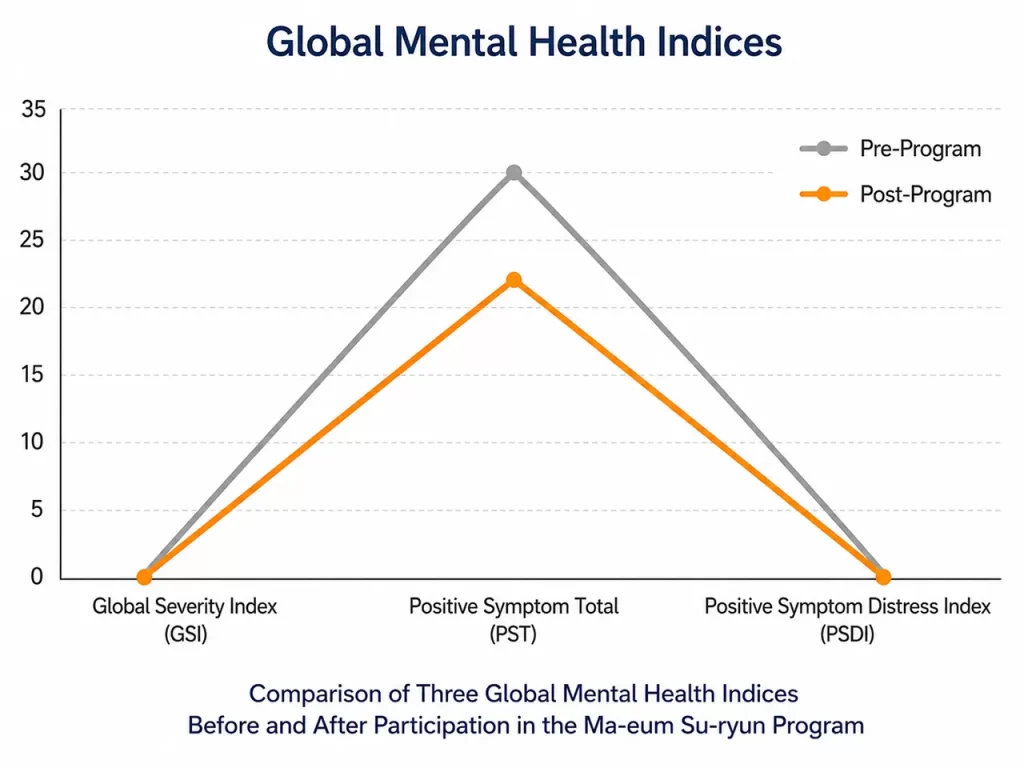
Researchers also evaluated overall psychological distress through several global mental health indices.
Happiness Assessment
Two separate measures were used:
- Happiness Index
- Subjective Happiness Scale
These assessments allowed researchers to examine both objective and personal perceptions of happiness and life satisfaction.
🌱 THE MA-EUM SU-RYUN CAMP PROGRAM
The intervention consisted of an intensive Level 1 Ma-eum Su-ryun meditation program specifically designed for college students.
Participants completed:
- Six meditation sessions per day
- Ninety minutes per session
- Eight consecutive days of training
- Instruction from professional Ma-eum Su-ryun instructors
The program focused on the practice of mind subtraction, a systematic method of reviewing and discarding accumulated memories, thoughts, emotions, and mental images.
⚡ THE SCIENTIFIC RESULTS: IMPROVEMENTS ACROSS ALL MENTAL HEALTH DIMENSIONS
1. Significant Improvement in Mental Health
The most remarkable finding was that all nine mental health symptom dimensions showed statistically significant improvement after participation in the camp.
Researchers observed reductions in:
- Depression
- Anxiety
- Hostility
- Interpersonal sensitivity
- Obsessive thinking
- Physical stress symptoms
- Phobic anxiety
- Paranoid thinking
- Psychotic symptoms
This means participants experienced broad improvements across virtually every area of psychological functioning measured in the study.
2. Increased Happiness
The Happiness Index increased significantly following participation in the program.
Students reported greater positivity, emotional stability, and overall well-being after completing the camp.
3. Increased Subjective Happiness
Participants also reported significantly higher levels of subjective happiness.
Researchers noted that students appeared to experience greater gratitude, forgiveness, emotional brightness, and a more positive outlook on life as they released accumulated emotional burdens through the meditation process.
🌟 WHY DID THE PROGRAM WORK?
According to the researchers, the Ma-eum Su-ryun method allows participants to repeatedly review and discard memories that have accumulated throughout their lives.
As individuals let go of painful memories associated with sadness, anxiety, fear, resentment, and emotional distress, the psychological burden carried by those memories naturally decreases.
Researchers suggested that this process may help:
- Reduce depression and anxiety
- Relieve emotional tension
- Improve interpersonal relationships
- Decrease stress-related physical symptoms
- Enhance overall emotional well-being
As participants released false thoughts and emotional burdens, they became more capable of experiencing positive emotions such as gratitude, acceptance, forgiveness, and happiness.
🌿 CONCLUSION: A SCIENTIFICALLY SUPPORTED APPROACH TO STUDENT WELL-BEING
This study demonstrated that the Ma-eum Su-ryun Camp Program significantly improved college students’ mental health, Happiness Index, and subjective happiness.
Perhaps most notably, all nine dimensions of psychological distress showed statistically significant reductions following participation in the program.
The findings suggest that Ma-eum Su-ryun offers more than temporary stress relief. By systematically discarding accumulated mental burdens through mind subtraction, students may develop greater emotional resilience, improved mental health, and a deeper sense of happiness and life satisfaction.
The researchers concluded that Ma-eum Su-ryun-based programs may serve as valuable tools for promoting healthier and happier university communities and recommended broader implementation within higher education settings.
— End of Research Summary —
If stress, anxiety, uncertainty, or emotional burdens are preventing you from fully enjoying life, a practical solution may be closer than you think. Through the systematic mind subtraction method taught by Master Woo Myung, countless students and adults have discovered greater happiness, emotional freedom, and inner peace. Experience Ma-eum Su-ryun for yourself at Santa Clara Meditation.
🔬 RESEARCH DOCUMENTATION INFO
Researchers
- Prof. Mi-Han Kim (Kyungil University)
- Prof. In-Soo Lee (Korea National University of Transportation)
- Yang-Kyung Yoo (Kunsan National University)
Publisher: Journal of the Academic Society for Human Completion, Vol. 5
Year Published: 2013
Study Title: Effects of the Ma-eum Su-ryun Camp Program on Mental Health and Happiness Among College Students
