
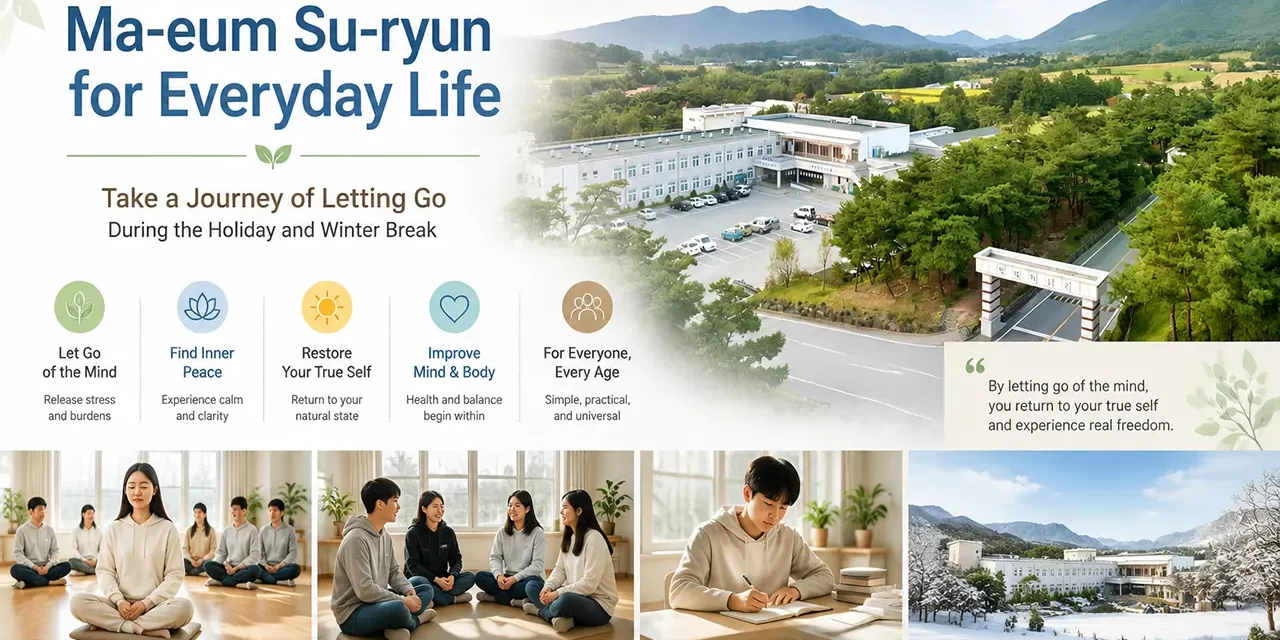
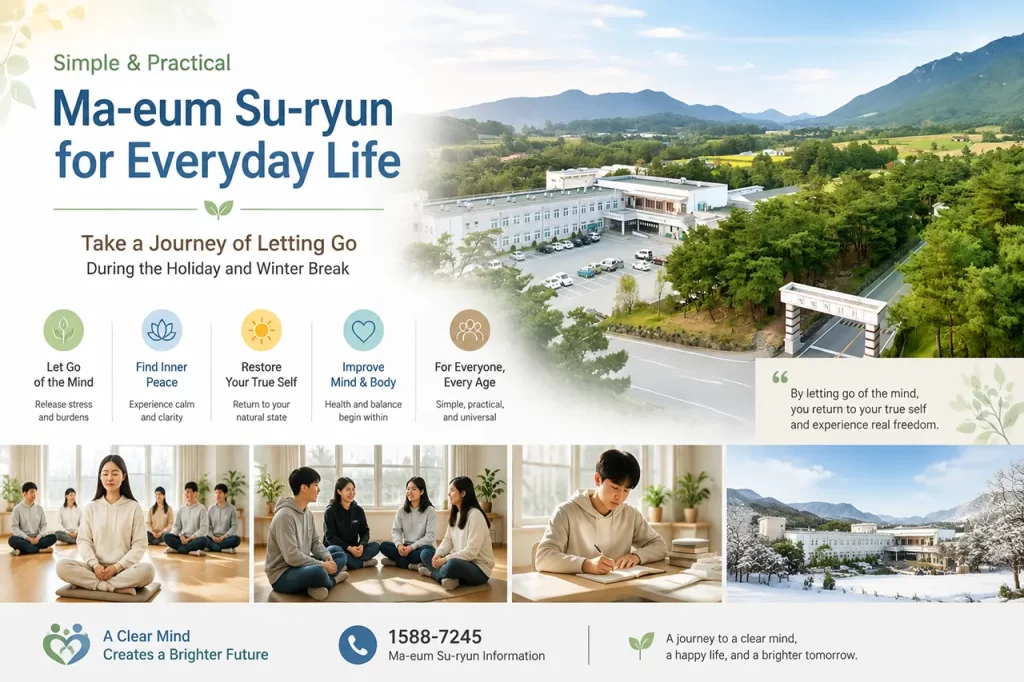
As the holiday season and winter break approach, many people begin planning vacations to rest their bodies. But according to a feature published by Naeil News, an increasing number of people are choosing a different kind of getaway—one designed to refresh the mind.
The article introduces Ma-eum Su-ryun as a simple and practical meditation method that can be practiced by people of all ages and backgrounds. Rather than requiring special abilities or religious beliefs, the practice focuses on helping individuals reflect on their lives and let go of the mental burdens accumulated through everyday experiences.
As interest in mental well-being continues to grow, the article explores why more families, students, teachers, and professionals have begun spending part of their holidays on what participants call a “vacation for the mind.”
🌱 A Meditation Anyone Can Practice
Since its introduction in 1996, Ma-eum Su-ryun has grown steadily as a practical approach to meditation.
According to the article, one reason for its popularity is its simplicity.
The method is designed so that people from diverse backgrounds can participate, including:
- Children
- Adults
- Seniors
- Entire families
- People of all religious backgrounds
Because the practice centers on self-reflection and letting go of the mind, no prior meditation experience or academic background is required.
📷 Understanding the Mind Through a Simple Analogy
One of the unique aspects of Ma-eum Su-ryun is its explanation of the mind through the analogy of photographs.
The article explains that every experience throughout life is stored like a photograph—not only what we see, but also what we hear, smell, and feel.
These accumulated memories shape how we interpret the world around us.
According to the meditation method, many people unknowingly live through these remembered images rather than experiencing reality directly.
By recognizing and letting go of these accumulated “mental photographs,” practitioners seek to experience greater clarity, freedom, and peace.
💙 Letting Go of Mental Burdens
The article suggests that many of life’s emotional difficulties arise from the accumulation of stressful memories and attachments.
These may include:
- Stress
- Resentment
- Anger
- Anxiety
- Excessive attachment
- Distracting thoughts
Rather than trying to suppress these emotions, the meditation encourages participants to acknowledge them through self-reflection and gradually let them go.
As these burdens are released, many practitioners report feeling lighter, calmer, and more emotionally balanced.
🩺 The Connection Between Mind and Body
The article also explores the relationship between mental and physical well-being.
It introduces the idea that long-term emotional patterns can influence habits, which may in turn affect overall health.
Former Memorial Sloan Kettering Cancer Center researcher Dr. Lee Sang-yul, who later became a professor at Pusan National University College of Medicine, commented on the importance of the relationship between psychological well-being and physical health.
Rather than presenting meditation as a treatment for illness, the article explains that the practice focuses on addressing the mental burdens that may contribute to stress and unhealthy patterns over time.
✨ A Story of Personal Change
The article also shares the experience of Lee Hee-joo, a lawyer from Seoul who struggled with insomnia and chronic dry skin associated with work and family stress.
According to her account, meditation helped her become less reactive to anger.
Instead of responding emotionally, she found herself able to remain calm and let difficult feelings pass more naturally.
As her stress diminished, she reported sleeping more deeply and feeling refreshed even after long workdays.
Her story illustrates how emotional changes may positively influence overall quality of life.
❄️ A Different Kind of Holiday
According to the article, the period between late December and early February is one of the busiest times of the year for Ma-eum Su-ryun centers.
Many participants choose to spend part of their winter vacation focusing on personal reflection rather than traditional travel.
During this season, centers offer programs including:
- Teacher training
- Youth meditation camps
- University student meditation camps
- Residential meditation retreats
- Flexible local programs for families and working adults
Whether attending an intensive residential retreat or commuting to a nearby center, participants have opportunities to explore meditation in a setting that fits their individual schedules.
🌟 Making Time for the Mind
Modern life often leaves little time for quiet reflection.
The Naeil News feature suggests that taking care of the mind can be just as important as taking care of the body.
For many participants, setting aside time during the holidays to reflect, release accumulated stress, and cultivate inner peace has become a meaningful way to begin a new year.
Rather than simply escaping daily life, they choose to better understand themselves—and return home with a clearer, lighter perspective.
📰 About the Article
Publication: Naeil News
Article Title: Simple and Practical Ma-eum Su-ryun for Everyday Life: Take a Journey of Letting Go During the Holiday and Winter Break
Published: December 10, 2010
