

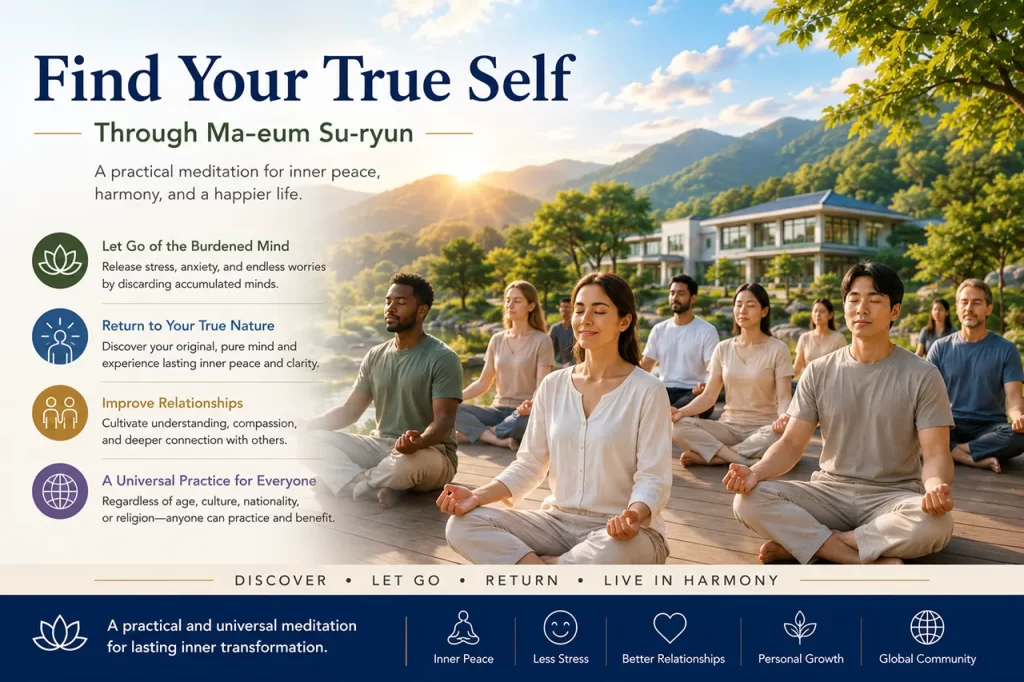
In a special cover story titled “The Mind Deep-Cleaning Project: Where Misery Ends and Happiness Begins,” JoongAng Ilbo explored the experiences of people from diverse backgrounds who turned to Ma-eum Su-ryun in search of greater peace, healthier relationships, and freedom from long-held emotional burdens.
The article featured newlyweds, teachers, professionals, healthcare workers, and even a 105-year-old independence activist who shared how reflecting on and letting go of accumulated memories and emotions transformed their lives.
💍 A Honeymoon Unlike Any Other
Most newly married couples choose beaches, resorts, or famous tourist destinations for their honeymoon.
For Song Young-seop and his wife, the destination was something entirely different: a week-long stay at the Ma-eum Su-ryun Education Institute.
The couple described their decision as a promise they had made before marriage. Through meditation and self-reflection, they hoped to better understand themselves and each other.
During their stay, they examined the thoughts, expectations, attachments, and emotions they had accumulated throughout their lives.
By the end of the week, Song felt that something profound had changed.
“The more you empty, the more you are filled,” he reflected, describing the sense of freedom and happiness they experienced as they returned to daily life together.
🌱 Looking Back on Life Through Self-Reflection
According to the article, approximately 200,000 people had participated in Ma-eum Su-ryun programs over a ten-year period.
The JoongAng Ilbo reporting team visited the center directly and observed participants engaged in guided reflection exercises designed to help them revisit memories and release the emotions attached to them.
The method encouraged participants to look honestly at painful experiences, long-held resentments, attachments, and self-centered perspectives.
For many, this process became an opportunity to understand themselves in a completely new way.
❤️ From Resentment to Gratitude
One participant, office worker Kim Jung-sook, described arriving at the center under severe stress and carrying years of emotional pain.
As she reflected on her life and emotions, she found herself crying intensely.
What surprised her most was that feelings of resentment gradually gave way to gratitude.
She explained that as old emotional burdens dissolved, she experienced a sense of freedom she had never known before.
😴 Freedom from a Decade of Insomnia
Another participant, teacher Jung Eun-chae, shared a story that deeply resonated with many readers.
After losing her father at a young age, she spent years supporting her family and carrying a strong belief that she was sacrificing herself for others.
That burden stayed with her throughout adulthood and contributed to ten years of chronic insomnia.
During the meditation program, she began examining those deeply rooted thoughts and emotions.
To her surprise, she slept deeply after just one day at the center — the first restful sleep she had experienced in a decade.
She later described realizing that true love involves giving without constantly thinking about one’s own sacrifice.
🍎 A Teacher’s Transformation
One of the most memorable stories in the article came from elementary school teacher Kim Nak-sook.
She openly admitted that she had once been what many would call a “tiger mom.”
She believed academic achievement determined happiness and often placed enormous pressure on her son.
Their relationship deteriorated to the point where conflicts became frequent and painful.
Through meditation and self-reflection, she began recognizing how strongly her own beliefs and expectations had shaped her behavior.
As she let go of those rigid ideas, her relationship with her son changed dramatically.
Today, she encourages him to study at his own pace and focus on balance rather than perfection.
Her classroom changed as well.
Instead of commanding students, she began guiding them with greater understanding and empathy.
Perhaps her most important realization was simple:
“Happiness does not depend on grades.”
💙 From Divorce to Reconciliation
Dentist Kim Man-jung shared another powerful story.
Despite professional success, his marriage was falling apart.
Family conflicts, financial struggles, childhood insecurities, and differing expectations created constant tension between him and his wife.
Eventually, he seriously considered divorce.
At the recommendation of a senior colleague, he attended a Ma-eum Su-ryun program as a last attempt to save the relationship.
Through reflecting on his life experiences and emotional burdens, he came to a surprising conclusion:
The problem was not simply his wife or his circumstances.
He needed to change himself.
After returning home, he began approaching his marriage from a different perspective.
Over time, the relationship improved, and eventually his wife also chose to attend the program.
Today, he describes their marriage as stronger and more loving than before.
🌸 A 105-Year-Old Finds Freedom
Perhaps the most remarkable story featured in the article was that of Han Sook-ja, who was 105 years old at the time.
Having lived through Japanese occupation, imprisonment during the independence movement, war, family loss, and more than a century of life’s hardships, she believed she had little left to learn.
Yet after attending the program, she found herself revisiting memories she had carried for decades.
Among them were painful memories from the March First Independence Movement, imprisonment at Seodaemun Prison, and the loss of loved ones.
She described repeatedly letting go of regrets, grief, guilt, and sorrow that had remained with her for much of her life.
Eventually, she experienced what she called a profound sense of freedom.
One statement from her interview stood out:
“The prison of the mind is more painful than Seodaemun Prison.”
After releasing those burdens, she said she no longer feared death and felt grateful for everything in life.
🌿 A Common Theme: Letting Go
Although the participants came from vastly different backgrounds, their stories shared a common thread.
Many described:
- Reduced stress
- Improved relationships
- Better sleep
- Greater emotional freedom
- Less resentment and anxiety
- A deeper sense of gratitude
Their experiences suggest that meaningful change often begins not by changing the world around us, but by examining and releasing the burdens we carry within.
📰 About the Article
Publication: JoongAng Ilbo
Cover Story: The Mind Deep-Cleaning Project: Where Misery Ends and Happiness Begins
Published: June 1, 2006
