

📖 Introduction
Behind beautiful performances and elegant stages, many musicians quietly struggle with pressure, anxiety, perfectionism, competition, and fear of failure.
For performers, even the smallest emotional instability can immediately appear through sound, breathing, and expression.
This meditation testimonial shares the heartfelt story of Ji Hye S., a professional oboist who studied in Germany and performed with orchestras and chamber ensembles while teaching music at universities in Korea.
Although she appeared calm and successful on the outside, internally she constantly battled stress, nervousness, attachment to achievement, and fear of losing recognition.
Through meditation and learning how to let go of the thoughts and emotional burdens inside her mind, she gradually discovered something far more important than technical perfection:
True freedom.
As she discarded attachment, pressure, and fear, her music itself began to change. Performing became joyful again, concentration deepened naturally, and music began flowing more freely and sincerely from her heart.
This inspiring meditation testimonial beautifully shows how inner peace and genuine expression can emerge when the mind becomes lighter and free from attachment.
💬 Meditation Testimonial: “For Great Music, There Is Something Essential: Meditation and Letting Go”
By Ji Hye S. | Oboist
I am an oboist.
The oboe is the instrument that gives the tuning note before an orchestra begins performing.
When the oboist plays the “A” note, every other instrument tunes itself to that sound.
Just from hearing that single note, people can immediately tell how skilled the oboist is.
Because of that, there is tremendous pressure.
If the oboe’s pitch is unstable, the entire orchestra can become unstable as well.
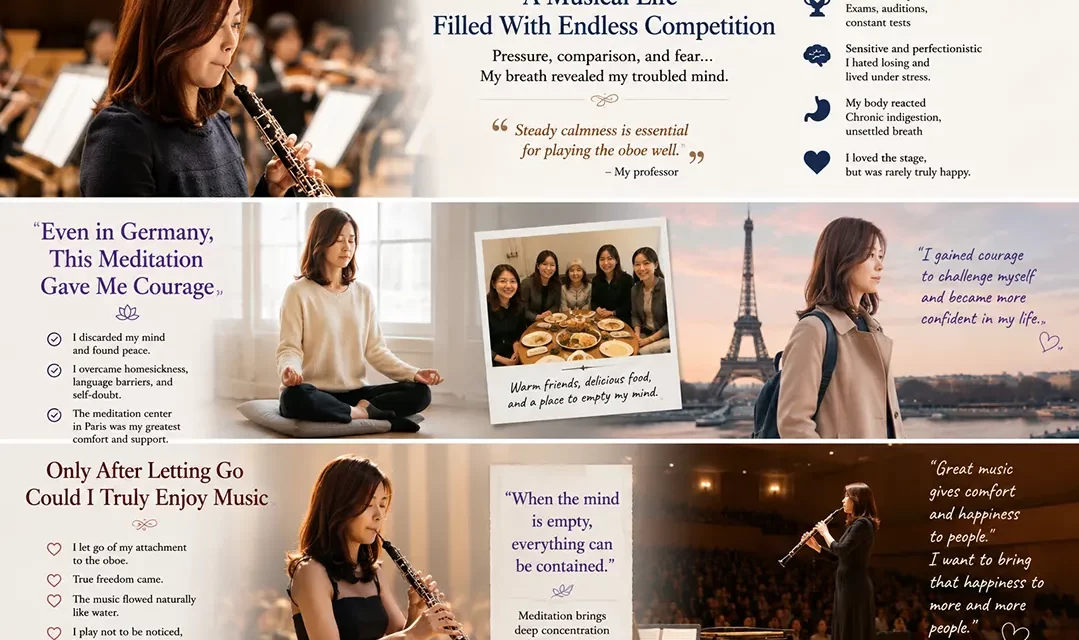
Honestly, the life of a musician may appear elegant from the outside, but in reality it is an endless cycle of competition:
Entrance exams.
Auditions.
Evaluations.
Performances.
Since childhood, music was always part of my life.
My mother had majored in piano, so our home was constantly filled with music. She frequently took me to concerts, orchestras, and recitals, and naturally she hoped her daughter would also become a musician.
I first learned piano, then cello, and eventually started playing the oboe during middle school.
There was something about the sound of the oboe that deeply moved my heart.
Even though practicing was difficult, I loved the feeling of standing on stage, receiving applause, and being recognized.
But honestly, I was rarely truly happy.
🌱 Music, Competition, and Constant Pressure
I hated losing and was extremely sensitive emotionally.
Because of constant stress, I suffered from chronic indigestion for a long time.
And since the oboe is a wind instrument, every emotional state immediately appears in the sound.
If my mind became unsettled, my performance also became unstable.
My professor often emphasized that calmness was essential for good oboe performance.
But maintaining that calmness was never easy.
The turning point in my life came during my second year of college, when I first encountered this meditation.
Originally, I only intended to try it briefly.
But after actually practicing meditation and emptying my mind, I felt such peace and comfort that I continued.
As I gradually discarded my mind, many things began changing.
My chronic indigestion disappeared.
Unnecessary stress and worries faded away.
And slowly, even my musical performance improved.
🇩🇪 Even While Studying Abroad in Germany, I Continued Meditation
In 2007, I went to Germany to study at the State University of Music and Performing Arts Mannheim.
But once I arrived there, I lost much of my confidence.
In Korea, I had always believed I was talented.
But in Germany, suddenly I felt like I was nothing.
I struggled with the unfamiliar environment, language barriers, loneliness, and pressure.
During that difficult period, the place that gave me the greatest comfort was the meditation center in Paris.
At that time, it was the closest meditation center to Mannheim, about three hours away by train near the Eiffel Tower.
Many people gathered there:
Professors.
Office workers.
International students.
Because everyone came there to discard their minds, the atmosphere naturally felt warm and comforting.
Whenever I visited, people prepared food for me, encouraged me, and helped me continue meditating.
Through that support, I slowly discarded the burdens, fears, and mental barriers inside me.
And gradually, I gained courage to challenge myself more confidently while living abroad.
🎵 The Thing I Was Holding Onto Most Tightly Was the Oboe Itself
One day during meditation, I realized something shocking:
The thing I was most attached to was the oboe itself.
I could not imagine who I was without it.
My confidence came from being an oboist.
Recognition and praise also came because of the oboe.
That attachment had quietly become a prison inside my mind.
Because the oboe became my identity, I constantly pressured myself to perform well so people would acknowledge me.
I became anxious about making mistakes.
When performances did not go well, I suffered deeply.
Eventually, I realized:
I was no longer playing music because I loved music.
I was playing because I was afraid.
Afraid that without the oboe, people might no longer value me.
🌿 Only After Letting Go Could I Truly Enjoy Music
For oboists, the reed is extremely important.
Even with the exact same instrument, every performer produces a completely different sound because the tone changes according to the mind and heart of the person shaping the reed.
At some point, I realized I needed to let go of the oboe itself.
For many days, I intensely discarded those attachments through meditation.
And finally, the moment I released it in my heart…
The feeling of freedom was indescribable.
That was true liberation.
I realized that when you let go of attachment to recognition, success, music, love, and identity, you finally become truly free.
At first, letting go feels frightening, as if you are losing everything.
But in reality, something much greater returns.
Only after overcoming myself in that way was I finally able to truly enjoy music again.
Performing on stage completely changed.
The act of playing itself became deeply precious.
Even though I was performing the same music, I began discovering expressions and emotions I had never noticed before.
Before, I performed inside the narrow world of “myself.”
Now, music flows much more naturally and freely.
In the past, my performances felt like they were saying:
“Please notice how well I play.”
But now, because I no longer obsess over evaluation or recognition, I can immerse myself completely in the music itself.
And when that happens, the music flows naturally like water.
✨ “When the Mind Is Empty, Everything Can Be Contained”
Friends often tell me that I seem far more relaxed now, and even my face looks different.
One of the greatest changes through meditation has been concentration.
When endless distracting thoughts disappear, you can fully use your abilities to their greatest extent.
I truly came to understand the saying:
“Only when nothing is inside can everything be contained.”
Especially for musicians, I believe learning how to manage the mind is incredibly important.
Many performers around me cannot even stand on stage without anxiety medication because of nervousness.
Music expresses the heart.
So for the sake of truly beautiful music, I sincerely hope people will give themselves time to let go of themselves and empty their minds, even just once.
Great music brings comfort and happiness to people.
And I too hope to continue sharing genuine music free from attachment.
I dream of the day when many people will listen to my music and simply say:
“I felt truly happy.”
