
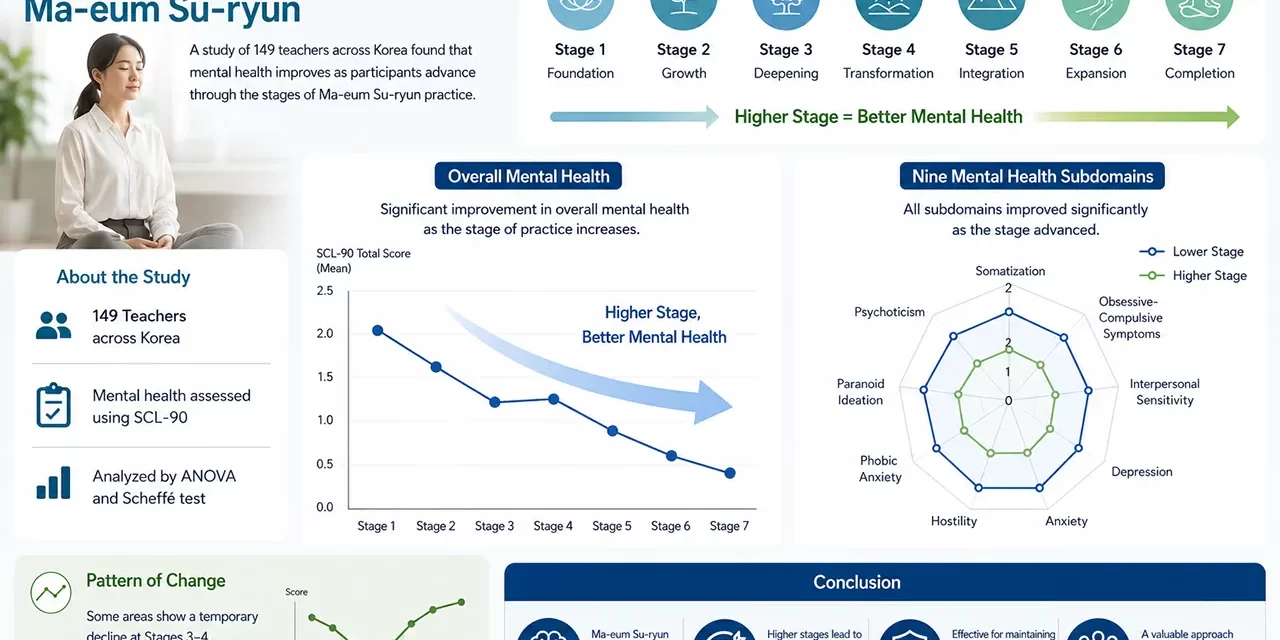
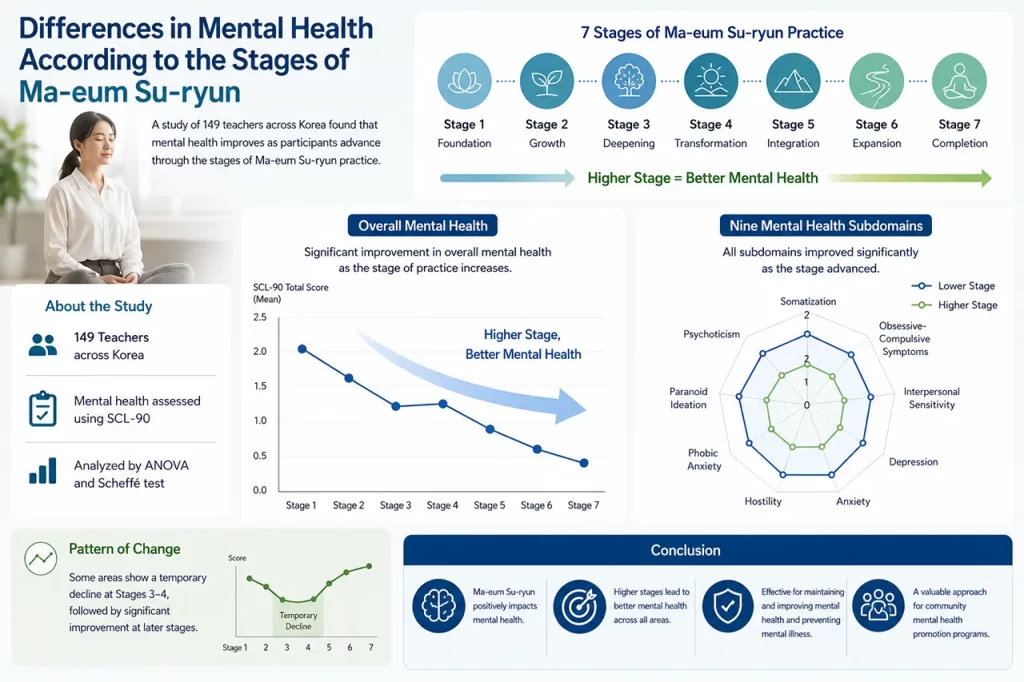
This scientific study examined how mental health changes as individuals progress through the stages of Ma-eum Su-ryun practice. Researchers found that overall mental health and all nine dimensions of psychological well-being improved significantly as participants advanced through higher levels of the Ma-eum Su-ryun meditation method founded by Master Woo Myung.
Mental health challenges have become increasingly common in today’s fast-paced world. Stress, anxiety, depression, emotional instability, and interpersonal difficulties affect people of all ages and can significantly impact overall quality of life. As researchers continue exploring the connection between the mind and physical well-being, meditation has emerged as one of the most widely studied approaches for promoting psychological health.
This study investigated whether long-term participation in Ma-eum Su-ryun is associated with measurable improvements in mental health. Rather than focusing solely on short-term benefits, the researcher examined how mental health differed according to participants’ stages of practice.
The results revealed a clear and encouraging pattern. Participants who had progressed to more advanced stages of Ma-eum Su-ryun consistently demonstrated better mental health outcomes across every psychological category measured in the study.
The findings suggest that as practitioners continue the process of mind subtraction and discard accumulated mental burdens, meaningful improvements in emotional well-being and psychological resilience may naturally occur.
🌱 WHY THIS STUDY MATTERS
Mental health has become a major public health concern worldwide. Anxiety, depression, stress-related disorders, and emotional difficulties affect countless individuals and contribute to declining quality of life.
At the same time, growing scientific evidence suggests that mental interventions such as meditation may positively influence emotional well-being, physical health, and stress management.
While many studies have examined whether meditation works, relatively few have explored whether the benefits continue to increase as individuals deepen their practice over time.
This study sought to answer that question by examining differences in mental health among practitioners at various stages of Ma-eum Su-ryun.
👥 STUDY PARTICIPANTS
The study included:
- 149 teachers practicing Ma-eum Su-ryun throughout South Korea
- Participants from:
- Kindergartens
- Elementary schools
- Middle schools
- High schools
- Universities
All participants voluntarily agreed to participate and completed structured mental health questionnaires.
🔬 HOW MENTAL HEALTH WAS EVALUATED
Researchers used the Symptom Checklist-90 (SCL-90), a widely recognized psychological assessment tool.
Mental health was measured across nine dimensions:
- Somatization
- Obsessive-Compulsive Symptoms
- Interpersonal Sensitivity
- Depression
- Anxiety
- Hostility
- Phobic Anxiety
- Paranoid Ideation
- Psychoticism
Researchers also evaluated participants’ overall mental health by combining results across all symptom categories.
📈 THE SCIENTIFIC RESULTS: BETTER MENTAL HEALTH AT HIGHER STAGES
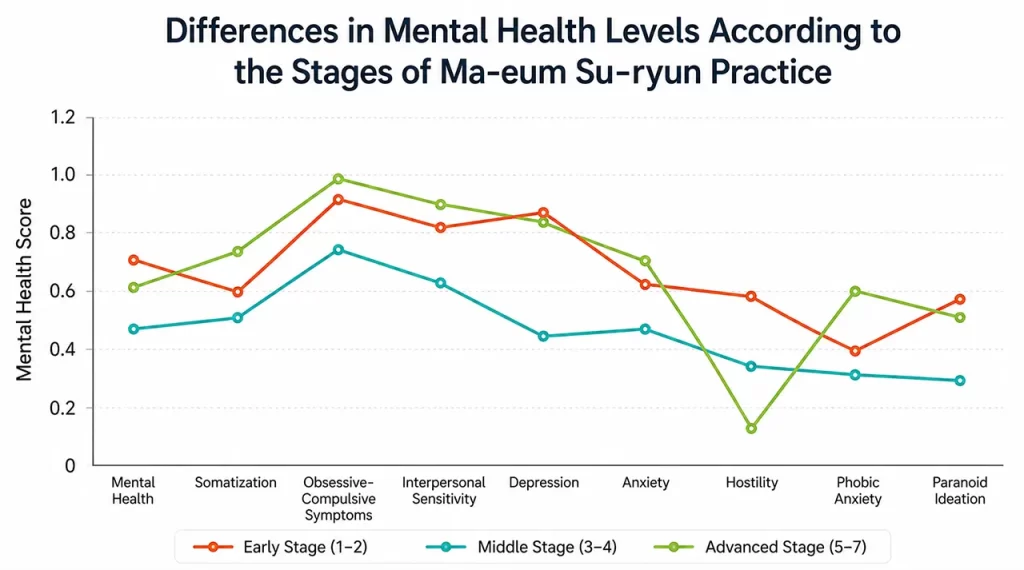
The study found statistically significant differences in overall mental health according to participants’ stages of Ma-eum Su-ryun practice.
Participants in more advanced stages consistently demonstrated healthier psychological profiles than those in earlier stages.
Significant Improvements Were Observed In:
- Depression
- Anxiety
- Hostility
- Interpersonal Sensitivity
- Obsessive-Compulsive Symptoms
- Somatic Complaints
- Phobic Anxiety
- Paranoid Ideation
- Psychoticism
Most importantly, improvements were observed not only in individual categories but also in overall mental health.
✨ A REMARKABLE PATTERN OF GROWTH
One of the most interesting findings was that mental health improvement did not always occur in a perfectly straight line.
For some categories, participants experienced temporary fluctuations during intermediate stages before showing substantial improvement at more advanced levels.
Researchers suggested that this pattern may reflect the natural process of confronting and discarding deeply accumulated memories, emotions, and mental burdens.
The findings highlight the importance of persistence and continued practice throughout the stages of Ma-eum Su-ryun.
🌿 CONCLUSION: MA-EUM SU-RYUN SUPPORTS LONG-TERM MENTAL HEALTH
This study demonstrated that mental health differs significantly according to participants’ stages of Ma-eum Su-ryun practice.
Researchers found significant differences not only in overall mental health but also across all nine psychological symptom dimensions. Participants practicing at higher stages consistently demonstrated healthier mental and emotional functioning.
The findings suggest that Ma-eum Su-ryun may serve as an effective approach for:
- Maintaining mental health
- Improving psychological well-being
- Building resilience to stress
- Preventing mental illness
- Supporting emotional balance
As individuals continue the process of mind subtraction and move through progressively deeper stages of practice, they may experience meaningful improvements in both emotional health and overall quality of life.
— End of Research Summary —
If stress, anxiety, emotional burdens, or negative thought patterns are affecting your daily life, a practical solution may be within reach. Through the systematic process of mind subtraction taught by Master Woo Myung, countless people have discovered greater emotional freedom, inner peace, and lasting well-being. Experience the benefits of Ma-eum Su-ryun for yourself at Santa Clara Meditation.
