
📖 INTRODUCTION
Many people believe success will bring happiness.
A prestigious career.
Recognition.
Achievement.
Respect from others.
Yet countless successful people eventually discover that external accomplishments do not always fill the emptiness within.
This meditation testimonial shares the story of Jin-woo Y., a renowned theater artist and the first Asian professor at the world-famous École Jacques Lecoq in Paris.
After years of pursuing excellence and achieving what many only dream of, he found himself facing a difficult question:
“Why do I still feel empty?”
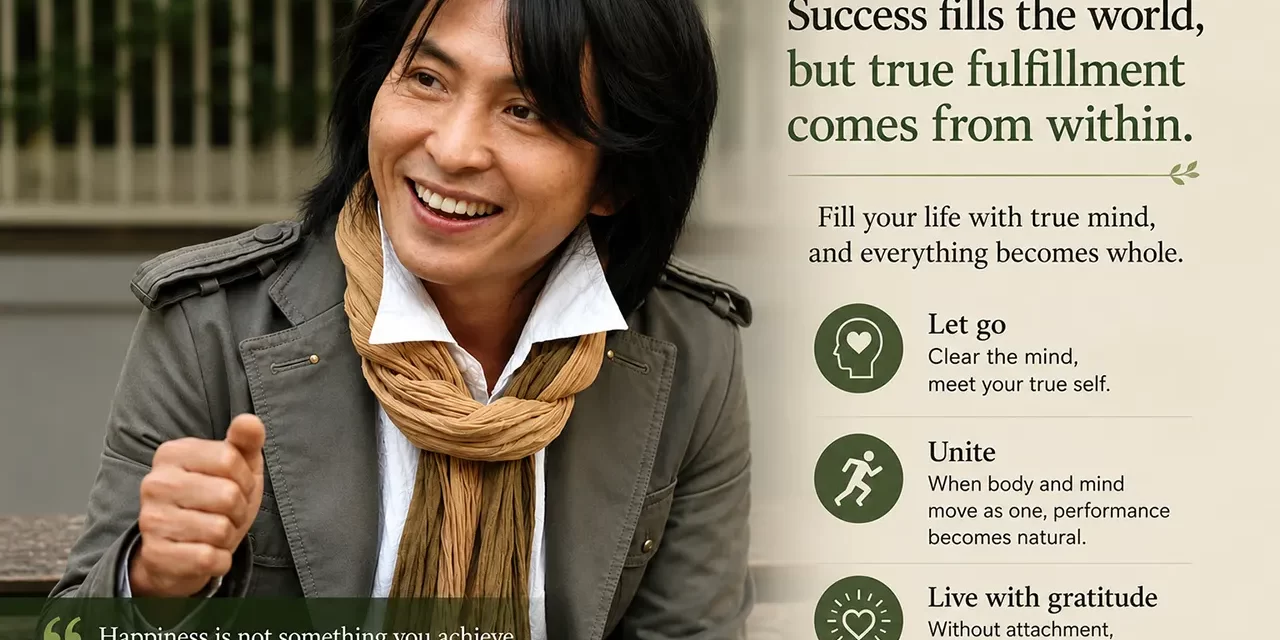
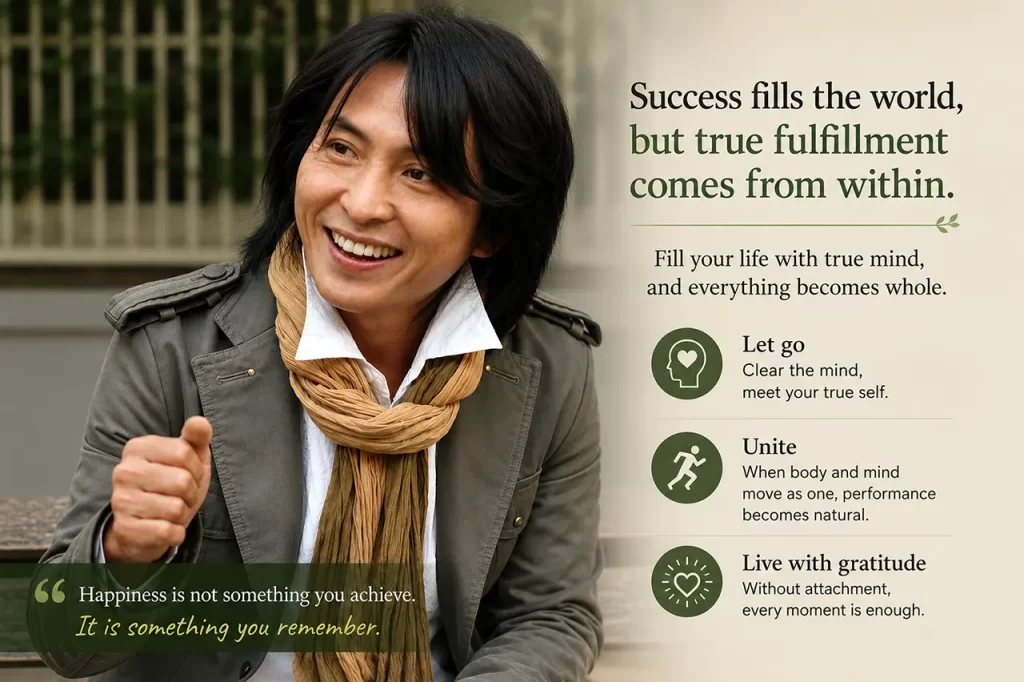
Through this meditation, he discovered that the answer was not found in gaining more success, but in letting go of the countless thoughts, attachments, and identities he had accumulated throughout his life.
His story beautifully illustrates how true fulfillment comes not from what we achieve, but from discovering our true nature.
💬 MEDITATION TESTIMONIAL: “EVEN AFTER SUCCESS, WHY DOES LIFE STILL FEEL EMPTY?”
By Jin-woo Y. | Theater Artist
In 1995, I stood atop the Eiffel Tower in Paris and made a promise to myself.
“When I need you now, France, someday I will make you need me.”
At the time, I was a struggling mime artist pursuing a dream.
Five years later, that dream became reality.
I became the first Asian professor at École Jacques Lecoq, one of the most respected theater schools in the world.
Students from around the globe came to learn movement acting from me.
Many even called me “Maestro.”
Yet despite all those accomplishments, something inside me remained unresolved.
🌟 SUCCESS COULDN’T FILL THE EMPTINESS
As a child growing up in a small mountain village in Jeongeup, I loved performing.
I imitated singers.
Entertained neighbors.
And naturally found joy expressing myself through movement.
After entering university and studying theater, I devoted myself completely to mastering my craft.
Long after classes ended, I continued training.
I practiced:
• Traditional Korean mask dance
• Acrobatics
• Stretching
• Handstands
• Physical theater techniques
In 1992, I debuted professionally as a mime artist.
As my career advanced, recognition increased.
Yet strangely, the more recognition I received, the more emptiness I felt.
I often wondered:
“Why do I still feel incomplete?”
Physically, I felt capable.
But internally, my mind and body felt disconnected.
That question eventually led me to Paris.
🇫🇷 “WHAT WE NEED IS JIN-WOO Y. — HE JUST HAPPENS TO BE KOREAN”
At École Jacques Lecoq, I discovered an environment unlike anything I had experienced before.
The school was internationally respected for movement and physical theater.
I immersed myself completely.
Fortunately, I adapted quickly.
People often told me I had a rare ability to observe movement once and reproduce it almost perfectly.
Eventually, I became the first Asian to complete the school’s elite instructor training program.
Later, I was invited to join the faculty.
At one point, administrative authorities questioned appointing a Korean professor.
The school’s response became famous:
“What we need is Jin-woo Y. He simply happens to be Korean.”
Those words deeply moved me.
Yet even then, the emptiness remained.
No amount of success seemed able to remove it.
💌 A SINGLE SENTENCE CHANGED EVERYTHING
In 2002, after a television documentary about my life aired in Korea, I received an email from a woman living in Seoul.
We exchanged messages regularly.
Her warmth and sincerity drew me in.
Eventually, she would become my wife.
But one sentence she shared remained with me:
“When I emptied my mind, I became one with everything in the world.”
That statement fascinated me.
As a movement artist, I constantly explored how human beings connect with emotions, nature, and the world around them.
Yet I realized I had only imagined such unity.
I had never actually experienced it.
Soon afterward, I began practicing meditation.
🌱 THE ANSWERS I HAD SEARCHED FOR ALL MY LIFE
As I continued meditation, I began experiencing something remarkable.
The questions I had struggled with for years slowly started resolving themselves.
I realized I had spent much of my life pursuing:
• Recognition
• Achievement
• Success
• Validation
Without realizing it, I had neglected my inner world.
As I reflected on my life, countless memories surfaced.
Years of striving.
Years of competition.
Years of attachment.
Years of wanting to become “the best.”
I saw how much of my life had been driven by selfish desire and attachment.
And for the first time, I understood the source of my emptiness.
It wasn’t asking for more achievement.
It was asking for true mind.
That realization changed everything.
🪞 “I REALIZED I HAD NOT TRULY BEEN LIVING”
Meditation helped me see aspects of myself I had never recognized before.
I had always been extremely stubborn.
I believed I was right.
I rarely listened deeply to others.
Even as a professor, I sometimes dismissed students’ questions too quickly.
When criticized, I became angry.
When challenged, my pride reacted immediately.
I constantly tried to solve everything by myself.
But as I let go of those minds, something began changing.
Gradually, listening became natural.
Instead of arguing, I found myself saying:
“Ah, I see.”
Even I was surprised by the transformation.
✨ LETTING GO OF THE IDENTITY OF “SUCCESS”
Eventually, I let go of another attachment.
The identity of being:
“Professor Jin-woo Y.”
“The successful Korean professor in France.”
After six years of teaching in Paris, I returned to Korea.
Very few people recognized me.
Years earlier, my pride would have been wounded.
I probably would have rushed back to France immediately.
But this time felt different.
I simply accepted the situation.
Movement acting was still relatively unknown in Korea.
And I realized these experiences were opportunities to discover and release the remaining attachments still hidden inside me.
🌿 ONLY NOW DO I FEEL TRULY MATURE
Today, I teach movement and acting at universities and cultural institutions in Korea.
But my priorities have changed.
I no longer chase recognition.
I no longer measure my value through accomplishments.
Instead, I simply feel grateful.
Grateful for the opportunities given to me.
Grateful for the people around me.
Grateful for the chance to continue learning.
Looking back, I realize something important:
Success was never the final destination.
Recognition was never the answer.
The emptiness I carried was not asking for more achievements.
It was asking me to discover my true nature.
And through meditation, I finally found what I had been searching for all along.
Now, when I see myself living without attachment, without pride, and without constantly seeking recognition, I feel something I never felt even at the height of my success.
I feel that only now have I truly matured.
